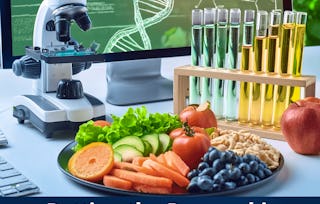
e.g. This is primarily aimed at first- and second-year undergraduates interested in engineering or science, along with high school students aFunctional foods sit at the intersection of nutrition science, food technology, and preventive medicine, and this course offers a rigorous introduction to how such foods are conceived, engineered, and scientifically evaluated.

The Development and Application of Functional Foods
La Fête du Travail commence avec plus de 70 $ d'économies sur Coursera Plus. Bénéficiez de 40 % de réduction pendant 3 mois.

The Development and Application of Functional Foods

Instructeur : Kuan-Hung Lu
Inclus avec En savoir plus
Obtenez un aperçu d'un sujet et apprenez les principes fondamentaux.
niveau Débutant
Expérience recommandée
9 heures à compléter
Planning flexible
Apprenez à votre propre rythme
Ce que vous apprendrez
Define functional foods and distinguish them from dietary supplements and nutraceuticals.
Explain how fermentation improves food quality and identify factors shaping microbial communities.
Apply gut immunity and extraction principles to evaluate functional food design and applications.
Compétences que vous acquerrez
- Catégorie : Health Assessment
- Catégorie : Food Safety and Sanitation
- Catégorie : Microbiology
- Catégorie : Immunology
- Catégorie : Nutrition Education
- Catégorie : Clinical Nutrition
- Catégorie : Chronic Diseases
- Catégorie : Food Quality Assurance And Control
- Catégorie : Environment
- Catégorie : Biology
- Catégorie : Sustainable Systems
- Catégorie : Biochemistry
- Catégorie : Scientific Methods
- Catégorie : Pharmacology
- Catégorie : Medical Science and Research
- Catégorie : Nutrition and Diet
- Catégorie : Good Manufacturing Practices
- Catégorie : Nutritional Assessment
- Catégorie : Regulatory Compliance
- Catégorie : Life Sciences
Détails à connaître

Certificat partageable
Ajouter à votre profil LinkedIn
Récemment mis à jour !
septembre 2026
Évaluations
6 devoirs
Enseigné en Anglais
Découvrez comment les employés des entreprises prestigieuses maîtrisent des compétences recherchées

Il y a 4 modules dans ce cours
Instructeur
Offert par

En savoir plus sur Nutrition
University of Illinois Urbana-Champaign
ISSA (International Sports Sciences Association)
University of Michigan

The Hong Kong University of Science and Technology
Pour quelles raisons les étudiants sur Coursera nous choisissent-ils pour leur carrière ?

Felipe M.
Étudiant(e) depuis 2018
’Pouvoir suivre des cours à mon rythme à été une expérience extraordinaire. Je peux apprendre chaque fois que mon emploi du temps me le permet et en fonction de mon humeur.’

Jennifer J.
Étudiant(e) depuis 2020
’J'ai directement appliqué les concepts et les compétences que j'ai appris de mes cours à un nouveau projet passionnant au travail.’

Larry W.
Étudiant(e) depuis 2021
’Lorsque j'ai besoin de cours sur des sujets que mon université ne propose pas, Coursera est l'un des meilleurs endroits où se rendre.’

Chaitanya A.
’Apprendre, ce n'est pas seulement s'améliorer dans son travail : c'est bien plus que cela. Coursera me permet d'apprendre sans limites.’




Foire Aux Questions
Plus de questions
Aide financière disponible,