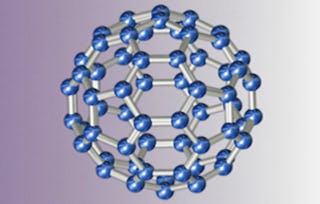
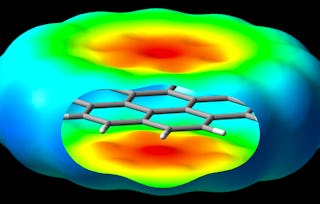
This is an introductory course for students with limited background in chemistry; basic concepts such as atomic and molecular structure, solutions, phases of matter, and quantitative problem solving will be emphasized with the goal of preparing students for further study in chemistry.
<p>Welcome! Over the eight weeks of the Introduction to Chemistry: Structures and Solutions course, we will begin discussions about the electronic structure of the atom, structures of molecules, phases of matter, and solutions. This week, we included some basic concept videos in Chemistry. These come from the partner course called Introduction to Chemistry: Reactions and Ratios. You can technically start with either course, but when these courses were originally designed, the Reactions and Ratios content came first, and you might find it helpful to complete that course before this course. If you are not familiar with the concepts of physical change v.s. chemical change, or significant figure and scientific notations, then please begin by reviewing video “Introduction”. I hope you enjoy this week's materials!</p>
What's included
8 videos1 reading
Show info about module content
8 videos•Total 83 minutes
1.0 Introduction•8 minutes
1.1 Scientific Method•9 minutes
1.2 Measurement and Significant Figures Part I •16 minutes
1.3 Measurement and Significant Figures Part II •13 minutes
1.4 Energy Part I •15 minutes
1.5 Energy Part II •14 minutes
1.6 [DEMO] Physical Change •4 minutes
1.7 [DEMO] Chemical Change •4 minutes
1 reading•Total 5 minutes
Report a problem with the course•5 minutes
light
Module 2•2 hours to complete
Module details
We will cover introduction to light, Bohr model of the hydrogen atom, atomic orbitals, electron configurations, valence versus core electrons. Don’t forget to use this week’s discussion forum for any questions and discussions.
What's included
7 videos1 assignment
Show info about module content
7 videos•Total 88 minutes
Light Waves•20 minutes
[DEMO] Blackbody Radiation•6 minutes
Light Wave Particle Duality•14 minutes
Atom Emission Spectra•9 minutes
Bohr Model Part I•21 minutes
[Demo] Colored Flames•6 minutes
Bohr Model Part II•12 minutes
1 assignment•Total 30 minutes
Week 1 Exercises•30 minutes
Quantum Number, Lewis Dot Structure
Module 3•3 hours to complete
Module details
<p>Welcome to week 2! This week we will introduce quantum numbers, more information about periodicity, chemical bonding concepts including Lewis dot structures, resonance, bond order. Continue using the discussion forum for any questions, concerns, discussions, and suggestions. We value your feedback very much!</p>
<p>I hope you already found out how we captured the course logo from Colored Flames. Wasn't that fun to watch? Kudos to those of you who browsed the course, watched videos, submitted exercises, and/or posted on the discussion forum! Keep the great work going please.</p>
What's included
7 videos1 assignment
Show info about module content
7 videos•Total 127 minutes
Introduction to Quantum Numbers Part I•17 minutes
Introduction to Quantum Numbers Part II•25 minutes
Electron Configurations•14 minutes
Core and Valence Electrons•10 minutes
Introduction to Lewis Structures•18 minutes
Lewis Dot Structure Construction•24 minutes
Bond Order, Expanded Octet•18 minutes
1 assignment•Total 30 minutes
Week 2 Exercise•30 minutes
Formal Charge, VSEPR Theory, Hybridization
Module 4•3 hours to complete
Module details
<p>Welcome to week 3! This week includes introduction to the octet rule and expanded octets, formal chargevalence shell electron pair repulsion (VSEPR) theory, sigma and pi bonds, hybridization of the main group elements, and introduction to molecular shapes.</p>
<p>I hope you enjoyed the last two weeks of learning chemistry. Great work on watching videos, posting on the discussion forum and submitting your exercises!</p>
What's included
6 videos2 assignments
Show info about module content
6 videos•Total 98 minutes
Simple Structure, Formal Charge and Resonance Part I•13 minutes
Simple Structure, Formal Charge and Resonance Part II•12 minutes
Valence Shell Electron Pair Repulsion Part I•21 minutes
Valence Shell Electron Pair Repulsion Part II•11 minutes
Sigma and Pi Bonds•17 minutes
Hybridization•24 minutes
2 assignments•Total 60 minutes
Week 3 Exercise•30 minutes
First Advanced Problem Set•30 minutes
Phases of Matter, Gas Laws
Module 5•2 hours to complete
Module details
<p>Welcome to week 4! This week we will discuss phases of matter, the importance of thermal energy, ideal gas law calculations, kinetic molecular theory of gases. Hope you will enjoy!</p>
<p>We are at the midway point in the course! As a group you have been watching videos, completing quizzes, and/or actively discussing chemistry on the forums, so please accept our compliments on your hard work so far in the course. </p>
What's included
6 videos1 assignment
Show info about module content
6 videos•Total 85 minutes
[DEMO] Compressibility and Pressure•7 minutes
[DEMO] Gas Phase•15 minutes
Ideal Gas Law•21 minutes
Gas Law: Partial Pressure•20 minutes
The Importance of Thermal Energy•6 minutes
Phases of Matter, Liquids•15 minutes
1 assignment•Total 30 minutes
Week 4 Exercise•30 minutes
Intermolecular Forces and Phase Changes
Module 6•2 hours to complete
Module details
<p>Welcome to week 5! This week we will examine the phases of matter more closely, looking at concepts such as intermolecular forces and thermal energy. We will also practice calculations of energetics such as those requiring enthalpies of phase transitions. Finally, we will introduce concepts in metal bonding and solid lattices. We made a few illustrative demonstrations for your viewing pleasure; I hope that these are helpful! </p><p>Remember to continue posting any questions, concerns and suggestions to the discussion forum. Also help your peers out on the forum to build a beneficial learning community together!</p>
What's included
6 videos1 assignment
Show info about module content
6 videos•Total 91 minutes
Intermolecular Forces•20 minutes
Phase Changes Part I•18 minutes
Phase Changes Part II•18 minutes
Solids Part I•11 minutes
Solids Part II•11 minutes
Solids Part III•12 minutes
1 assignment•Total 30 minutes
Week 5 Exercise•30 minutes
Solutions
Module 7•3 hours to complete
Module details
<p>Welcome to week 6! We have reached the last week of video lectures and exercises for the course! Are you ready to make the final push through the rest of the material? After that, you should be ready to tackle the final exam which opens next week. I have enjoyed working on this course; and I hope you have too!</p>
<p>This week, we will first release a couple of review videos related to solution and solubility from <i>Introduction to Chemistry: Reactions and Ratios</i>. Please review these important concepts before starting Lesson Two - Solutions. Then we will start with a review of dissolution and covers some concentration units. This is accompanied by solution-related demonstrations and another bonus interview with a chemist who also works at Duke. The interviews were conceived and filmed by Abdul Latif, an undergraduate in the humanities who is interested in the history of chemistry and how people choose their professions. Enjoy!</p>
What's included
11 videos2 assignments
Show info about module content
11 videos•Total 137 minutes
2.1 Introduction to Solutions Part I •18 minutes
2.2 Introduction to Solutions Part II •12 minutes
2.3 [Demo] Electrolytes•11 minutes
2.4 Dissolution and the Solubility Product Constant Part I •15 minutes
2.5 Dissolution and the Solubility Product Constant Part II•12 minutes
2.6 Solubility Rules •13 minutes
Solution Review•11 minutes
Solutions: Factor Affecting Solubility•15 minutes
Solutions: Calculations & Dilutions Part I•11 minutes
Solutions: Calculations & Dilutions Part II•11 minutes
[Interview] Dr. Dubay Interview•8 minutes
2 assignments•Total 60 minutes
Week 6 Exercise•30 minutes
Second Advanced Problem Set•30 minutes
Strengthen Your Understanding
Module 8•1 hour to complete
Module details
<p>Congratulations on making through to the final week of the course! For many of you it was not an easy journey for the past six weeks with dozens of videos, exercises, problem sets, and forum discussions. I am proud of all of you! The last components of the course - final exam opens this week. Please use it as a chance to apply what you have learned from the course.</p>
<p>There are two parts (timed, 90 minutes for each part) in the final exam. You are encouraged to review all course lectures, exercises, and problem sets before attempting the Final exam. Please feel welcome to use a calculator, scratch paper, simple periodic table, and the reference materials we provided in the course. Good luck with your final exam!</p>
What's included
1 reading2 assignments
Show info about module content
1 reading•Total 10 minutes
Share your learning experience•10 minutes
2 assignments•Total 60 minutes
Final Exam Part A (12 Questions)•30 minutes
Final Exam Part B (12 Questions)•30 minutes
Instructor
Instructor ratings
Instructor ratings
We asked all learners to give feedback on our instructors based on the quality of their teaching style.
Duke University has about 13,000 undergraduate and graduate students and a world-class faculty helping to expand the frontiers of knowledge. The university has a strong commitment to applying knowledge in service to society, both near its North Carolina campus and around the world.
"To be able to take courses at my own pace and rhythm has been an amazing experience. I can learn whenever it fits my schedule and mood."
Jennifer J.
Learner since 2020
"I directly applied the concepts and skills I learned from my courses to an exciting new project at work."
Larry W.
Learner since 2021
"When I need courses on topics that my university doesn't offer, Coursera is one of the best places to go."
Chaitanya A.
"Learning isn't just about being better at your job: it's so much more than that. Coursera allows me to learn without limits."
Learner reviews
4.7
570 reviews
5 stars
79.85%
4 stars
12.95%
3 stars
2.97%
2 stars
1.22%
1 star
2.97%
Showing 3 of 570
L
LG
4·
Reviewed on Aug 19, 2020
worthwhile course, great professor, advanced problem sets sometimes go beyond course scope
A
AK
5·
Reviewed on Jun 6, 2020
It is excellent course. Mentor in this course are very helpful. Teacher is also very good with her knowledge and there is no doubt about way of teaching.
Y
YS
5·
Reviewed on Aug 21, 2025
Wow, it's amazing how this program is helpful and very interesting. It showcases the chemistry in a very easy way. Thank you so much, Dr. Dorian
Will I receive a transcript from Duke University for completing this course?
No. Completion of a Coursera course does not earn you academic credit from Duke; therefore, Duke is not able to provide you with a university transcript. However, your electronic Certificate will be added to your Accomplishments page - from there, you can print your Certificate or add it to your LinkedIn profile.
When will I have access to the lectures and assignments?
To access the course materials, assignments and to earn a Certificate, you will need to purchase the Certificate experience when you enroll in a course. You can try a Free Trial instead, or apply for Financial Aid. The course may offer 'Full Course, No Certificate' instead. This option lets you see all course materials, submit required assessments, and get a final grade. This also means that you will not be able to purchase a Certificate experience.
What will I get if I purchase the Certificate?
When you purchase a Certificate you get access to all course materials, including graded assignments. Upon completing the course, your electronic Certificate will be added to your Accomplishments page - from there, you can print your Certificate or add it to your LinkedIn profile.
Is financial aid available?
Yes. In select learning programs, you can apply for financial aid or a scholarship if you can’t afford the enrollment fee. If fin aid or scholarship is available for your learning program selection, you’ll find a link to apply on the description page.