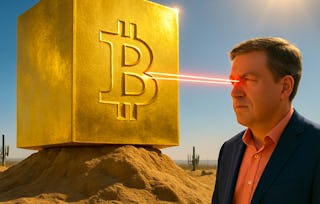
The value of all the gold in the world is $25 trillion – yet very few investors have gold in their portfolios. Ironically, gold is the oldest financial asset, but it is poorly understood and under-researched. There are many stories about gold, but very little evidence. This course provides the evidence. After completing the course, you will understand how gold performs during equity market turmoil and during inflation surges and its role in a diversified portfolio. The course explores the reasons why the gold price has recently surged by focusing on the financialization of gold, central bank accumulation, de-dollarization efforts, questions about the status of the U.S. dollar as a reserve currency, and the potential demand shock if gold is classified in a future version of Basel III as an asset commercial banks can hold for regulatory purposes (central banks hold gold as a reserve asset and it seems contradictory not to allow commercial banks to do the same). The Golden Dilemma framework is also introduced to credible future price paths for gold. Finally, the long-term prospects for gold are detailed, given expected technological innovations.
This module explains why gold has sustained value over centuries by grounding its appeal in physical and institutional properties—durability, scarcity, fungibility, and the absence of single-authority control. We introduce the “golden constant” and evaluate gold’s performance as an inflation hedge, separating its long-term, purchasing-power stability from its short-term volatility. We then analyze gold’s role in diversified portfolios by examining its volatility and its (time-varying) correlations with equities and bonds, drawing out implications for portfolio risk. Finally, we assess the recent drivers of price increases and, using the golden-constant lens, construct plausible future price scenarios.
What's included
5 videos2 readings1 assignment
Show info about module content
5 videos•Total 26 minutes
Course Introduction•6 minutes
Gold Characteristics•6 minutes
Inflation Protection•5 minutes
Diversification•2 minutes
Crisis Hedge•6 minutes
2 readings•Total 20 minutes
Course Overview•10 minutes
Report a Problem with the Course •10 minutes
1 assignment•Total 30 minutes
Module 1 Graded Quiz •30 minutes
Why is the Current Price of Gold so High? Financialization and Politics
Module 2•1 hour to complete
Module details
This module explains how gold’s price is shaped by supply rigidity (slow, capital-intensive mine responses) and sector-specific demand across jewelry, technology, and investment. It then examines how financialization—via exchange-traded funds and gold-backed stablecoins—has broadened access and intensified demand, weighing the trade-offs between physical holdings and ETF exposure (liquidity, fees, tracking error, and custody risk). Using the “golden constant” framework alongside new empirical evidence, we assess how ETF adoption has influenced real gold prices. We analyze how the “weaponization” of the U.S. dollar and sanctions regimes spur some countries to reduce dollar dependence and de-dollarize, redirecting portfolio demand toward gold. Finally, we evaluate central-bank accumulation—especially by China and Russia—its implications for global reserves, and what this means for future demand and price dynamics.
What's included
6 videos1 assignment
Show info about module content
6 videos•Total 40 minutes
Limited supply•7 minutes
The Financialization of Gold•6 minutes
The Financialization of Gold - Impact of ETFs•10 minutes
The Financialization of Gold - Impact on Prices•5 minutes
The Weaponization of the U.S. Dollar•6 minutes
Central Bank and China accumulation•7 minutes
1 assignment•Total 30 minutes
Module 2 Graded Quiz •30 minutes
Why is the Price of Gold so High? New Currency Regime and a New Role for Gold
Module 3•1 hour to complete
Module details
This module examines how the U.S. dollar’s reserve-currency status channels global demand into dollar assets while creating the Triffin dilemma. It then analyzes how bilateral central-bank swap lines, sanctions risk, and deliberate de-dollarization efforts are reshaping reserve strategies and lifting official-sector demand for gold. We review Basel III’s High-Quality Liquid Asset (HQLA) framework—eligibility tests, haircuts, and liquidity horizons—and evaluate the case for classifying gold as Tier 1 HQLA alongside top-quality sovereigns. Finally, we assess the demand and price impact if such a designation were adopted, including likely balance-sheet reallocation by banks and central banks and plausible price paths for gold under alternative adoption scenarios.
What's included
3 videos1 assignment
Show info about module content
3 videos•Total 32 minutes
Doubts About the Dollar as Reserve Asset•8 minutes
How Important Is It to Have a Reserve Currency?•9 minutes
Basel III •15 minutes
1 assignment•Total 30 minutes
Module 3 Graded Quiz•30 minutes
Where Will the Price of Gold Go?
Module 4•1 hour to complete
Module details
This module applies the Golden Dilemma framework to derive implications for gold’s expected real returns. We compare gold’s valuation against inflation and key asset benchmarks - other commodities and broad equity indices - to separate cyclical moves from structural trends. We then assess bitcoin’s emergence as an alternative safe asset and its substitution or complementarity effects on portfolio demand for gold. Finally, we evaluate long-horizon technological and supply risks - ranging from improved extraction and recycling to transmutation and off-world sources - and integrate these forces into scenario paths for demand, scarcity, and price.
What's included
5 videos1 reading1 assignment
Show info about module content
5 videos•Total 20 minutes
The Golden Dilemma•9 minutes
Comparables•2 minutes
What About Bitcoin?•1 minute
Gold for the Long Run?•3 minutes
Course Conclusion •5 minutes
1 reading•Total 10 minutes
Share your learning experience •10 minutes
1 assignment•Total 30 minutes
Module 4 graded quiz•30 minutes
Instructor
Instructor ratings
Instructor ratings
We asked all learners to give feedback on our instructors based on the quality of their teaching style.
Duke University has about 13,000 undergraduate and graduate students and a world-class faculty helping to expand the frontiers of knowledge. The university has a strong commitment to applying knowledge in service to society, both near its North Carolina campus and around the world.
"To be able to take courses at my own pace and rhythm has been an amazing experience. I can learn whenever it fits my schedule and mood."
Jennifer J.
Learner since 2020
"I directly applied the concepts and skills I learned from my courses to an exciting new project at work."
Larry W.
Learner since 2021
"When I need courses on topics that my university doesn't offer, Coursera is one of the best places to go."
Chaitanya A.
"Learning isn't just about being better at your job: it's so much more than that. Coursera allows me to learn without limits."
Learner reviews
4.9
29 reviews
5 stars
96.55%
4 stars
0%
3 stars
3.44%
2 stars
0%
1 star
0%
Showing 3 of 29
A
AA
5·
Reviewed on Jan 17, 2026
Enjoyed the course, it is basic and insightful, gives a historical context, and provides knowledge of why gold is considered a 'safe-haven' for investment.
N
NN
5·
Reviewed on Mar 16, 2026
Excellent Gold market foundations learning... Sharp insight and concise material!
M
MG
5·
Reviewed on Oct 30, 2025
Very structured course, rock solid reasoning and data. Loved it (despite already knowing the topic quite well)
When will I have access to the lectures and assignments?
To access the course materials, assignments and to earn a Certificate, you will need to purchase the Certificate experience when you enroll in a course. You can try a Free Trial instead, or apply for Financial Aid. The course may offer 'Full Course, No Certificate' instead. This option lets you see all course materials, submit required assessments, and get a final grade. This also means that you will not be able to purchase a Certificate experience.
What will I get if I purchase the Certificate?
When you purchase a Certificate you get access to all course materials, including graded assignments. Upon completing the course, your electronic Certificate will be added to your Accomplishments page - from there, you can print your Certificate or add it to your LinkedIn profile.
Is financial aid available?
Yes. In select learning programs, you can apply for financial aid or a scholarship if you can’t afford the enrollment fee. If fin aid or scholarship is available for your learning program selection, you’ll find a link to apply on the description page.