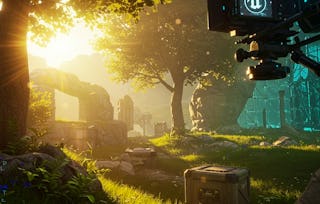
Design and construct immersive top-down survival game arenas in Unreal Engine through a practical visual development workflow. This course guides you from foundational landscape creation to a complete, playable arena while building hands-on skills in terrain sculpting, landscape painting, material systems, foliage, modular assets, lighting, and level design.

Unreal Engine Landscape & Environment Design

Unreal Engine Landscape & Environment Design
This course is part of Unreal Engine Game World & Environment Design Specialization

Instructor: EDUCBA
Included with Learn more
Gain insight into a topic and learn the fundamentals.
10 reviews
Intermediate level
Recommended experience
2 weeks to complete
at 10 hours a week
What you'll learn
Design and sculpt Unreal Engine landscapes using terrain tools, painting, material layers, and height-based blending.
Integrate foliage, modular assets, lighting, and post-processing to create immersive and cohesive game environments.
Construct and refine a playable top-down survival arena with effective blocking, visual composition, and environmental detail.
Implement lighting, post-processing, terrain painting, and arena blocking to create a polished, playable survival game arena.
Skills you'll gain
Tools you'll learn
Details to know

Shareable certificate
Add to your LinkedIn profile
Assessments
17 assignments
Taught in English
Flexible schedule
Learn at your own pace
See how employees at top companies are mastering in-demand skills

Build your subject-matter expertise
This course is part of the Unreal Engine Game World & Environment Design Specialization
When you enroll in this course, you'll also be enrolled in this Specialization.
- Learn new concepts from industry experts
- Gain a foundational understanding of a subject or tool
- Develop job-relevant skills with hands-on projects
- Earn a shareable career certificate


Explore more from Design and Product



Why people choose Coursera for their career

Felipe M.
Learner since 2018
"To be able to take courses at my own pace and rhythm has been an amazing experience. I can learn whenever it fits my schedule and mood."

Jennifer J.
Learner since 2020
"I directly applied the concepts and skills I learned from my courses to an exciting new project at work."

Larry W.
Learner since 2021
"When I need courses on topics that my university doesn't offer, Coursera is one of the best places to go."

Chaitanya A.
"Learning isn't just about being better at your job: it's so much more than that. Coursera allows me to learn without limits."
Learner reviews
- 5 stars
100%
- 4 stars
0%
- 3 stars
0%
- 2 stars
0%
- 1 star
0%
Showing 3 of 10
PJ
5.0
Reviewed on Oct 27, 2026
The modules on Lumen, Sky Atmosphere, and volumetric clouds took my scenes from looking flat and video-gamey to looking like hyper-realistic cinematic shots.
RV
5.0
Reviewed on Oct 17, 2026
Master the art of crafting expansive, breathtaking terrains from scratch. The lessons on sculpting mountains, valleys, and mixing material layers make procedural world-building completely intuitive.
AS
5.0
Reviewed on Oct 15, 2026
Embrace procedural tools like PCG and material functions. Building environments that can update dynamically when you change a landscape parameter saves hundreds of hours when art direction shifts.
What brings you to Coursera today?
Advance your career with an online degree
Earn a degree from world-class universities - 100% online