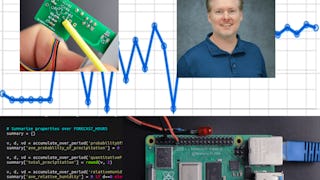
This course on integrating sensors with your Raspberry Pi is course 3 of a Coursera Specialization and can be taken separately or as part of the specialization. Although some material and explanations from the prior two courses are used, this course largely assumes no prior experience with sensors or data processing other than ideas about your own projects and an interest in building projects with sensors.
This course focuses on core concepts and techniques in designing and integrating any sensor, rather than overly specific examples to copy. This method allows you to use these concepts in your projects to build highly customized sensors for your applications.
Some of the ideas covered include calibrating sensors and the trade-offs between different mathematical methods of storing and applying calibration curves to your sensors. We also discuss accuracy, precision, and how to understand uncertainty in your measurements. We study methods of interfacing analog sensors with your Raspberry Pi (or other platform) with amplifiers and the theory and technique involved in reducing noise with spectral filters. Lastly, we borrow from the fields of data science, statistics, and digital signal processing, to post-process our data in Python.
Status: Statistical Methods
Statistical Methods
Status: Digital Signal Processing
Digital Signal Processing
Course·8 hours
All reviews
Showing: 5 of 5
All Learners
All Stars
Most Helpful
R
Russell Eugene Bauer
5.0
·Reviewed Nov 22, 2023
Each of the four courses in the specialization focused on one aspect of a home project with a Raspberry Pi. This one, as the title indicates, focus on the very vital part, Sensors.
This specialization is really very special as it really encompasses a wide variety of parts of the a home project. I highly recommend the whole specialization. You can take them in any order as they all go off in deep dives and different aspects of a home project.
Thanks to Drew Wilson for a wonderful course and specialization.
V
Vincenzo Carollo
5.0
·Reviewed Jun 30, 2024
This is one of better courses follows by me, good professor and very clear to explain all of various arguments of the course. Thank you very much prof!