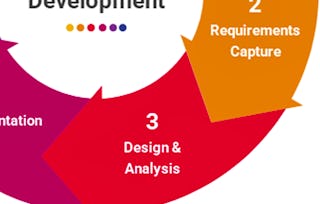
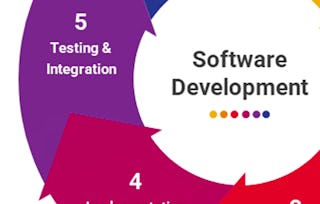
Software Development Life Cycle (SDLC) is the process of developing software through planning, requirement analysis, design, implementation, testing, and maintenance. This course focuses on the requirement analysis phase of SDLC, and you will learn how to use UML models to capture the system requirements and to facilitate communication between client/users and developers. UML is a general purpose visual modeling language for systems. It can be used to highlight different aspects of the system that are of interest to different stakeholders. Data requirements are captured in the domain model, which describes the important concepts of the application domain as classes, associations between them and constraints on them. Functional requirements are captured in the use-case model to describe the interactions between the system and its environment (users, other systems).

Software Engineering: Modeling Software Systems using UML

Software Engineering: Modeling Software Systems using UML
This course is part of Software Engineering Specialization

Instructor: Kenneth Wai-Ting Leung
40,758 already enrolled
Skills you'll gain
- Object Oriented Programming (OOP)
- Software Development
- Functional Requirement
- System Requirements
- Model Evaluation
- Systems Development Life Cycle
- Project Management
- Software Engineering
- Data Modeling
- Functional Specification
- Software Documentation
- Verification And Validation
- Diagram Design
- Object Oriented Design
- Requirements Analysis
- Project Planning
Tools you'll learn
Details to know

Add to your LinkedIn profile
7 assignments
See how employees at top companies are mastering in-demand skills

Build your subject-matter expertise
- Learn new concepts from industry experts
- Gain a foundational understanding of a subject or tool
- Develop job-relevant skills with hands-on projects
- Earn a shareable career certificate

There are 7 modules in this course
Earn a career certificate
Add this credential to your LinkedIn profile, resume, or CV. Share it on social media and in your performance review.
Instructor

Why people choose Coursera for their career

Felipe M.

Jennifer J.

Larry W.

Chaitanya A.
Learner reviews
- 5 stars
71.75%
- 4 stars
20.10%
- 3 stars
4.07%
- 2 stars
1.52%
- 1 star
2.54%
Showing 3 of 393
Reviewed on Feb 20, 2023
Good course but if I didn't already know this stuff it would have taken 2 weeks.
Reviewed on Jul 22, 2024
This course was quite good actually, i learned many new things.
Reviewed on Jul 22, 2023
Thank You sir, you are amazing and your way of teaching is exceptional. You covered every use case that comes in the way of UML.
Explore more from Computer Science
The Hong Kong University of Science and Technology
The Hong Kong University of Science and Technology

Amazon
University of Alberta