AK
5.0Reviewed Feb 28, 2018
An excellent course which make me feel myself proud. I wholeheartedly thank my professor for sharing his knowledge.Thank u sir i really enjoyed it

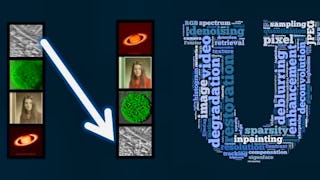
In this class you will learn the basic principles and tools used to process images and videos, and how to apply them in solving practical problems of commercial and scientific interests. Digital images and videos are everywhere these days – in thousands of scientific (e.g., astronomical, bio-medical), consumer, industrial, and artistic applications. Moreover they come in a wide range of the electromagnetic spectrum - from visible light and infrared to gamma rays and beyond. The ability to process image and video signals is therefore an incredibly important skill to master for engineering/science students, software developers, and practicing scientists. Digital image and video processing continues to enable the multimedia technology revolution we are experiencing today. Some important examples of image and video processing include the removal of degradations images suffer during acquisition (e.g., removing blur from a picture of a fast moving car), and the compression and transmission of images and videos (if you watch videos online, or share photos via a social media website, you use this everyday!), for economical storage and efficient transmission. This course will cover the fundamentals of image and video processing. We will provide a mathematical framework to describe and analyze images and videos as two- and three-dimensional signals in the spatial, spatio-temporal, and frequency domains. In this class not only will you learn the theory behind fundamental processing tasks including image/video enhancement, recovery, and compression - but you will also learn how to perform these key processing tasks in practice using state-of-the-art techniques and tools. We will introduce and use a wide variety of such tools – from optimization toolboxes to statistical techniques. Emphasis on the special role sparsity plays in modern image and video processing will also be given. In all cases, example images and videos pertaining to specific application domains will be utilized.
AK
An excellent course which make me feel myself proud. I wholeheartedly thank my professor for sharing his knowledge.Thank u sir i really enjoyed it
HK
I am a newbie in image processing (from audio processing). I found this course interesting and I learnt a lot of new things. Thanks
HS
Accent was a bit hard to understand for me, I used google to study separate topics and then gave assignments. Helpful as a guide to direct you what all to study in the space.
PK
This course was amazing. And to be very honest I learnt a lot from this. The content and tutorial was very good and it proved to be very helpful in taking my works.
HS
This course is much simpler and easier to understand for those who wanna get and set their goals towards the image engineering field. Really enjoy much doing this course. THank you everyone !!!
AK
A course which looks hard at first glance but they lecturers made it look so easy and inspired us students to teach us. Thank you for the course.
AD
This course is very useful and fundamental for those we are studying Image and Video Processing and would like to enhance their skills in this domain.
SK
Highly relevant and comprehensive, covering important information in the field. Can be improved however by incorporating code using other language libraries besides MATLAB (e.g. Python, etc).
EE
I had a wonderful experience through this marvelous course, way to much changed my view on the world, especially the last week's sparsity optimal problems, very impressive.
NS
One or two lecture should be there for Optimization and Regularization. I enjoyed the course and it was useful and very informative.
GG
This course has got me very much interested in image and video processing. I need to delve deeper into this field. Thanks a lot for this course. Cheers.
P
Excellent course, easy to understand. The professor has given a lot of inputs with examples. Grade assignment with MATLAB code made me understand the logic practically in a better way.
Showing: 20 of 366
The course combines a relatively high mathematical level with a lack of depth. For people that understand the mathematics it won't go deep enough/not explain a lot of the things in depth. The depth fits better with someone that doesn't understand the mathematics, but they won't be able to follow the mathematics. In short, I don't understand who this course is meant for, definitely not for me. The level of the content seems to me like perhaps third year of a Bachelor's or undergrad degree. If you do not have some background in mathematics, don't take this course. It is way too easy to pass the quizzes. You just shouldn't be able to pass with 50%. Also, the presentations are often not very focused. Sometimes the teacher glosses over quite important things you need to really understand what's going on. However, sometimes a lot of time is spent explaining completely trivial things (at least they will be trivial to anyone that understands the rest of the course). I decided to also do a different course in this field, because I don't feel I learned that much here. I did a Physics bachelor's and master's degree and am already proficient in MATLAB. It took me about 3-4 hours per week to learn the content and make the quiz in the first 8 weeks. If you want to really understand the content, you will have to find sources outside coursera as well. The last 4 weeks I got too annoyed with the presentations glossing over everything that I went through it more quickly. I do not recommend following this course.
I had to quit the course after the first week. Prof. Katsaggelos gave examples including MRI where he states that "Each pulse causes a corresponding pulse of radio waves to be emitted by the patient's tissues." That of course is nonsense. Tissues does not emit any radio waves. The coils register variation in magnetic field through induction of current. How I am supposed to trust someone whom I catch presenting false information about something I know very well (I am a radiologist). How can I be sure that the information I know nothing about and want to learn is actually relevant and true? It is a question of credibility. He doesn't have to dig in what he doesn't understand. Also, and I am sorry to say that, the presentations are not really engaging which might of course be my personal taste.
This class is WAY too theoretical, I took it hoping to have emphasis on matlab but I was very disappointed. The lectures didn't help me complete the homeworks at all. I always had to look things up in other places to get the right answers. Need more problem solving and less describing the math behind everything.
Very informative and comprehensive course in image processing. Many examples are presented throughout the course, which make the content tangible and help to better sink-in the material.
As an amateur photographer who is interested in post-processing, I came here to find more about how image processing softwares work. Sometimes it took me lots of time to catch up what the professor was teaching. This course is not friendly to the person who does not have basic knowledge about signal processing and math. And the professor's accent is quite noticeable to me, a non-native English speaker, plus there are tons of errors and [UNKNOWN] in the subtitles, which is the one biggest challenges I had met. But frankly speaking, This course is great in the most of aspects, I have learnt a lot from it. The most of tests are relative easy compared to the lectures.
BTW, In the final MATLAB test, there is a hint about normc function, that is useless for the student who is using MATLAB online because the function belongs to additional toolkits that online users will not have.
The lecturer tries to fit too much information into the limited size of the lectures, so he has to skip too much, so many formulas are given with not enough explanation. I think the only folks who can follow are the people who already know all the math from other sources.
感觉是印式英语,太难懂,承受不了了。
By far one of the most challenging courses presented in Coursera. This course should be classified as an Advanced course for people with Engineering Mathematics Background, else it would be tremendously difficult to follow. I truly enjoyed the course presented here, and once the fundamentals are understood, it would be quite easy to understand all the Imaging Processing Technique presented. Now I am confident of using Matlab to try out the Algorithms to do Image and Video Processing!
Mr Aggelos made one mistake: he should have explicitly said in the course description: this is a course for mathematicians and not programmers. Most of the course is heavy math. After studying CS for 10 years I have no clue what those equations are supposed to be doing. Matrix this, vector that. Yeah sure.
A comprehensive introduction to the theoretical aspect of the subject, with many well designed hands-on practice. The course is not very friendly to complete newcomers who don't have any existing experience, but serves as a great starting point
Very informative and helpful course for beginners in image processing. The lectures are well organized and - in most cases - are clearly explained. I would recommend it to anyone who wants to start studying image processing/computer vision, although linear algebra and digital signal processing are required prerequisites. There is only one drawback of this course I would like to mention. MATLAB tasks that start from week 6 are not as helpful as the previous ones were, because it only requires to put a few lines into already existing code or just change a value of a variable there to complete it. I think, it would more useful to write a code on my own with thorough guides provided (as it had been prior to week 6). I know, it might be a bit hard but it's worth it.
This was one of my favorite courses I've done on Coursera (I've done about 50). A couple of the weeks (e.g. week 12 and another week somewhere around 5-7) are really hard but for the most part it's awesome. The professor is a leading expert in this subject, so that's pretty cool. The one thing that I think would improve this course is to have more practical applications (e.g. in the Andrew Ng courses there's a lot more hands-on programming exercises).
Was very useful to brush up the image and video processing concepts.
The course need more practical examples and more explanation for how to apply the theory using computer software. But over all the course explain the theory in details without making it so complicated. It was a great experience.
This is just fundamentals of image processing. The course has breadth but lack of depth. There are lots of materials but the course only dips the water. I would rather have a course dedicated to some certain algorithm with more details and depth than just quickly survey the topics.
This professor really knows how to teach a boring course...
The material is very unclear.
It's awful!
This course covers a wide range of topics starting from Signals and Systems all the way to applications of Machine Learning in the domain of Image Processing. One must not be fooled by the short length of the Video Lectures , as every second is packed with information. A minor lapse in concentration may force you to replay the Video Lectures. Upon completion of this course, one would gain a good understanding of topics in Video Compression and Image Processing and will be better oriented to learn and take on challenges. Brushing up one's knowledge on Digital Signal Processing and Differential Calculus would be highly beneficial in following the contents of the mathematical and signal processing portions of the lecture.
A good course, with a tremendous amount of information. I would suggest to split it up to (at least) two courses. Prof. Katsaggelos is very enthusiastic, the summaries in the beginning and in the end are useful. Maybe, it would be helpful for the students to summarize the necessary mathematical knowledge for this course, because this topic is really colorful in mathematical point of view. As a mathematician, I really enjoyed that, but an outsider may not feel the same. All in all, if somebody learns all of the topics, he/she will have a very strong basis in this topic.