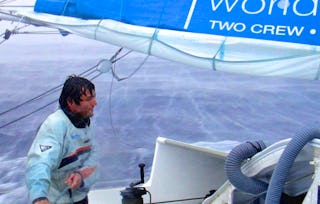
The course for a round the world regatta leads the boats through the Mediterranean Sea and the Atlantic, Southern Indian and South Pacific Oceans. On their voyage, the skippers come across a large variety of oceanographic situations: strong currents, floating ice, wave formations of every kind and biological diversity.


Oceanography: a key to better understand our world


Oceanography: a key to better understand our world

Instructor: Jordi Serra
Access provided by VodafoneZiggo
32,886 already enrolled
Gain insight into a topic and learn the fundamentals.
4.5
287 reviews
3 weeks to complete
at 10 hours a week
Flexible schedule
Learn at your own pace
96%
Most learners liked this course
Gain insight into a topic and learn the fundamentals.
4.5
287 reviews
3 weeks to complete
at 10 hours a week
Flexible schedule
Learn at your own pace
96%
Most learners liked this course
Details to know

Shareable certificate
Add to your LinkedIn profile
Assessments
7 assignments
Taught in English
See how employees at top companies are mastering in-demand skills

There are 7 modules in this course
Module 1 addresses some of the fundamental concepts of descriptive oceanography related to the physical characteristics of water: the vertical distribution of temperature and salinity, TS diagram, stability and destabilization of the water column, the formation of water dense and deep, the water masses and circulation. It is necessary also introduces concepts to understand the relationship between the distribution of the mass of water, its surface topography of a regional or larger scale, and called geostrophic circulation, where it plays a fundamental role the Coriolis force. While the concepts presented have general applicability, examples are the Mediterranean, starting with the characteristics of the waters near Barcelona, where it begins and ends the Barcelona World Race, and ending with the general circulation of the water masses around the Mediterranean.
What's included
5 videos13 readings1 assignment
5 videos•Total 59 minutes
- Video Course Presentation•8 minutes
- 1.0 Video Introduction•11 minutes
- 1.1 Video Temperature, salinity, density•16 minutes
- 1.2.1 Video Introduction: Vertical profiles for T and S on the Catalan coast, NW Mediterranean.•12 minutes
- 1.2.2 Video Vertical stability•13 minutes
13 readings•Total 130 minutes
- Introduction•10 minutes
- Course structure•10 minutes
- 1. Introduction to the module 1 (A and B)•10 minutes
- 1.1 The Mediterranean: a model of an ocean - Temperature, salinity and pressure•10 minutes
- 1.1.1 Temperature•10 minutes
- 1.1.2 Salinity•10 minutes
- 1.1.3 Pressure•10 minutes
- 1.1.4 Density and the T/S diagram•10 minutes
- 1.2 The annual hydrographic cycle opposite Barcelona•10 minutes
- 1.2.1 Vertical profiles for T and S on the Catalan coast, NW Mediterranean.•10 minutes
- 1.2.2 Vertical stability•10 minutes
- 1.2.3 Stability gains and losses•10 minutes
- 1.2.4 The construction and destruction of the thermocline•10 minutes
1 assignment•Total 30 minutes
- Quiz 1A•30 minutes
In this module you will learn how dense waters and water bodies are formed. Where the Mediterranean will be used as a model of ocean. As well as some of the fundamental concepts of marine dynamics, which is how the Coriolis and pressure gradient force is formed. Besides the importance of dynamic topography and geostrophic flow. Hope will be to your liking.
What's included
4 videos8 readings1 assignment
4 videos•Total 66 minutes
- 1.3 Video: The formation of dense water and water masses•19 minutes
- 1.4 Video: The Mediterranean a model of an ocean•16 minutes
- 1.5.1 Video The pressure gradient force•13 minutes
- 1.5.2 Video: The Coriolis Force•18 minutes
8 readings•Total 80 minutes
- 1.3 The formation of dense water and water masses•10 minutes
- 1.4 The Mediterranean a model of an ocean•10 minutes
- 1.4.1 The Mediterranean, a negative estuary•10 minutes
- 1.4.2 The circulation of the Mediterranean's main masses of water•10 minutes
- 1.5 Fundamental concepts of marine dynamics•10 minutes
- 1.5.1 The “pressure gradient force”•10 minutes
- 1.5.2 The Coriolis Force•10 minutes
- 1.5.3 Dynamic topography and geostrophic circulation•10 minutes
1 assignment•Total 30 minutes
- Quiz 1B•30 minutes
This module will enter fully into the Global Ocean, will review and generalize the aspects previously referred to in the previous module. We will see the role of the ocean on a global scale, and how we can affect those who live closer or farther from the coast. Try to understand why it is still quite unknown and will glance nose in the marine environment. That is, how it behaves for those living beings, most who live within the ocean or in direct contact with him.
What's included
12 videos18 readings1 assignment
12 videos•Total 151 minutes
- 2.1.1 Video: From the Mediterranean to the ocean. Changing scales past Gibraltar•12 minutes
- 2.1.2 Video: The water cycle on the planet•6 minutes
- 2.1.3 Video: The confinement of the ocean and the freedom of the atmosphere. Exchanges of energy and evaporation. Heating and cooling. Consequences of ocean dynamics.•15 minutes
- 2.1.4 Video: Vertical structure by density. Intrusions and intermediate waters•7 minutes
- 2.2.1 Video Circulation, water masses and the internal structure of the oceans. Geostrophy or how ocean structure reflects circulation and how the circulation affects structure•15 minutes
- 2.2.3 Video Wind-induced circulation. Ekman and upwelling.•13 minutes
- 2.3.1 Video Instabilities. Inertial motion. Mesoscale.•11 minutes
- 2.3.2 Video Deep and intermediate water formation•18 minutes
- 2.3.3 Video Climate impact. Heat distribution on the planet. Hidden heat.•13 minutes
- 2.3.4 Video Non-linearity and instabilities: Niños and Niñas•14 minutes
- 2.4.1 Video A three-dimensional environment, with little or no visibility and no fixed references•12 minutes
- 2.4.2 Video A sea full of life: the pelagic and benthic environments. Near to and far from the coast. In light and darkness.•14 minutes
18 readings•Total 180 minutes
- 2. Introduction Planet Earth is also 'planet water'•10 minutes
- 2.1.The Global Ocean•10 minutes
- 2.1.1 From the Mediterranean to the ocean. Changing scales past Gibraltar•10 minutes
- 2.1.2 Water cycle on the planet•10 minutes
- 2.1.3 The confinement of the ocean and the freedom of the atmosphere. Exchanges of energy and evaporation. Heating and cooling. Consequences of ocean dynamics.•10 minutes
- 2.1.4 Vertical structure by density. Intrusions and intermediate waters•10 minutes
- Introduction Ocean Circulation•10 minutes
- 2.2.1 Circulation, water masses and te internal structure of the oceans. Geostrophy or how ocean structure reflects circulation and how the circulation affects structure•10 minutes
- 2.2.2 Thermohaline circulation. Water transport and the conveyor belt•10 minutes
- 2.2.3 Wind-induced circulation. Ekman and upwelling.•10 minutes
- 2.3 Introduction Other scales of motion•10 minutes
- 2.3.1 Instabilities. Inertial motion. Mesoscale.•10 minutes
- 2.3.2 Deep and intermediate water formation•10 minutes
- 2.3.3 Climate impact. Heat distribution on the planet. Hidden heat.•10 minutes
- 2.3.4 Non-linearity and instabilities: Niños and Niñas•10 minutes
- 2.4 Introduction The ocean as an environment. A sea full of life•10 minutes
- 2.4.1 A three-dimensional environment, with little or no visibility and no fixed references•10 minutes
- 2.4.2 A sea full of life: the pelagic and benthic environments. Near to and far from the coast. In light and darkness.•10 minutes
1 assignment•Total 30 minutes
- Quiz 2•30 minutes
In this module you will learn the importance of ocean observation by satellite, talk about remote sensing, electromagnetic radiation emitted and reflected, and the importance of their study for navigation.
What's included
4 videos9 readings1 assignment
4 videos•Total 22 minutes
- Video: 3A. Introduction•3 minutes
- 3.1.1 Video Can we do something similar for the ocean?•6 minutes
- 3.1.2 Video Why do we want to use remote sensing for oceanography?•7 minutes
- 3.2.2 Video Sensing the ocean surface from a satellite•6 minutes
9 readings•Total 90 minutes
- 3.1 What is remote sensing? Why do we want to observe the ocean from space?•10 minutes
- 3.1.1 Can we do something similar for the ocean?•10 minutes
- 3.1.2 Why do we want to use remote sensing for oceanography?•10 minutes
- 3.1.3 Advantages and disadvantages of ocean remote sensing•10 minutes
- 3.2 Electromagnetic radiation emitted and reflected by the ocean•10 minutes
- 3.2.1 Oceans and electromagnetic radiation•10 minutes
- 3.2.2 Sensing the ocean surface from a satellite•10 minutes
- 3.2.3 Sea Surface Temperature (SST)•10 minutes
- 3.2.4 Ocean colour•10 minutes
1 assignment•Total 30 minutes
- Quiz 3A•30 minutes
This new module will expand the study of oceanography satellite, and microwave as for obtaining information are used. What are they and what is the importance of active sensors. And finally, other applications of satellites and their importance.
What's included
8 videos15 readings1 assignment
8 videos•Total 75 minutes
- 3.3.1 Video Microwave radiometers•10 minutes
- 3.3.2 Video Sea surface salinity determined by microwaves•13 minutes
- 3.4.3 Video How is this used in satellite oceanography?•14 minutes
- 3.4.3.1 Video scatterometer wind vector retrieval•8 minutes
- 3.4.4 Video Radar altimeter: the revolution in operational oceanography•8 minutes
- 3.5.1 Video Beyond satellite measurements: navigation and communications•7 minutes
- 3.5.2 Video The Argo array of profiling floats•2 minutes
- 3.5.3 Video Operational oceanography•13 minutes
15 readings•Total 150 minutes
- 3.3 A very interesting atmospheric window: the microwave domain•10 minutes
- 3.3.1 Microwave radiometers•10 minutes
- 3.3.2 Sea surface salinity determined by microwaves•10 minutes
- 3.3.3 Sea ice observation and icebergs tracking•10 minutes
- 3.3.4 Surface wind speed and direction•10 minutes
- 3.4 Active sensors: satellites that illuminate the oceans•10 minutes
- 3.4.1 Lidar: using a laser to observe the ocean•10 minutes
- 3.4.2 Radars: active sensors to illuminate the ocean through clouds•10 minutes
- 3.4.3 Side-looking radars to image the ocean surface and quantify its roughness•10 minutes
- 3.4.4 Radar altimeter: the revolution in operational oceanography•10 minutes
- 3.5 Other satellite applications in oceanography and final summary•10 minutes
- 3.5.1 Beyond satellite measurements: navigation and communications•10 minutes
- 3.5.2 The Argo array of profiling floats•10 minutes
- 3.5.3 Operational oceanography•10 minutes
- 3.5.4 Final summary•10 minutes
1 assignment•Total 30 minutes
- Quiz 3B•30 minutes
In this section you will learn ocean chemistry what is it? how does it work? What is the vertical axis of the biosphere and the vertical segregació of the elements and how it works? What is carbon carbonate system and what is its relationship with the ocean conveyor belt?. The answers to all these questions will help us understand how the oceans work, the importance for navigation and its relationship to the planet's climate.
What's included
5 videos19 readings1 assignment
5 videos•Total 80 minutes
- 4. Video Introduction: Ocean chemistry•13 minutes
- 4.1 Video: Water, solutes and particles•16 minutes
- 4.2 Video The biosphere's vertical axis and the vertical segregrations of the elements•14 minutes
- 4.3 Video The carbon carbonate system•19 minutes
- 4.4 Video The chemistry of the global ocean conveyor belt•18 minutes
19 readings•Total 190 minutes
- 4.1 Water, solutes and particles•10 minutes
- 4.1.1 General Introduction: A complex chemical plant with no pipes•10 minutes
- 4.1.2 Water•10 minutes
- 4.1.3 The chemical composition of sea water•10 minutes
- 4.1.4 Solute or particle: chemistry and gravity•10 minutes
- 4.2 The biosphere's vertical axis and the vertical segregrations of the elements•10 minutes
- 4.2.1 Production: light, nutrients and organisms•10 minutes
- 4.2.2 Vertical segregation and the role of auxiliary energy in production•10 minutes
- 4.2.3 New production and recycled production•10 minutes
- 4.3 The carbon carbonate system•10 minutes
- 4.3.1. Forms of inorganic carbon•10 minutes
- 4.3.2 Processes which modify dissolved inorganic carbon•10 minutes
- 4.3.3 Changes in alkalinity and pH•10 minutes
- 4.3.4 CO2 exchanges with the atmosphere•10 minutes
- 4.4 The chemistry of the global ocean conveyor belt•10 minutes
- 4.4.1 The vertical and horizontal segregation of the nutrient elements•10 minutes
- 4.4.2 Apparent oxygen utilisation and the apparent production of nutrients•10 minutes
- 4.4.3 Respiration, acidification and dissolution of carbonate•10 minutes
- 4.4.4 The global ocean distribution of chemical elements of interest for life•10 minutes
1 assignment•Total 30 minutes
- Quiz 4•30 minutes
The result of the evolution of the crust of the Earth: a set of land masses and ocean basins in continuous motion over crust. With a little history we will achieve understand the result of the evolution of the crust of the earth and the diversity of ocean domains: the continental margins to large tanks. Large ocean basins
What's included
11 videos15 readings1 assignment
11 videos•Total 136 minutes
- 5 Video: Introduction: The result of the evolution of the Earth's crust. Ocean basins•1 minute
- 5.1.1. Video: A bit of history•14 minutes
- 5.1.2. Video The result of the evolution of the Earth's crust•20 minutes
- 5.2.1 Video Paleoceanography Introduction•22 minutes
- 5.2.2 Video The marine record of glacial and interglacial cycles of the Quaternary•13 minutes
- 5.2.3 Video The role of the oceans in the rapid advance of climatic variability•16 minutes
- 5.2.4 Video The Carbon cycle as feedback for climate change•14 minutes
- 5.2.5 Video Summary•3 minutes
- 5.3.1 Video The marine sediment system as a response to the conditions and evolution of the medium•8 minutes
- 5.4 Video Typologies of marine biogenous and hydrogenous sediment•13 minutes
- 5.4.1 Video Biogenous sediment•13 minutes
15 readings•Total 150 minutes
- 5. Introduction:The result of the evolution of the Earth's crust.Ocean basins•10 minutes
- 5.1.1. Some history•10 minutes
- 5.1.2. The result of the evolution of the Earth's crust•10 minutes
- 5.1.3 The diversity of the ocean domains: from continental margins to great trenches. The great ocean basins•10 minutes
- 5.2 Paleoceanography•10 minutes
- 5.3 Marine sediment distribution•10 minutes
- 5.3.1 The marine sediment system as a response to the conditions and evolution of the medium•10 minutes
- 5.3.2 The conditioning factors for the distribution of terrigenous sediment and rates of sedimentation•10 minutes
- 5.3.3 The marine sediment system as a response to conditions and the evolution of the environment•10 minutes
- 5.4 Typologies of marine biogenous and hydrogenous sediment•10 minutes
- 5.4.1 biogenous sediment•10 minutes
- 5.4.2 Evaporite sediment and chemical precipitation (hydrogenous)•10 minutes
- 5.4.3 Marine productivity and the preservation of organic matter in sediment•10 minutes
- 5.4.4 Other deposits of interest•10 minutes
- 5.5 Important points along the BWR course and their oceanic and structural significance•10 minutes
1 assignment•Total 30 minutes
- Quiz 5•30 minutes
Instructor
Instructor ratings
4.4 (95 ratings)Instructor ratings
We asked all learners to give feedback on our instructors based on the quality of their teaching style.
Offered by

Offered by

Universitat de Barcelona
The University of Barcelona is the most formidable public institution of higher education in Catalonia, catering to the needs of the greatest number of students and delivering the broadest and most comprehensive offering in higher educational courses. The UB is also the principal centre of university research in Spain and has become a European benchmark for research activity, both in terms of the number of research programmes it conducts and the excellence these have achieved.

Offered by

Fundació Navegació Oceànica Barcelona
The Barcelona Foundation for Ocean Sailing (FNOB), was created with three strategic objectives in mind: sports, industry & technology and communication, and devised to undertake a series of projects geared towards promoting and boosting activities related to top-level ocean sailing. To fulfil these objectives, the FNOB defined four key strategic areas: R&D, Education and Knowledge, Science & Technology and the Environment.
Why people choose Coursera for their career

Felipe M.
Learner since 2018
"To be able to take courses at my own pace and rhythm has been an amazing experience. I can learn whenever it fits my schedule and mood."

Jennifer J.
Learner since 2020
"I directly applied the concepts and skills I learned from my courses to an exciting new project at work."

Larry W.
Learner since 2021
"When I need courses on topics that my university doesn't offer, Coursera is one of the best places to go."

Chaitanya A.
"Learning isn't just about being better at your job: it's so much more than that. Coursera allows me to learn without limits."
Learner reviews
4.5
287 reviews
- 5 stars
69.68%
- 4 stars
19.16%
- 3 stars
4.87%
- 2 stars
2.78%
- 1 star
3.48%
Showing 3 of 287
L
LR
5·
Reviewed on Jan 27, 2022
The learning curve are great but too hard especially in weeks 6
A
AA
5·
Reviewed on Jan 1, 2018
I enjoyed the learning process for this course. I definitely recommend it. This course is very interactive and quite interesting :)
J
JQ
5·
Reviewed on Jul 31, 2017
Fun and interesting. A wonderful review (I'm an ex pilot)
Explore more from Physical Science and Engineering
 U
UUniversitat de Barcelona
Course
Category: Credit offeredCredit offered A
AAmerican Museum of Natural History
Course
Category: Credit offeredCredit offered U
UUniversity of Colorado Boulder
Course
Category: Credit offeredCredit offered U
UUniversity of Cape Town
Course
Category: Credit offeredCredit offered