Crafting Your Resume Objective: 2026 Guide (+ Examples)
The objective on a resume provides a brief explanation of your professional goals to potential employers. Learn more about resume objectives and how to use them effectively.
![[Featured Image] A person in business casual clothing reviews resumes.](https://d3njjcbhbojbot.cloudfront.net/api/utilities/v1/imageproxy/https://images.ctfassets.net/wp1lcwdav1p1/2HB3zGCFXsuiRmSZNMFfhd/37d5955becc9ec2b5a57d2f00def5f64/HdQhGiLQ-converted-from-jpeg.webp?w=1500&h=680&q=60&fit=fill&f=faces&fm=jpg&fl=progressive&auto=format%2Ccompress&dpr=1&w=1000)
Key takeaways
When crafting your resume objective, focus on summarizing who you are, what you wish to achieve, and the value you can bring.
Knowing how to write a career objective for a resume can help you share more about yourself with the hiring manager.
Reading career objective for resume examples can help you understand how to craft your resume based on different scenarios, such as if you’re a recent graduate or making a career change.
Learning how to write an objective for a resume is especially valuable if you’re in a situation where you don’t have much experience, are relocating, or switching industries. Learn more about writing a career objective for your resume with useful examples and tips below.
Then, begin sharpening your resume writing skills by enrolling in the Interviewing and Resume Writing in English Specialization from the University of Maryland. You’ll have the opportunity to gain tools and develop strategies to help you throughout the job-search process, including advanced interviewing techniques, as well as effective resume and cover letter writing practices.
What is a resume objective? Key facts
A resume objective is a one- or two-sentence summation of your most immediate career goals. While you don't need to include a resume objective every time you apply for a job, it may help a recruiter or hiring manager understand who you are, what you’re looking for, and why you’d be worthwhile to interview.
When you apply for jobs, a resume objective is a tailored synopsis that helps explain what you're looking for. It's a way to answer the question: "Why this job?"
Strong resume objectives tend to include the following information:
Who you are
What you want to achieve with your next career move
The value you’ll add to a position or company
What's the difference between a resume objective and a resume summary?
Put simply, resume objectives look forward and resume summaries look back. Resume objectives briefly state your experience and skills so you can highlight your career goals, whereas resume summaries are an opportunity for you to share your career accomplishments without going into your larger career goals.
Read more: How to Write a Resume Summary + Examples

How to write a career objective for resume
Resume objectives tend to follow certain conventions. For example, many job seekers write in the third person, but you can also write in the first person or jump straight to explaining your career goals.
Let’s take a look at a few examples that employ the information mentioned above:
Third-person emphasis: Social media coordinator [who you are] with agency experience [value add] looking for a position managing social media strategy, planning, and execution for a major health care brand [what you want]
First-person emphasis: I am an agency-trained social media coordinator [who you are] seeking a social media manager position [what you want], where I can apply my health care brand knowledge to grow audience awareness and engagement [value add].
Position emphasis: Seeking a social media manager position at a health care start-up [what you want], where I can apply my three years of social media experience using tools like Hootsuite and Buffer, and strong interpersonal skills, to assist patients [value add + who you are].
Adjust your resume objective by determining which format, either third-person, first-person, or position emphasis, whichever best fits your particular needs, and by changing how you present the three key pieces of information expected in an objective.
For example, to create a more concise description of who you are, use an adjective that grabs a prospective employer's attention, like “savvy [job title]” or “organized [job title].” Instead, you can summarize your experience, like “[job title] with X years of experience.”
When should you use a resume objective?
A resume objective isn’t always necessary because it can take up valuable space that might be better served in another way, such as clarifying the impact you made in your most recent role, highlighting your extensive experience, or listing out any extra technical skills you have.
But there are certain scenarios where it can be more helpful to use a resume objective than others, including:
If you don’t have much professional experience
If you recently graduated college
If you’ve held many different types of roles
If you’re interested in changing careers or industries
If you’re interested in career advancement
If you’d like to relocate
Each scenario listed above might benefit from an explanation of what you hope to achieve in your next role, thereby providing prospective employers with valuable information that can help frame the information on your resume.
Where should an objective go on your resume?
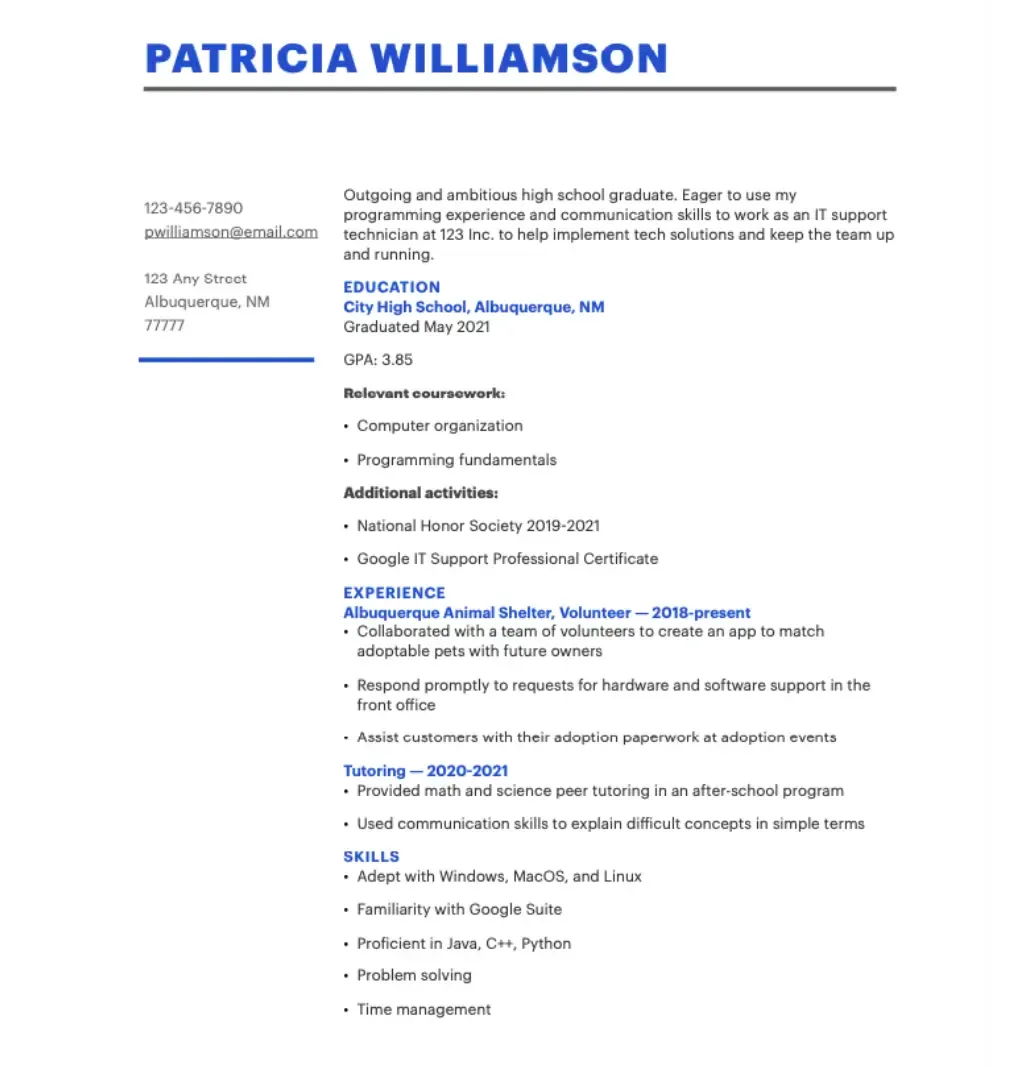
Depending on how you format your resume, it’s best to put a resume objective near the top of your resume, either underneath your header or to the right of it. Take a look at this resume template for recent graduates as an example:
How to write an objective for a resume: 5 resume objective tips
In two sentences max, a resume objective needs to say a lot about who you are and what you want. To make your resume objective as effective as possible, consider the following tips:
1. Research keywords.
As part of your job search, take note of any resume keywords that come up in various job descriptions, and see if there’s a way to integrate a few of them into your objective. For example, if a job description mentions attention to detail, mention that quality when you describe yourself or your experience: “Successful UX designer with strong attention to detail.”
2. Tailor your objective for each role.
You’ll want to make sure you tailor your objective statement for each role, either by updating the job title you’re looking for, the goal you aim to achieve, or your desire to work specifically for that company.
3. Be specific about your experience.
After you draft your objective, go back and look for opportunities to replace words with action verbs and powerful adjectives, and identify places where you can specify your experience. Whether you're just starting or possess extensive experience, action verbs can be a good way to highlight key qualifications like your relevant skills or highlights from your career path.
For example: Instead of Professional and talented financial advisor with several years of experience, get specific while still being succinct: Skilled financial advisor with significant experience guiding clients on major product decisions.
4. Make your value clear.
A resume objective states what you want, but it’s also important to convey what you have to offer a company. Try to connect your objective, such as career advancement or relocation, with unique skills that will make your value clear to a recruiter or hiring manager.
5. Highlight your needs.
Beyond the type of role you’re seeking, make sure to include any specifications, such as part-time work, remote work, or relocation, so that recruiters understand what you’re looking for right away. This can be a good way to contextualize your application in the job market, making it easier for employers to understand how you can help them.
Objective for resume examples: By scenario
Below, we’ve drafted a number of resume objective templates depending on the scenarios noted earlier and included tips to help you shape your story.
1. No experience
Since you may not have a title to add to the description you craft about yourself, describe some of your greatest strengths. Use the first-person or third-person format to showcase some of your strongest transferable skills:
Organized, detail-oriented individual seeking an entry-level position as a customer service representative at [Company Name] to sharpen my communication and sales skills
I am a collaborative team member with terrific workplace skills. I’m looking for a part-time barista role where I can learn more about customer service and share my passion for coffee.
2. Recent graduate
Highlight your high school diploma or college degree in your objective, and connect what you learned with the position you’d like to hold:
Recent graduate with a degree in computer science seeking a position as a web designer at an innovative start-up. Experienced in HTML/CSS, graphic design, and major CMS platforms
To obtain a position on [Company Name’s] product team, where I can apply my MBA and contribute my knowledge of strategy, consumer research, and user experience (UX) design
3. Different roles
Call attention to the transferable skills you’ve developed along the way and how that experience will serve the direction you’re interested in moving next:
Collaborative, quick learner who is skilled in communications, research, and design, and would like to apply that multidimensional experience to a role in sales for a luxury retail brand
I’m a seasoned communicator with experience in data analysis and design, looking to apply that varied training to a marketing manager position at [Company Name].
4. Career advancement
Advancing in your career sometimes means applying for bigger roles and explaining why you’re interested in taking on additional responsibility:
Successful project coordinator with five years of experience overseeing eight direct reports, seeking to become a project manager for an industry-leading fintech company
Established cybersecurity analyst with experience in multiple frameworks and intrusion detection, looking to become a security architect for a global company, where I can implement key design features to safeguard critical data
5. Career change
It’s important to explain the reason behind your desire to change careers and the people and technical skills you believe will help you make the pivot:
Savvy data analyst with experience growing customer insight and retention in the education tech sector. Now interested in finding a role as a financial analyst for a major banking institution, where I can strengthen my knowledge of trend spotting and forecasting.
Driven social media manager with over seven years of experience in consumer research, audience engagement, and market strategy. Interested in pivoting to a marketing manager position and leading the broader marketing efforts of [Company Name].
6. Relocation
Whether you're about to relocate or already have, a company may want to understand your larger plans.
I am an experienced graphic designer relocating to Denver in February, and I’m eager to find a position at [Company Name]. I have over four years of experience in website design, and I’m trained in Adobe Creative Suite.
Innovative business intelligence analyst with experience contributing data-backed insight to three Fortune 500 companies. Seeking a position at a leading product engineering firm in Chicago, where I’ll be relocating in April.
Explore our free career development resources
Subscribe to our weekly LinkedIn newsletter, Career Chat, for job-search tips and skill-building resources. Then, check out some of our other free resources to help you take the next step in your career:
Take the quiz: Career Test: What Career is Right for Me Quiz?
Watch on YouTube: 8 Job Search Engines to Land Your Next Role
Learn from an expert: How to Use GenAI to Advance Your Career: Insight from Coursera's Former CEO
Whether you want to develop a new skill, get comfortable with an in-demand technology, or advance your abilities, keep growing with a Coursera Plus subscription. You’ll get access to over 10,000 flexible courses.


Keep reading
- December 31, 2025
- May 30, 2026
- November 29, 2025
- December 19, 2024
- November 11, 2025
- February 14, 2026
Coursera Staff
Editorial Team
Coursera’s editorial team is comprised of highly experienced professional editors, writers, and fact...
This content has been made available for informational purposes only. Learners are advised to conduct additional research to ensure that courses and other credentials pursued meet their personal, professional, and financial goals.