College Algebra Courses
College Algebra courses can help you learn functions, equations, inequalities, and polynomial expressions. You can build skills in graphing, solving systems of equations, and working with exponential and logarithmic functions. Many courses introduce tools like graphing calculators and software for visualizing data, which enhance your understanding of algebraic concepts and their applications in real-world situations.
Popular College Algebra Courses and Certifications

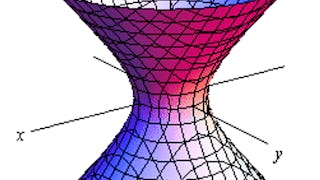
Johns Hopkins University
Skills you'll gain: Algebra, Mathematical Modeling, Graphing, Arithmetic, Advanced Mathematics, Applied Mathematics, Deductive Reasoning, Analytical Skills, Probability & Statistics, Geometry
Johns Hopkins University
Skills you'll gain: Algebra, Graphing, Applied Mathematics, Mathematical Modeling, Trigonometry, Probability, Advanced Mathematics, Data Analysis, Probability & Statistics, Data Literacy, Statistical Analysis, Logical Reasoning, Probability Distribution, Mathematical Theory & Analysis, Descriptive Statistics, Arithmetic, Statistics, Engineering Calculations, Calculus, Analytical Skills
Birla Institute of Technology & Science, Pilani
Skills you'll gain: Differential Equations, Applied Mathematics, Engineering Analysis, Linear Algebra, Calculus, Advanced Mathematics, Mathematical Modeling, Integral Calculus, Dependency Analysis, Mathematical Theory & Analysis, Derivatives

Johns Hopkins University
Skills you'll gain: Linear Algebra, Algebra, Applied Mathematics, Advanced Mathematics, Artificial Intelligence and Machine Learning (AI/ML), Engineering Analysis, Mathematical Theory & Analysis, Geometry, Applied Machine Learning, Markov Model

University of North Texas
Skills you'll gain: Arithmetic, Graphing, Geometry, Statistics, Algebra, Descriptive Statistics, General Mathematics, Applied Mathematics, Statistical Visualization
University of London
Skills you'll gain: Computational Logic, Algorithms, Arithmetic, Applied Mathematics, Advanced Mathematics, Mathematics and Mathematical Modeling, Deductive Reasoning, Mathematical Theory & Analysis, Trigonometry, Geometry, Statistics, General Mathematics, Graphing, Computer Science, Mathematical Modeling, Programming Principles, Business Mathematics, Business Logic, Algebra, Problem Solving
What brings you to Coursera today?

Universitat Politècnica de València
Skills you'll gain: Linear Algebra, Algebra, Geometry, General Mathematics, Applied Mathematics
Birla Institute of Technology & Science, Pilani
Skills you'll gain: Integral Calculus, Trigonometry, Engineering Analysis, Linear Algebra, Calculus, Advanced Mathematics, Differential Equations, Mathematical Modeling, Mathematical Theory & Analysis, Applied Mathematics, Engineering, Algebra, Derivatives

Universitat Autònoma de Barcelona
Skills you'll gain: Trigonometry, Integral Calculus, Calculus, General Mathematics, Arithmetic, Advanced Mathematics, Algebra, Mathematical Theory & Analysis, Applied Mathematics, Graphing, Derivatives, Problem Solving
Johns Hopkins University
Skills you'll gain: Linear Algebra, Algebra, Advanced Mathematics, Engineering Analysis, Applied Mathematics, Mathematical Theory & Analysis, Geometry

University of London
Skills you'll gain: Combinatorics, Probability & Statistics, Data Analysis, Advanced Mathematics, Linear Algebra, Mathematics and Mathematical Modeling, Mathematical Theory & Analysis, Geometry, Applied Mathematics, Statistics, Statistical Analysis, Statistical Methods, Probability, Algorithms, Algebra, Descriptive Statistics

Johns Hopkins University
Skills you'll gain: Algebra, Arithmetic, Mathematical Modeling, Applied Mathematics, Advanced Mathematics, Graphing, Probability & Statistics
In summary, here are 10 of our most popular college algebra courses
- Algebra: Elementary to Advanced: Johns Hopkins University
- Honors Algebra 2: Johns Hopkins University
- Differential Equations and Applications: Birla Institute of Technology & Science, Pilani
- Linear Algebra from Elementary to Advanced: Johns Hopkins University
- Math Prep: College & Work Ready: University of North Texas
- Essential Mathematics for Computer Science: University of London
- Basic Math: Algebra: Universitat Politècnica de València
- Basic Engineering Mathematics: Birla Institute of Technology & Science, Pilani
- Pre-Calculus: Universitat Autònoma de Barcelona
- Linear Algebra: Linear Systems and Matrix Equations: Johns Hopkins University










