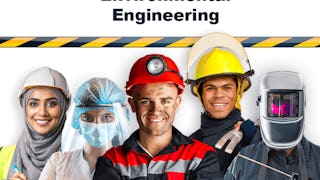
Industrial courses can help you learn supply chain management, production planning, quality control, and process optimization. You can build skills in data analysis, project management, and lean manufacturing techniques. Many courses introduce tools like Six Sigma, ERP software, and simulation modeling, showing how these skills are applied to enhance efficiency and reduce waste in industrial settings.
Khalifa University
Skills you'll gain: Accident Reporting, Fire And Life Safety, Accident Prevention, Safety Assurance, Hazard Analysis, Risk Analysis, Human Factors, Health And Safety Standards, Occupational Safety And Health, Risk Management, Risk Modeling, Legal Risk, Regulation and Legal Compliance, Investigation, Emergency Response, Root Cause Analysis
★ 4.7 (53) · Mixed · Course · 1 - 4 Weeks

University of Michigan
Skills you'll gain: Internet Of Things, Manufacturing Operations, Digital Transformation, Cloud Services, Cloud Computing, Automation, Operational Efficiency, Emerging Technologies, System Implementation, Technology Strategies, Real Time Data, Value Propositions, Case Studies, Cybersecurity
★ 4.5 (208) · Beginner · Course · 1 - 4 Weeks

L&T EduTech
Skills you'll gain: Robotics, Machine Controls, Automation Engineering, Programmable Logic Controllers, Control Systems, Automation, Simulation and Simulation Software, Manufacturing Processes, Simulations, Industrial Engineering, Equipment Design, Internet Of Things, Matlab, Electronic Components, Engineering, Scientific, and Technical Instruments, Process Control
★ 4.5 (125) · Intermediate · Course · 1 - 4 Weeks

Starweaver
Skills you'll gain: Supply Chain Planning, Supply Chain, Logistics Management, Supply Chain Management, Industrial Engineering, Logistics, Transportation, Supply Chain, and Logistics, Engineering Management, Business Operations, Operations Management, Inventory and Warehousing, Operating Cost, Corporate Strategy, Business Strategy, Operations, Operational Efficiency, Business Management, Manufacturing Processes, Sustainable Business, Strategic Planning
★ 4.2 (142) · Beginner · Course · 1 - 4 Weeks

University of Manchester
Skills you'll gain: Biotechnology, Biological Engineering, Chemical and Biomedical Engineering, Sustainable Technologies, Process Engineering, Molecular Biology, Chemical Engineering, Molecular, Cellular, and Microbiology, Biomedical Technology, Sustainable Engineering, Life Sciences, Biochemistry, Bioinformatics, Pharmaceuticals, Cell Cultures, Materials science, Drug Development, Scalability
★ 4.7 (3.6K) · Beginner · Course · 1 - 3 Months

Illinois Tech
Skills you'll gain: Industrial and Organizational Psychology, Job Analysis, Talent Management, Leadership and Management, Team Leadership, Organizational Leadership, Performance Analysis, Staff Management, Performance Review, Diversity Equity and Inclusion Initiatives, Leadership, People Development, Human Resource Management, Performance Appraisal, Human Resources, Team Motivation, Human Resources Management and Planning, Diversity and Inclusion, Diversity Programs, Occupational Safety And Health
★ 4.7 (19) · Beginner · Course · 1 - 3 Months

Northwestern University
Skills you'll gain: Robotics, Machine Controls, Control Systems, Mathematical Modeling, Mathematical Software, Simulation and Simulation Software, Engineering, Mechanics, Mechanical Engineering, Torque (Physics), Applied Mathematics, Numerical Analysis, Process Control, Virtual Environment, Graph Theory, Matlab, Algorithms, Engineering Calculations, Simulations, Data Structures
★ 4.7 (1.2K) · Intermediate · Specialization · 3 - 6 Months

Skills you'll gain: Internet Of Things, Automation, Infrastructure Architecture, Data Management, Systems Architecture, Network Protocols, Information Management, Systems Integration, Information Systems Security, Security Strategy, Emerging Technologies, Communication Systems, Systems Design
★ 4.5 (42) · Beginner · Course · 1 - 4 Weeks

University of Colorado Boulder
Skills you'll gain: Control Systems, Machine Controls, Engineering, Scientific, and Technical Instruments, Process Control, Embedded Systems, Embedded Software, Real Time Data, Laboratory Experience, Electronic Systems, Electronics, Power Electronics, Electronic Hardware, Manufacturing Processes, Three-Phase, Automation Engineering, Electrical Equipment, Thermal Management, Hardware Design, Electrical Engineering, Electrical Systems
★ 4.6 (2.9K) · Intermediate · Specialization · 3 - 6 Months

Coursera
Skills you'll gain: Manufacturing and Production, Manufacturing Operations, Production Process, Manufacturing Processes, Process Control, Production Planning, Lean Manufacturing, Production Management, Lean Methodologies, Operational Efficiency, Continuous Improvement Process, Sustainable Business, Collaboration, Innovation, Adaptability, Communication

★ 4.7 (19) · Intermediate · Course · 1 - 4 Weeks

Lund University
Skills you'll gain: Sustainable Business, Sustainable Design, Sustainable Development, Environment and Resource Management, Environmental Engineering, Strategic Sourcing, Environmental Science, Supply Management, Social Impact, Environmental Policy, Business Analysis, Innovation, Stakeholder Engagement, Policy Analysis
★ 4.8 (2.1K) · Beginner · Course · 1 - 3 Months

Skills you'll gain: Labor Compliance, Industrial Engineering, Manufacturing and Production, Process Mapping, Product Improvement, Team Management, Service Improvement, Manufacturing Processes, Safety Training, Internal Communications, Engineering, Waste Minimization
Intermediate · Course · 1 - 4 Weeks
Industrial refers to the sector that encompasses the production of goods and services through the use of machinery, labor, and technology. It plays a crucial role in the economy by driving innovation, creating jobs, and improving efficiency. The industrial sector includes various fields such as manufacturing, construction, and energy production, all of which contribute significantly to economic growth and development. Understanding industrial processes is essential for optimizing operations, ensuring safety, and meeting the demands of a rapidly changing market.‎
A variety of job opportunities exist within the industrial sector. Positions can range from engineers and technicians to project managers and safety officers. Common roles include industrial engineer, manufacturing technician, quality control inspector, and operations manager. Each of these positions plays a vital role in ensuring that industrial processes run smoothly and efficiently. With the ongoing evolution of technology, roles related to automation, data analysis, and industrial IoT are also becoming increasingly important.‎
To thrive in the industrial sector, several key skills are essential. Technical skills related to machinery operation, process optimization, and safety standards are crucial. Additionally, problem-solving abilities, analytical thinking, and project management skills can significantly enhance your effectiveness in this field. Familiarity with emerging technologies, such as the Internet of Things (IoT) and automation, is also becoming increasingly important as industries evolve.‎
There are numerous online courses available for those interested in industrial topics. Some notable options include the Chip based VLSI design for Industrial Applications Specialization and the Design of Industrial Piping Systems Specialization. These courses provide valuable insights and practical skills that can help you advance your career in the industrial sector.‎
Yes. You can start learning industrial skills on Coursera for free in two ways:
If you want to keep learning, earn a certificate in industrial topics, or unlock full course access after the preview or trial, you can upgrade or apply for financial aid.‎
Learning about industrial topics can be approached through various methods. Online courses, such as those offered on Coursera, provide structured learning paths that cover essential concepts and skills. Additionally, hands-on experience through internships or projects can enhance your understanding. Networking with professionals in the field and participating in industry-related events can also provide valuable insights and opportunities for growth.‎
Typical topics covered in industrial courses include manufacturing processes, quality control, safety regulations, and automation technologies. Courses may also explore the principles of industrial engineering, supply chain management, and the integration of IoT in industrial applications. This comprehensive coverage ensures that learners gain a well-rounded understanding of the industrial landscape.‎
For training and upskilling employees in the industrial sector, courses like the Fundamentals of Robotics & Industrial Automation and the Applied Industrial Internet of Things are particularly beneficial. These courses provide practical knowledge and skills that can be directly applied in the workplace, helping employees stay current with industry trends and technologies.‎