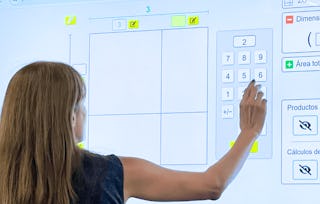
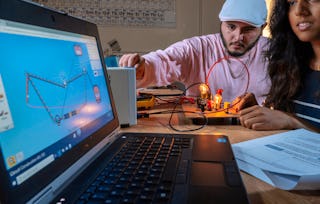
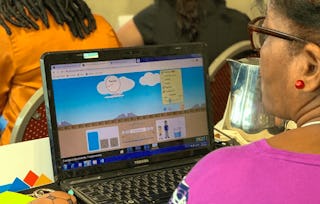
PhET Interactive Simulations (https://phet.colorado.edu/), a project of the University of Colorado Boulder, provides fun, free, interactive, research-based science and mathematics simulations for use across, primary, secondary, and higher education levels. We extensively test and evaluate each simulation to ensure educational effectiveness. All simulations are open source and free to all students and teachers.
In this course, you will acquire teaching and facilitation strategies for how to use PhET simulations for teaching introductory, conceptual electricity and magnetism topics. Specifically, you will interact with 16 PhET simulations, engage as a learner with model lessons, and reflect as a teacher on PhET’s instructional strategies in the context of introductory electricity and magnetism.
To finish this course, you need to complete one assignment with peer review: design your own sim-based plans (such as a unit plan) for teaching electricity and/or magnetism, making use of five or more PhET simulations and instructional strategies.
In this module, you will get an overview of PhET’s simulations for electricity and magnetism, including a brief tour of the PhET website, making a teacher account (if you don’t already have one), and thinking about when and why to incorporate simulations into your teaching.
Inclus
12 lectures2 devoirs4 sujets de discussion1 plugin
Afficher les informations sur le contenu du module
12 lectures•Total 82 minutes
Course Updates and Accessibility Support•1 minute
Welcome!•2 minutes
Teaching Introductory E&M with Simulations•15 minutes
Accessing PhET Simulations and Teacher Resources•10 minutes
Create a PhET Teacher Account•5 minutes
Topics in E&M•5 minutes
External Resources to Support Your Understanding•10 minutes
Open Play with Build an Atom•5 minutes
Benefits of Open Play•5 minutes
Facilitation Tips for Open Play•3 minutes
Role of Simulations in Contrast to Physical Experimentation•20 minutes
Introducing the Next Modules•1 minute
2 devoirs•Total 35 minutes
Navigating the E&M Collection•5 minutes
Prior Knowledge in E&M•30 minutes
4 sujets de discussion•Total 55 minutes
Reflecting on PhET's Collection•10 minutes
A Hierarchy of Concepts in E&M•20 minutes
Reflecting on Open Play with Build an Atom•10 minutes
Role of Simulations in Contrast to Physical Experimentation•15 minutes
1 plugin•Total 20 minutes
Pre-Survey•20 minutes
Electric Charge and Coulomb's Law
Module 2•5 heures à terminer
Détails du module
In this module, you will review the concepts of electric charge and electrostatic forces from the perspective of a learner, using PhET simulations to bring key ideas to life. Along the way, you’ll pause to consider how to teach these ideas effectively.
Inclus
17 lectures6 devoirs7 sujets de discussion
Afficher les informations sur le contenu du module
17 lectures•Total 130 minutes
Welcome to Electrostatics•3 minutes
Open Play with Balloons and Static Electricity•5 minutes
OpenStax: Static Electricity Ch 18.1•20 minutes
Student Challenges with Electric Charge•5 minutes
Digging Deeper into the Organization of Charges•1 minute
Open Play with John Travoltage•10 minutes
Video Primers: Balloons and Static Electricity & John Travoltage•6 minutes
Proportional Reasoning with Coulomb’s Law•10 minutes
OpenStax High School Physics 18.2•10 minutes
Reflecting on Ranking Tasks•10 minutes
Connecting Electric and Gravitational Interactions•2 minutes
Electric Forces vs. Gravitational Forces•10 minutes
Reflecting on Module 2•5 minutes
6 devoirs•Total 70 minutes
Balloons and Static Electricity Comprehension Questions•7 minutes
Self-Assessment for Electric Charge•6 minutes
Induction and Polarization in Balloons and Static Electricity•7 minutes
John Travoltage Comprehension Questions•5 minutes
Ranking Tasks•15 minutes
Finding Charge and Coulomb's Law Activities•30 minutes
7 sujets de discussion•Total 95 minutes
Reflecting on Open Play with Balloons and Static Electricity•5 minutes
Representations in Balloons and Static Electricity•10 minutes
Using Simulations to Address Student Challenges•20 minutes
Reflecting on Open Play with John Travoltage•10 minutes
Challenge Prompt #1•10 minutes
Additional Challenge Prompts•30 minutes
Electric Forces vs. Gravitational Forces•10 minutes
Whole Group Questioning Strategies
Module 3•2 heures à terminer
Détails du module
In this module, you will take a step back from physics content to focus on pedagogical strategies. In the prior lessons, your exploration of PhET simulations was guided by a variety of teacher-created questions, including questions that could best be used when leading discussions with the whole group, using a projected simulation. Learn how to create the best context to promote student inquiry.
Inclus
6 lectures2 devoirs4 sujets de discussion
Afficher les informations sur le contenu du module
6 lectures•Total 39 minutes
Student Questions and Teacher Questions•5 minutes
Prediction Questions Overview•5 minutes
Prediction Questions: Whole Class Inquiry•5 minutes
In this module, you will learn about electric fields and electric potential.
Inclus
17 lectures5 devoirs5 sujets de discussion
Afficher les informations sur le contenu du module
17 lectures•Total 198 minutes
What is a Field?•3 minutes
Open Play with Charges and Fields•5 minutes
Activity Sheet with Charges and Fields•30 minutes
Superposition Principle•10 minutes
Electric Field Hockey•20 minutes
OpenStax High School Physics 18.3•20 minutes
What is Electric Potential and Voltage?•5 minutes
Scaffolded Exploration of Electric Potential and Voltage•20 minutes
Visualizing Electric Potential•10 minutes
Additional Resources for Visualizing Potential•10 minutes
Comparing Electric Field and Potential•10 minutes
Video Primer: Charges and Fields•5 minutes
Electric Field, Potential, and Potential Energy•10 minutes
Exploration with Capacitor Lab: Basics•10 minutes
Multiple Ways to Represent an Electric Field•5 minutes
Student Challenges with Electric Field, and Potential, and Potential Energy•5 minutes
OpenStax High School Physics 18.4•20 minutes
5 devoirs•Total 100 minutes
Electric Field Comprehension Questions•10 minutes
Determining the Nature of Charge from Equipotentials•20 minutes
A Closer Look at Electric Potential•20 minutes
Electric Field, Voltage, and Potential Energy Comprehension Questions•20 minutes
Finding Charges and Fields & Capacitor Lab: Basics Activities•30 minutes
5 sujets de discussion•Total 50 minutes
Single and Double Source Charges•10 minutes
Representing Electric Potential and Voltage•10 minutes
Comparing Electric Field and Potential•10 minutes
Reflecting on Exploration with Capacitor Lab: Basics•10 minutes
A Personal Reflection on Field Concepts•10 minutes
Small Group Questioning Strategies
Module 5•1 heure à terminer
Détails du module
In this module, you will again take a step back from physics content to focus on pedagogical strategies. In the prior lessons, your exploration of PhET simulations was guided by a variety of teacher-created questions, including challenge prompts that scaffold learning when students have direct access to manipulate the simulations themselves.
Inclus
3 lectures1 devoir2 sujets de discussion
Afficher les informations sur le contenu du module
3 lectures•Total 20 minutes
Challenge Prompts Overview•10 minutes
A Note About Limiting Instructions•5 minutes
Summarizing Question Types•5 minutes
1 devoir•Total 10 minutes
Identifying Challenge Prompts•10 minutes
2 sujets de discussion•Total 30 minutes
Reflecting on Challenge Prompts•10 minutes
Creating Challenge Prompts•20 minutes
Electric Current and Circuits
Module 6•8 heures à terminer
Détails du module
In this module, we shift our attention from charges at rest to charges in motion. Our goal is to help you leverage the natural relevance and excitement that electric circuits offer so that students see circuits not just as diagrams on paper, but as tools for solving real-world problems and imagining new inventions.
Inclus
28 lectures5 devoirs7 sujets de discussion
Afficher les informations sur le contenu du module
28 lectures•Total 332 minutes
Can you Light the Bulb?•10 minutes
Can you Light the Bulb? - A Video Vignette•5 minutes
The Circuit Challenge•30 minutes
Reflecting on Circuit Challenge•10 minutes
Simple Circuits•3 minutes
Measuring Current and Voltage•15 minutes
How are Voltage and Current Related?•30 minutes
How Does Voltage Affect Current?•10 minutes
Role of the Component•20 minutes
How Does the Component Type Affect Current?•5 minutes
Ohm's Law•5 minutes
Reinforcing Concepts with Battery-Resistor Circuit•10 minutes
Strengthening Proportional Reasoning with Ohm's Law•5 minutes
Video Primer: Ohm’s Law•4 minutes
OpenStax High School Physics Ch 19.1•20 minutes
Series Circuits•10 minutes
Parallel Circuits•10 minutes
OpenStax High School Physics Ch 19.2 & 19.3•30 minutes
What Determines the Brightness of a Bulb?•10 minutes
Introducing Power•10 minutes
What Brightness Really Depends On•3 minutes
OpenStax High School Physics Ch 19.4•10 minutes
Resistance in a Wire•10 minutes
Empirical vs. Cause-and-Effect Relationships•3 minutes
Video Primer: Resistance in a Wire•4 minutes
Advanced Features and Video Primer: Circuit Construction Kit: DC•10 minutes
Learning Challenges with Circuits•10 minutes
Advanced Features: More Simulations•30 minutes
5 devoirs•Total 61 minutes
Applying Knowledge from the Circuit Challenge•10 minutes
Using a Voltmeter and Ammeter•15 minutes
Calculating the Resistance of an Unknown Component•10 minutes
Equivalent Resistance•20 minutes
Making Sense of the Data•6 minutes
7 sujets de discussion•Total 85 minutes
Why Was Lighting the Bulb So Difficult?•10 minutes
Create Your Own Circuit Challenge•30 minutes
Analyzing the Voltage and Current Relationship•10 minutes
Sharing Your Results•10 minutes
Comparing Power and Brightness•5 minutes
Resistance in a Wire•10 minutes
More Simulations•10 minutes
Modeling Strategies
Module 7•2 heures à terminer
Détails du module
Already throughout this course, you have used multiple models, and you have engaged in modeling of physical phenomena. In this module, you will learn about models and modeling as an underlying process skill that can enhance your use of PhET simulations.
Inclus
4 lectures1 devoir2 sujets de discussion
Afficher les informations sur le contenu du module
4 lectures•Total 47 minutes
Models and Representations•10 minutes
Modeling with Graphical and Mathematical Representations•30 minutes
A Note About the Limitations of Models•5 minutes
How Much Modeling?•2 minutes
1 devoir•Total 30 minutes
Modeling with a Parallel-Plate Capacitor•30 minutes
2 sujets de discussion•Total 30 minutes
Modeling with Graphical and Mathematical Representations•20 minutes
Modeling in Your Classroom•10 minutes
Magnetism & Electromagnetism
Module 8•4 heures à terminer
Détails du module
In this module, you will explore magnetic fields and electromagnetic induction from the perspective of a learner using simulations. While magnets are familiar to many students, the mechanism behind their behavior is invisible and frequently misunderstood. Our goal in this module is to help make magnetic fields visible, directional, and meaningful.
Inclus
16 lectures4 devoirs4 sujets de discussion
Afficher les informations sur le contenu du module
16 lectures•Total 159 minutes
A Different Type of Field•4 minutes
Mapping the Magnetic Field of a Bar Magnet•10 minutes
Magnetic Field of a Bar Magnet•10 minutes
From Magnetic Field Vectors to Magnetic Field Lines•5 minutes
More Sources of Magnetic Fields•10 minutes
OpenStax High School Physics Ch 20.1•30 minutes
Scope of this Module•3 minutes
Where Electricity and Magnetism Meet•2 minutes
Inducing an Electric Current in a Coil of Wire•10 minutes
What is Electromagnetic Induction?•5 minutes
What Affects the Strength and Direction of the Induced Current?•10 minutes
OpenStax High School Physics Ch 20.3•20 minutes
Electromagnetic Induction in the World Around Us•10 minutes
Exploring the Generator•10 minutes
Exploring the Transformer•10 minutes
OpenStax High School Physics Ch 20.2•10 minutes
4 devoirs•Total 40 minutes
Magnets and Electromagnets Observations•10 minutes
Which Actions Induce a Current?•10 minutes
Generator Behavior•10 minutes
Transformer Behavior•10 minutes
4 sujets de discussion•Total 50 minutes
Exploring the Magnet and Compass Sim•10 minutes
Exploring the Magnets and Electromagnets Sim•20 minutes
What Affects the Strength and Direction of the Induced Current?•10 minutes
Generators and Transformers as Learning Tools•10 minutes
Creating a Sim-Based Unit
Module 9•2 heures à terminer
Détails du module
In the past modules, you engaged with over a dozen powerful PhET simulations. Now, it’s time to think about how you plan to integrate these simulations–and effective strategies for using them with students–into your teaching.
Inclus
6 lectures1 évaluation par les pairs
Afficher les informations sur le contenu du module
6 lectures•Total 27 minutes
Developing a Portfolio•5 minutes
Selecting PhET Simulations•5 minutes
Activity Plans and Strategies•5 minutes
Narrative Reflection•5 minutes
Supplemental Resources for Teaching E&M: LabXchange•5 minutes
Instructions•2 minutes
1 évaluation par les pairs•Total 120 minutes
Portfolio Submission & Peer Review•120 minutes
Conclusion
Module 10•22 minutes à terminer
Détails du module
In this module, you will take appropriate steps to complete the course and download your certificate.
Inclus
1 lecture1 plugin
Afficher les informations sur le contenu du module
CU Boulder is a dynamic community of scholars and learners on one of the most spectacular college campuses in the country. As one of 34 U.S. public institutions in the prestigious Association of American Universities (AAU), we have a proud tradition of academic excellence, with five Nobel laureates and more than 50 members of prestigious academic academies.
Pour quelles raisons les étudiants sur Coursera nous choisissent-ils pour leur carrière ?
Felipe M.
Étudiant(e) depuis 2018
’Pouvoir suivre des cours à mon rythme à été une expérience extraordinaire. Je peux apprendre chaque fois que mon emploi du temps me le permet et en fonction de mon humeur.’
Jennifer J.
Étudiant(e) depuis 2020
’J'ai directement appliqué les concepts et les compétences que j'ai appris de mes cours à un nouveau projet passionnant au travail.’
Larry W.
Étudiant(e) depuis 2021
’Lorsque j'ai besoin de cours sur des sujets que mon université ne propose pas, Coursera est l'un des meilleurs endroits où se rendre.’
Chaitanya A.
’Apprendre, ce n'est pas seulement s'améliorer dans son travail : c'est bien plus que cela. Coursera me permet d'apprendre sans limites.’

When will I have access to the lectures and assignments?
To access the course materials, assignments and to earn a Certificate, you will need to purchase the Certificate experience when you enroll in a course. You can try a Free Trial instead, or apply for Financial Aid. The course may offer 'Full Course, No Certificate' instead. This option lets you see all course materials, submit required assessments, and get a final grade. This also means that you will not be able to purchase a Certificate experience.
What will I get if I purchase the Certificate?
When you purchase a Certificate you get access to all course materials, including graded assignments. Upon completing the course, your electronic Certificate will be added to your Accomplishments page - from there, you can print your Certificate or add it to your LinkedIn profile.
Is financial aid available?
Yes. In select learning programs, you can apply for financial aid or a scholarship if you can’t afford the enrollment fee. If fin aid or scholarship is available for your learning program selection, you’ll find a link to apply on the description page.