

How do global powers shape world politics—and why do countries make the foreign policy choices they do?
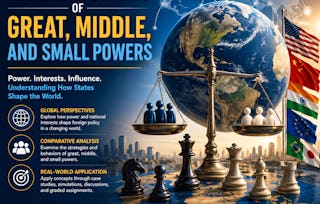
In this course, you’ll explore the relationship between power and foreign policy in international relations and learn how a country’s position in the international system influences its strategies, alliances and decisions. You’ll build a practical understanding of hard power, soft power, smart power, national interest, international power configurations and changing world orders. Go beyond theory through contemporary case studies of the United States, India and Qatar, representing great, middle and small powers. Examine how the US has responded to shifts from the Cold War and unipolarity towards an emerging multipolar order; how India has evolved into a rising power and strategic actor in the Indo-Pacific; and how Qatar has used energy resources, diplomacy and soft power to expand its influence beyond its size. You’ll also apply your knowledge through discussions, quizzes, peer review and hands-on activities that connect international relations theory to real-world foreign policy decisions. By the end of the course, you’ll be better equipped to analyse geopolitical developments, understand why states behave differently, evaluate foreign policy strategies and anticipate how changing power dynamics may reshape the international order. Whether you’re studying international relations, political science, diplomacy, global affairs or security studies, or simply want to understand the forces shaping world politics, this course gives you a structured foundation for analysing foreign policy and global power.