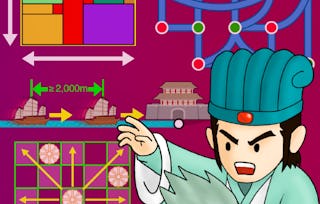
Optimization is a common form of decision making, and is ubiquitous in our society. Its applications range from solving Sudoku puzzles to arranging seating in a wedding banquet. The same technology can schedule planes and their crews, coordinate the production of steel, and organize the transportation of iron ore from the mines to the ports. Good decisions in manpower and material resources management also allow corporations to improve profit by millions of dollars. Similar problems also underpin much of our daily lives and are part of determining daily delivery routes for packages, making school timetables, and delivering power to our homes. Despite their fundamental importance, all of these problems are a nightmare to solve using traditional undergraduate computer science methods.

Basic Modeling for Discrete Optimization

Basic Modeling for Discrete Optimization


Instructors: Prof. Jimmy Ho Man Lee
Top Instructor
Access provided by UC Davis
29,033 already enrolled
460 reviews
Skills you'll gain
Tools you'll learn
Details to know
See how employees at top companies are mastering in-demand skills

There are 4 modules in this course
Instructors
Offered by

Why people choose Coursera for their career

Felipe M.

Jennifer J.

Larry W.

Chaitanya A.
Learner reviews
- 5 stars
86.08%
- 4 stars
11.73%
- 3 stars
1.52%
- 2 stars
0.21%
- 1 star
0.43%
Showing 3 of 460
Reviewed on Feb 16, 2020
Super interesting. Would be nice to have corrections of the assignment too but overall, super fun.The pdf description are sometimes unclea (constraints are sometimes put in the data description.)
Reviewed on Jul 26, 2019
Thank you so much for the course. I had to fight my coding habits, programming CP models is quite different from the traditional programming I'm, and it could even be more fun!
Reviewed on Jul 10, 2020
A classic combination of the story mode pitched in learning. I wish that the topics covered in the course were more elaborated.
Explore more from Computer Science
The Chinese University of Hong Kong

The Chinese University of Hong Kong
Northeastern University

Coursera