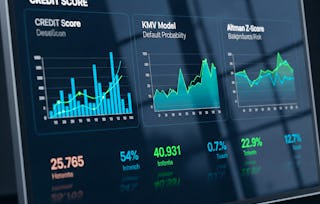
Build practical skills in credit default prediction with Python by learning how to prepare data, develop classification models, and evaluate predictive performance for financial risk analysis. In this course, you will follow a structured workflow that begins with importing datasets and libraries, preprocessing data, handling missing values, encoding categorical features, scaling numerical variables, and performing exploratory data analysis (EDA) to uncover meaningful patterns.

Credit Default Prediction with Python: Apply & Analyze

Credit Default Prediction with Python: Apply & Analyze
This course is part of Credit Risk Analytics Specialization

Instructor: EDUCBA
Access provided by University of Colorado at Boulder
Gain insight into a topic and learn the fundamentals.
12 reviews
6 hours to complete
Flexible schedule
Learn at your own pace
What you'll learn
Preprocess financial datasets using encoding, scaling, and EDA techniques.
Build and tune logistic regression, decision trees, and Random Forest models.
Evaluate credit risk models with confusion matrices, ROC curves, and ensemble methods.
Skills you'll gain
- Decision Tree Learning
- Data Analysis
- Model Evaluation
- Exploratory Data Analysis
- Risk Modeling
- Predictive Modeling
- Performance Analysis
- Data-Driven Decision-Making
- Financial Analysis
- Applied Machine Learning
- Model Optimization
- Data Preprocessing
- Model Training
- Logistic Regression
- Credit Risk
- Machine Learning Methods
- Predictive Analytics
- Risk Analysis
- Feature Engineering
Details to know

Shareable certificate
Add to your LinkedIn profile
Assessments
6 assignments
Taught in English
See how employees at top companies are mastering in-demand skills

Build your subject-matter expertise
This course is part of the Credit Risk Analytics Specialization
When you enroll in this course, you'll also be enrolled in this Specialization.
- Learn new concepts from industry experts
- Gain a foundational understanding of a subject or tool
- Develop job-relevant skills with hands-on projects
- Earn a shareable career certificate


Why people choose Coursera for their career

Felipe M.
Learner since 2018
"To be able to take courses at my own pace and rhythm has been an amazing experience. I can learn whenever it fits my schedule and mood."

Jennifer J.
Learner since 2020
"I directly applied the concepts and skills I learned from my courses to an exciting new project at work."

Larry W.
Learner since 2021
"When I need courses on topics that my university doesn't offer, Coursera is one of the best places to go."

Chaitanya A.
"Learning isn't just about being better at your job: it's so much more than that. Coursera allows me to learn without limits."
Learner reviews
- 5 stars
100%
- 4 stars
0%
- 3 stars
0%
- 2 stars
0%
- 1 star
0%
Showing 3 of 12
KK
Reviewed on Jul 30, 2026
The nuance around handling historical credit bureau features and modern alternative data sources added a layer of realism that standard data science tutorials completely lack.
LB
Reviewed on Jul 18, 2026
It moves seamlessly from basic logistic regression to advanced ensemble methods. The hands-on analysis of credit risk metrics felt highly realistic and practical.
LA
Reviewed on Jul 20, 2026
Learned more about applied financial modeling here than in my university modules.