In the Data Management and Database Design Part 1 course, you will gain an essential foundation in database theory and skills, exploring fundamental concepts and basic database structures. You will acquire valuable knowledge and skills in understanding, querying, and working with core database systems, with an emphasis on both relational and NoSQL database fundamentals.

Data Management and Database Design Part 1

Skills you'll gain
Details to know

Shareable certificate
Add to your LinkedIn profile
Assessments
16 assignments
Taught in English
See how employees at top companies are mastering in-demand skills

There are 7 modules in this course
In Module 1 of our course, you will embark on a journey through the history and evolution of database systems, gaining valuable insights into the milestones that have shaped modern data management. Through critical analysis of historical contexts and past design strategies, you will develop a nuanced understanding of how database designs have progressed and occasionally faltered. We will also evaluate the impact of these developments on current database practices and learn to apply this knowledge to assess and enhance database effectiveness.
What's included
4 videos17 readings2 assignments1 discussion prompt
4 videos•Total 12 minutes
- Course Introduction•1 minute
- Meet Your Faculty•1 minute
- Database System History•5 minutes
- Relational Database vs. NoSQL Database•5 minutes
17 readings•Total 177 minutes
- Course Introduction•2 minutes
- Data Management and Database Design Part 1 Syllabus•10 minutes
- Academic Integrity Attestation•1 minute
- The Evolution of Databases•24 minutes
- Data Categories•4 minutes
- Data Types and Uses•4 minutes
- Data Models and Their Use Cases•5 minutes
- Today's Database Landscape•23 minutes
- Lucidchart•45 minutes
- Sharding vs. Replication •3 minutes
- Understanding Relational Databases•17 minutes
- Key Takeaways: Relational Data Model•2 minutes
- What is NoSQL?•18 minutes
- Comparing Relational Model and NoSQL•4 minutes
- Data Universal Framework Comparison•6 minutes
- Case Study: Designing a Scalable Payment Processing System•8 minutes
- Module 1 Summary•1 minute
2 assignments•Total 11 minutes
- Assess Your Learning: Database History•6 minutes
- Assess Your Learning: Relational Database vs. NoSQL Database•5 minutes
1 discussion prompt•Total 30 minutes
- Meet Your Fellow Learners•30 minutes
In Module 2, you will explore the intricacies of database modeling, learning to articulate and refine models using established and emerging methodologies. This module aims to equip you with a solid understanding of fundamental modeling concepts, the skills to use UML (Unified Modeling Language) and Crow’s Foot notations effectively, and the ability to perform and critically analyze entity-relationship models. By exploring the principles and components of various data models, you will enhance your ability to develop robust database structures tailored to specific requirements.
What's included
2 videos16 readings4 assignments
2 videos•Total 4 minutes
- Data Modeling•2 minutes
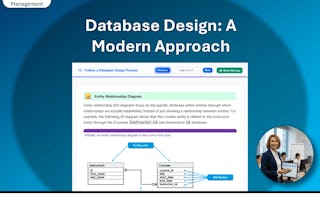
- Entity-Relationship Diagram (ERD)•2 minutes
16 readings•Total 170 minutes
- Database and Software Development Life Cycles•16 minutes
- Types of Keys and Data Integrity•10 minutes
- Entity-Relationship Modeling•17 minutes
- Crow’s Foot Notation•10 minutes
- Strong Entity vs. Weak Entity•5 minutes
- Identifying vs. Non-Identifying Relationships•10 minutes
- ERD Example•40 minutes
- Unified Modeling Language (UML) Notation•7 minutes
- Multiplicity•3 minutes
- Mission Statement and Objectives•6 minutes
- Modeling Comparison Between Relational and Document Databases•10 minutes
- Create ERD for Document Database•5 minutes
- Popular NoSQL Databases•20 minutes
- Intro to Enhanced Entity-Relationship Modeling•5 minutes
- Enhanced Entity-Relationship Modeling•5 minutes
- Module 2 Summary•1 minute
4 assignments•Total 22 minutes
- Assess Your Learning: Data Modeling•6 minutes
- Assess Your Learning: Entity Relationship Diagrams (ERD)•6 minutes
- Assess Your Learning: Crow’s Foot Notation•4 minutes
- Assess Your Learning: Enhanced Entity-Relationship Modeling•6 minutes
In Module 3, you will explore the crucial phases of the database development life cycle, delving deep into the theory and practice of database normalization. This module is designed to enhance your proficiency in developing streamlined and efficient database structures, aligning with industry best practices. Through a comprehensive survey and analysis, you will gain insights into how databases fit within software architectures, the importance of each development stage, and the critical role of normalization in optimizing database design for performance and scalability.
What's included
2 videos20 readings2 assignments
2 videos•Total 4 minutes
- Database Development Lifecycle•2 minutes
- How Does a Database Fit in the Overall Software Development Project?•2 minutes
20 readings•Total 163 minutes
- Stages of Database Design•5 minutes
- Two Major Approaches to Database Design•3 minutes
- CASE Tools•5 minutes
- Best Practices for Database Design•5 minutes
- Document Databases Design—Embedding vs. Referencing•8 minutes
- How to Design and Implement a MongoDB Database•10 minutes
- Design Comparison: Relational vs. NoSQL Databases•3 minutes
- Normalization•10 minutes
- Advanced Normalization•15 minutes
- Attributes•5 minutes
- Conceptual Database Design•15 minutes
- Logical Database Design for Relational Model•7 minutes
- Getting Started with MongoDB Atlas Database •10 minutes
- MongoDB Normalization•4 minutes
- MongoDB Design–Denormalization•5 minutes
- Common Ways to Query MongoDB Data•9 minutes
- Syntax Rules for MongoDB•18 minutes
- MongoDB Calculating Averages and Totals•20 minutes
- Object Database Normalization•5 minutes
- Module 3 Summary•1 minute
2 assignments•Total 12 minutes
- Assess Your Learning: Database Development Life Cycle•6 minutes
- Assess Your Learning: Database and Software Development Project•6 minutes
In Module 4, you will master the art and science of database design tailored to specific industry use cases, focusing on optimizing database functionality and effectiveness. Through this module, you will develop the skills to identify and prioritize critical business requirements, create comprehensive database design documents, and understand the evolution and standards of SQL. This exploration will enable you to critically assess database designs and articulate their strengths and weaknesses in meeting business needs.
What's included
1 video12 readings2 assignments
1 video•Total 2 minutes
- Project Database Design Document•2 minutes
12 readings•Total 114 minutes
- SQL: The Universal Data Language•4 minutes
- Database Design Examples•10 minutes
- Key Tables of AdventureWorks•7 minutes
- Document Basics•4 minutes
- Designing and Modeling Document-Oriented Databases•4 minutes
- SQL Server Management Studio•30 minutes
- Front-End Tools for the Database Engine•9 minutes
- DBeaver•10 minutes
- Evolution of SQL•10 minutes
- SQL Data Definition•15 minutes
- Close Look at SQL SELECT•10 minutes
- Module 4 Summary•1 minute
2 assignments•Total 9 minutes
- Assess Your Learning: Introduction to SQL•5 minutes
- Assess Your Learning: Project Database Design Document•4 minutes
In Module 5, you will deepen your understanding of SQL join types and their strategic applications in data retrieval tasks. This module is tailored to enhance your ability to critically assess and select the most appropriate join operations for specific queries, along with developing virtual tables for efficient data manipulation. By learning how different join types function and their impacts on database performance, you will gain proficiency in handling complex SQL queries and managing data interactions effectively.
What's included
2 videos24 readings1 assignment
2 videos•Total 3 minutes
- Inner, Outer, and Self Join•1 minute
- SQL JOINs•2 minutes
24 readings•Total 249 minutes
- Queries, SELECT, and JOIN•20 minutes
- How to Learn About Our Data•6 minutes
- How to Get Started with SQL Programming•55 minutes
- Common Types of SQL Joins•45 minutes
- Inner Joins•4 minutes
- Left Outer Joins•3 minutes
- Right Outer Joins•3 minutes
- Self Join•9 minutes
- Using Self Joins with the Northwind Database•8 minutes
- Clever Use of Aliases•6 minutes
- Clever Use of Aliases for JOIN•5 minutes
- Use SQL to Work with NoSQL Document Model Data•17 minutes
- SQL JOINs for NoSQL Document Model Data•15 minutes
- SQL Server Data Types•5 minutes
- SQL Identity Property•1 minute
- How to Find Last Identity Value•5 minutes
- Simple Subquery vs. Correlated Subquery•4 minutes
- Common Table Expression (CTE)•14 minutes
- Graph Processing–Recursive All•4 minutes
- Data Aggregation and GROUP BY•8 minutes
- GROUP BY WITH ROLLUP or CUBE•5 minutes
- MongoDB Architecture•2 minutes
- MongoDB Replication•4 minutes
- Module 5 Summary•1 minute
1 assignment•Total 6 minutes
- Assess Your Learning: Inner, Outer, and Self Join•6 minutes
In Module 6, you will explore advanced SQL techniques and structures, focusing on optimizing database performance through indexing and effective use of data hierarchies. This module aims to deepen your understanding of how data can be organized and accessed efficiently to enhance query performance and data integration. Through targeted learning objectives, you will evaluate different indexing strategies, understand the layers of data hierarchy, and master strategic SQL JOIN operations to maximize data retrieval efficiency across various levels of data organization.
What's included
2 videos11 readings3 assignments
2 videos•Total 3 minutes
- Data Hierarchy and SQL JOINs•2 minutes
- Data Hierarchy•1 minute
11 readings•Total 86 minutes
- Data Hierarchy and SQL JOINs•39 minutes
- Understanding Indexes•15 minutes
- Indexing Concepts•8 minutes
- Columnstore Index Basics•4 minutes
- Indexing Best Practices•2 minutes
- SQL INTERSECT and EXCEPT Concepts•2 minutes
- SQL INTERSECT and EXCEPT Commands•2 minutes
- SQL Intersect and Except Exercises•8 minutes
- SQL UPDATE Command•2 minutes
- How to Remove Data From SQL Table•3 minutes
- Module 6 Summary•1 minute
3 assignments•Total 15 minutes
- Assess Your Learning: Data Hierarchy and SQL JOINs•3 minutes
- Assess Your Learning: SQL INTERSECT and EXCEPT Commands•2 minutes
- Check Your Knowledge: Indexing Strategies•10 minutes
In Module 7, you will sharpen your SQL skills by mastering sophisticated functions and techniques that elevate data manipulation and analysis. This module focuses on employing SQL ranking functions and manipulating date components to perform advanced operations, enabling precise and effective data analysis. You will learn to apply these tools proficiently to organize, rank, and dissect datasets, enhancing your ability to extract actionable insights from complex information.
What's included
2 videos20 readings2 assignments
2 videos•Total 2 minutes
- SQL Ranking•1 minute
- GROUP BY vs. PARTITION BY•1 minute
20 readings•Total 121 minutes
- How to Best Work with SQL Ranking Functions•4 minutes
- RANK•1 minute
- DENSE_RANK•1 minute
- ROW_NUMBER•1 minute
- NTILE•1 minute
- SELECT TOP 1 WITH TIES vs. RANK•15 minutes
- Videos on SQL Functions•10 minutes
- Different Ways to Calculate Median•8 minutes
- How to Remove Duplicates From a Table•10 minutes
- Real-World Example Using SQL CASE•25 minutes
- Sample Report: Marketing Campaign Performance•3 minutes
- Comparing GROUP BY and PARTITION BY•12 minutes
- Use Case #1: Total Sales by Territory•4 minutes
- Use Case #2: Most Expensive Order by Territory•4 minutes
- Use Case #3: Top Performing Territory•5 minutes
- Running Date Components•7 minutes
- CASE Example•5 minutes
- Module 7 Summary•1 minute
- Saving Course Material•2 minutes
- Congratulations! •2 minutes
2 assignments•Total 10 minutes
- Assess Your Learning: SQL Ranking Functions•6 minutes
- Assess Your Learning: GROUP BY vs. PARTITION BY•4 minutes
Instructor

Offered by

Why people choose Coursera for their career

Felipe M.
Learner since 2018
"To be able to take courses at my own pace and rhythm has been an amazing experience. I can learn whenever it fits my schedule and mood."

Jennifer J.
Learner since 2020
"I directly applied the concepts and skills I learned from my courses to an exciting new project at work."

Larry W.
Learner since 2021
"When I need courses on topics that my university doesn't offer, Coursera is one of the best places to go."

Chaitanya A.
"Learning isn't just about being better at your job: it's so much more than that. Coursera allows me to learn without limits."
Explore more from Information Technology
 N
NNortheastern University
Course
 N
NNortheastern University
Course
 L
LLogical Operations
Course

Course