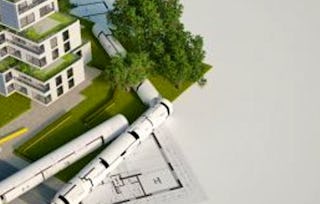
This course offers a comprehensive, interdisciplinary exploration of sustainability in architectural practice. Participants will gain foundational knowledge in the core components of sustainability evaluation (forming the initial analytical layer), alongside an understanding of contemporary trends shaping this field.

Introduction to interdisciplinary sustainable architecture

Introduction to interdisciplinary sustainable architecture

Instructor: Javier Orozco-Messana
Access provided by National Initiative for AI and Security
Gain insight into a topic and learn the fundamentals.
Intermediate level
Recommended experience
1 week to complete
at 10 hours a week
Flexible schedule
Learn at your own pace
What you'll learn
Build theoretical neighborhood sustainability models and assess performance metrics using foundational sustainability evaluation components.
Optimize building material performance and select urban infrastructure elements for green, blue, and gray infrastructure systems.
Integrate energy considerations and quantify climate change impacts through CO2 emissions analysis for global sustainability assessment.
Conduct unified sustainability assessments and directly link findings to relevant policy frameworks for practical implementation.
Skills you'll gain
- Sustainable Design
- Environment and Resource Management
- Architectural Design
- Sustainable Architecture
- Thermal Management
- Structural Analysis
- Sustainable Systems
- Materials science
- Sustainable Development
- Policy Analysis, Research, and Development
- Systems Thinking
- Architecture and Construction
- Environmental Engineering
- Building Design
- Environmental Regulations
- Landscape Architecture
Details to know

Shareable certificate
Add to your LinkedIn profile
Assessments
20 assignments
Taught in English
See how employees at top companies are mastering in-demand skills

There are 4 modules in this course
Instructor
Offered by

Why people choose Coursera for their career

Felipe M.
Learner since 2018
"To be able to take courses at my own pace and rhythm has been an amazing experience. I can learn whenever it fits my schedule and mood."

Jennifer J.
Learner since 2020
"I directly applied the concepts and skills I learned from my courses to an exciting new project at work."

Larry W.
Learner since 2021
"When I need courses on topics that my university doesn't offer, Coursera is one of the best places to go."

Chaitanya A.
"Learning isn't just about being better at your job: it's so much more than that. Coursera allows me to learn without limits."
Explore more from Physical Science and Engineering
Universitat Politècnica de València

University of Illinois Urbana-Champaign
Johns Hopkins University