Wenn Sie sich für diesen Kurs anmelden, werden Sie auch für dieses berufsbezogene Zertifikat angemeldet.
Lernen Sie neue Konzepte von Branchenexperten
Gewinnen Sie ein Grundverständnis bestimmter Themen oder Tools
Erwerben Sie berufsrelevante Kompetenzen durch praktische Projekte
Erwerben Sie ein Berufszertifikat von SAS zur Vorlage
In diesem Kurs gibt es 6 Module
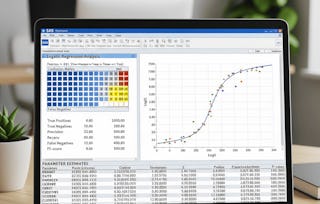
This course covers predictive modeling using SAS/STAT software with emphasis on the LOGISTIC procedure. This course also discusses selecting variables and interactions, recoding categorical variables based on the smooth weight of evidence, assessing models, treating missing values, and using efficiency techniques for massive data sets. You learn to use logistic regression to model an individual's behavior as a function of known inputs, create effect plots and odds ratio plots, handle missing data values, and tackle multicollinearity in your predictors. You also learn to assess model performance and compare models.
Welcome! In this module, you will review the fundamentals of predictive modeling. First we'll get you started by setting up the course environment. Then you explore the business scenario data that is used throughout the course. You’ll learn the goals of predictive modeling, key terms and model elements, and the basic workflow used to build predictive models, along with common real-world applications. You’ll also work through practical scenarios to explore data using descriptive statistics and frequency tables, and you’ll examine the code used to generate these summaries. Finally, you’ll learn about common data and analytical challenges.
Das ist alles enthalten
16 Videos6 Lektüren6 Aufgaben
Infos zu Modulinhalt anzeigen
16 Videos•Insgesamt 34 Minuten
Meet the Instructor•1 Minute
Overview•1 Minute
Introduction•0 Minuten
Goals of Predictive Modeling•2 Minuten
Terms for Elements in Predictive Modeling•1 Minute
Basic Steps of Predictive Modeling•3 Minuten
Applications of Predictive Modeling•2 Minuten
Demonstration Scenario: Target Marketing for a Bank•2 Minuten
Demo: Examining the Code for Generating Descriptive Statistics and Frequency Tables•2 Minuten
Introduction•0 Minuten
Data Challenges•6 Minuten
Analytical Challenges•2 Minuten
Separate Sampling•2 Minuten
Avoiding the Optimism Bias: Honest Assessment•2 Minuten
Splitting the Data for Model Training and Assessment•3 Minuten
Demo: Splitting the Data•5 Minuten
6 Lektüren•Insgesamt 46 Minuten
What You Learn in This Course•5 Minuten
Learner Prerequisites•1 Minute
Access SAS Software & Set up Data•10 Minuten
About the Demos and Practices in this Course•10 Minuten
Frequently Asked Questions•10 Minuten
Summary•10 Minuten
6 Aufgaben•Insgesamt 100 Minuten
Practice: Exploring the Bank Data for the Target Marketing Project•20 Minuten
Practice: Exploring the Veterans' Organization Data Used in the Practices•20 Minuten
Knowledge Check: Model Training & Sampling•5 Minuten
Knowledge Check: Splitting the Data•5 Minuten
Practice: Splitting the Data•20 Minuten
Module-End Graded Assessment•30 Minuten
Fitting the Model
Modul 2•2 Stunden abzuschließen
Moduldetails
In this module, you investigate the concepts behind the logistic regression model. Then you learn to use the LOGISTIC procedure to fit a logistic regression model. Finally, you learn how to score new cases and adjust the model for oversampling.
Das ist alles enthalten
18 Videos1 Lektüre4 Aufgaben
Infos zu Modulinhalt anzeigen
18 Videos•Insgesamt 54 Minuten
Overview•1 Minute
Introduction•0 Minuten
Understanding the Logistic Regression Model•3 Minuten
Constraining the Posterior Probability Using the Logit Transformation•2 Minuten
Understanding the Fitted Surface•1 Minute
Interpreting the Model by Calculating the Odds Ratio•3 Minuten
Understanding Logistic Discrimination•2 Minuten
Estimating Unknown Parameters Using Maximum Likelihood Estimation•2 Minuten
Interpreting Concordant, Discordant, and Tied Pairs•2 Minuten
Using PROC LOGISTIC to Fit Logistic Regression Models•0 Minuten
Demo: Fitting a Basic Logistic Regression Model, Part 1•8 Minuten
Demo: Fitting a Basic Logistic Regression Model, Part 2•12 Minuten
Scoring New Cases•0 Minuten
Demo: Scoring New Cases•8 Minuten
Introduction•0 Minuten
Understanding the Effect of Oversampling•1 Minute
Understanding the Offset•2 Minuten
Demo: Correcting for Oversampling•7 Minuten
1 Lektüre•Insgesamt 10 Minuten
Summary•10 Minuten
4 Aufgaben•Insgesamt 60 Minuten
Question 2.01•5 Minuten
Question 2.02•5 Minuten
Practice: Fitting a Logistic Regression Model•20 Minuten
Fitting the Model Review•30 Minuten
Preparing the Input Variables, Part 1
Modul 3•3 Stunden abzuschließen
Moduldetails
In this module, you learn how to deal with common problems with your predictor variables such as missing values, categorical predictors with many levels, a high number of redundant predictors, and nonlinear relationships with the response variable.
Das ist alles enthalten
26 Videos9 Aufgaben
Infos zu Modulinhalt anzeigen
26 Videos•Insgesamt 76 Minuten
Overview•1 Minute
Introduction•0 Minuten
Reasons for Missing Data•3 Minuten
Complete Case Analysis•2 Minuten
Methods for Imputing Missing Values•3 Minuten
Missing Value Imputation with Missing Value Indicator Variables•4 Minuten
Demo: Imputing Missing Values•4 Minuten
Cluster Imputation•2 Minuten
Introduction•0 Minuten
Problems Caused by Categorical Inputs•4 Minuten
Solutions to Problems Caused by Categorical Inputs•1 Minute
Linking to Other Data Sets•1 Minute
Collapsing Categories by Thresholding•1 Minute
Collapsing Categories by Using Greenacre's Method•3 Minuten
Demo: Collapsing the Levels of a Nominal Input, Part 1•6 Minuten
Demo: Collapsing the Levels of a Nominal Input, Part 2•10 Minuten
Replacing Categorical Levels by Using Smoothed Weight-of-Evidence Coding•3 Minuten
Demo: Computing the Smoothed Weight of Evidence•5 Minuten
Introduction•0 Minuten
Problem of Redundancy•2 Minuten
Variable Clustering Method•1 Minute
Understanding Principal Components•5 Minuten
Divisive Clustering•4 Minuten
PROC VARCLUS Syntax•1 Minute
Selecting a Representative Variable from Each Cluster•1 Minute
Demo: Reducing Redundancy by Clustering Variables•9 Minuten
9 Aufgaben•Insgesamt 105 Minuten
Question 3.01•5 Minuten
Practice: Imputing Missing Values•20 Minuten
Question 3.02•5 Minuten
Question 3.03•5 Minuten
Question 3.04•5 Minuten
Practice: Collapsing the Levels of a Nominal Input•20 Minuten
Practice: Computing the Smoothed Weight of Evidence•20 Minuten
Question 3.05•5 Minuten
Practice: Reducing Redundancy by Clustering Variables•20 Minuten
Preparing the Input Variables, Part 2
Modul 4•4 Stunden abzuschließen
Moduldetails
In this module, you learn how to select the most predictive variables to use in your model.
Das ist alles enthalten
23 Videos1 Lektüre12 Aufgaben
Infos zu Modulinhalt anzeigen
23 Videos•Insgesamt 92 Minuten
Introduction•0 Minuten
Detecting Nonlinear Relationships•4 Minuten
Demo: Performing Variable Screening, Part 1•6 Minuten
Demo: Performing Variable Screening, Part 2•4 Minuten
Univariate Binning and Smoothing•3 Minuten
Demo: Creating Empirical Logit Plots•10 Minuten
Remedies for Nonlinear Relationships•2 Minuten
Demo: Accommodating a Nonlinear Relationship, Part 1•6 Minuten
Demo: Accommodating a Nonlinear Relationship, Part 2•8 Minuten
Introduction•0 Minuten
Specifying a Subset Selection Method in PROC LOGISTIC•2 Minuten
Best-Subsets Selection•1 Minute
Stepwise Selection•3 Minuten
Backward Elimination•2 Minuten
Scalability of the Subset Selection Methods in PROC LOGISTIC•3 Minuten
Detecting Interactions•3 Minuten
BIC-based Significance Level•3 Minuten
Demo: Detecting Interactions•7 Minuten
Demo: Using Backward Elimination to Subset the Variables•4 Minuten
Demo: Displaying Odds Ratios for Variables Involved in Interactions•4 Minuten
Demo: Creating an Interaction Plot•3 Minuten
Demo: Using the Best-Subsets Selection Method•4 Minuten
Demo: Using Fit Statistics to Select a Model•10 Minuten
1 Lektüre•Insgesamt 10 Minuten
Summary of Preparing the Input Variables, Parts 1 and 2•10 Minuten
Practice: Using Forward Selection to Detect Interactions•20 Minuten
Question 3.10•5 Minuten
Practice: Using Backward Elimination to Subset the Variables•20 Minuten
Question 3.11•5 Minuten
Practice: Using Fit Statistics to Select a Model•20 Minuten
Preparing the Input Variables Review•30 Minuten
Measuring Model Performance
Modul 5•3 Stunden abzuschließen
Moduldetails
In this module, you learn how to assess the performance of your model and how to determine allocation rules that maximize profit. Finally, you learn how to generate a family of increasingly complex predictive models and how to select the best model.
Das ist alles enthalten
30 Videos1 Lektüre9 Aufgaben
Infos zu Modulinhalt anzeigen
30 Videos•Insgesamt 78 Minuten
Overview•1 Minute
Introduction•0 Minuten
Fit versus Complexity•2 Minuten
Assessing Models when Target Event Data Is Rare•2 Minuten
Demo: Preparing the Validation Data•5 Minuten
Introduction•0 Minuten
Understanding the Confusion Matrix•5 Minuten
Measuring Performance across Cutoffs by Using the ROC Curve•4 Minuten
Choosing Depth by Using the Gains Chart•3 Minuten
Effects of Oversampled Data on Performance Measures•3 Minuten
Adjusting a Confusion Matrix for Oversampling•1 Minute
Demo: Measuring Model Performance Based on Commonly-Used Metrics•7 Minuten
Introduction•0 Minuten
Understanding the Effect of Cutoffs on Confusion Matrices•1 Minute
Understanding the Profit Matrix•2 Minuten
Choosing the Optimal Cutoff by Using the Profit Matrix•3 Minuten
Using the Central Cutoff•1 Minute
Using Profit to Assess Fit•0 Minuten
Calculating Sampling Weights•1 Minute
Demo: Using a Profit Matrix to Measure Model Performance•6 Minuten
Introduction•0 Minuten
Plotting Class Separation•2 Minuten
Assessing Overall Predictive Power•3 Minuten
Demo: Using the K-S Statistic to Measure Model Performance•2 Minuten
Introduction•0 Minuten
Comparing ROC Curves of Several Models"•2 Minuten
Demo: Comparing ROC Curves to Measure Model Performance•4 Minuten
Using Macros to Compare Many Models•1 Minute
Demo: Comparing and Evaluating Many Models, Part 1•8 Minuten
Demo: Comparing and Evaluating Many Models, Part 2•7 Minuten
1 Lektüre•Insgesamt 10 Minuten
Summary•10 Minuten
9 Aufgaben•Insgesamt 85 Minuten
Question 4.01•5 Minuten
Question 4.02•5 Minuten
Question 4.03•5 Minuten
Practice: Assessing Model Performance•20 Minuten
Question 4.04•5 Minuten
Question 4.05•5 Minuten
Question 4.06•5 Minuten
Question 4.07•5 Minuten
Measuring Model Performance Review•30 Minuten
SAS Certification Practice Exam - Statistical Business Analysis Using SAS®9: Regression and Modeling
Modul 6•1 Stunde abzuschließen
Moduldetails
Das ist alles enthalten
1 Lektüre1 App-Element
Infos zu Modulinhalt anzeigen
1 Lektüre•Insgesamt 10 Minuten
About the Certification Exam•10 Minuten
1 App-Element•Insgesamt 60 Minuten
Access the Practice Exam•60 Minuten
Erwerben Sie ein Karrierezertifikat.
Fügen Sie dieses Zeugnis Ihrem LinkedIn-Profil, Lebenslauf oder CV hinzu. Teilen Sie sie in Social Media und in Ihrer Leistungsbeurteilung.
Dozent
Lehrkraftbewertungen
Wir haben alle Lernenden um Feedback zu unseren Dozenten gebeten, ausgehend von der Qualität ihres Unterrichtsstils.
Through innovative software and services, SAS empowers and inspires customers around the world to transform data into intelligence. SAS is a trusted analytics powerhouse for organizations seeking immediate value from their data. A deep bench of analytics solutions and broad industry knowledge keep our customers coming back and feeling confident. With SAS®, you can discover insights from your data and make sense of it all. Identify what’s working and fix what isn’t. Make more intelligent decisions. And drive relevant change.
Warum entscheiden sich Menschen für Coursera für ihre Karriere?
Felipe M.
Lernender seit 2018
„Es ist eine großartige Erfahrung, in meinem eigenen Tempo zu lernen. Ich kann lernen, wenn ich Zeit und Nerven dazu habe.“
Jennifer J.
Lernender seit 2020
„Bei einem spannenden neuen Projekt konnte ich die neuen Kenntnisse und Kompetenzen aus den Kursen direkt bei der Arbeit anwenden.“
Larry W.
Lernender seit 2021
„Wenn mir Kurse zu Themen fehlen, die meine Universität nicht anbietet, ist Coursera mit die beste Alternative.“
Chaitanya A.
„Man lernt nicht nur, um bei der Arbeit besser zu werden. Es geht noch um viel mehr. Bei Coursera kann ich ohne Grenzen lernen.“
Bewertungen von Lernenden
4.6
63 Bewertungen
5 stars
79,36 %
4 stars
14,28 %
3 stars
0 %
2 stars
3,17 %
1 star
3,17 %
Zeigt 3 von 63 an
S
SS
5·
Geprüft am 10. Apr. 2021
Great training sets of problems. Good guidance & teaching.
R
RM
5·
Geprüft am 14. Juni 2021
Thank you so much to the instructor, Michael J Patetta for teaching this course!
M
MC
5·
Geprüft am 30. Dez. 2022
Very completed and deep knowledge shared with very friendly ways, explained the knowledge very clearly. Also the practices help me to understand the knowledge better.
When will I have access to the lectures and assignments?
To access the course materials, assignments and to earn a Certificate, you will need to purchase the Certificate experience when you enroll in a course. You can try a Free Trial instead, or apply for Financial Aid. The course may offer 'Full Course, No Certificate' instead. This option lets you see all course materials, submit required assessments, and get a final grade. This also means that you will not be able to purchase a Certificate experience.
What will I get if I subscribe to this Certificate?
When you enroll in the course, you get access to all of the courses in the Certificate, and you earn a certificate when you complete the work. Your electronic Certificate will be added to your Accomplishments page - from there, you can print your Certificate or add it to your LinkedIn profile.