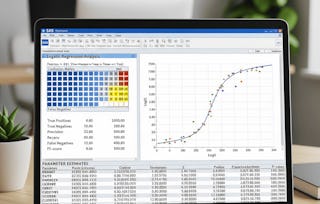
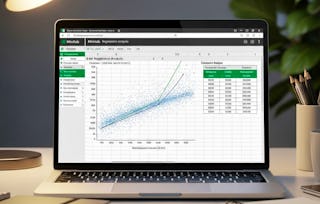
This beginner-friendly course provides a comprehensive introduction to logistic regression, one of the most widely used techniques in data science and analytics. Learners will explain regression fundamentals, differentiate probability prediction methods, and analyze logistic regression key concepts including logit transformation, odds interpretation, and Maximum Likelihood Estimation (MLE).
The course progresses from foundational regression principles to practical applications of logistic regression, covering approaches such as binning, continuous, and dummy variable transformations. Learners will also apply SAS methodologies for variable selection, use PROC LOGISTIC, and evaluate model performance with concordant/discordant pairs, chi-square tests, and global vs local goodness-of-fit measures.
By the end of the course, participants will be able to design stable predictive models, interpret results with confidence, and evaluate logistic regression models for real-world decision-making in analytics and business intelligence.
This module introduces learners to the fundamentals of regression and lays the groundwork for understanding logistic regression. Beginning with an overview of regression analysis, the module explores how dependent and independent variables interact, the role of coefficients, and the importance of error terms in modeling. Learners will examine practical applications of regression in real-world problem-solving and policymaking. The module then transitions into different probability prediction methods, highlighting when and why logistic regression is more appropriate than ordinary least squares (OLS). By the end, learners will have a solid conceptual foundation for applying logistic regression to binary outcomes in analytics and decision-making contexts.
Inclus
8 vidéos3 devoirs
Afficher les informations sur le contenu du module
8 vidéos•Total 48 minutes
Introduction•2 minutes
What is Regression Part 1•7 minutes
What is Regression Part 2•8 minutes
What is Regression Part 3•11 minutes
Different Methods of Predicting Probabilities Part 1•3 minutes
Different Methods of Predicting Probabilities Part 2•9 minutes
What is Logistic Regression•4 minutes
Why Logistic Regression and Not OLS•3 minutes
3 devoirs•Total 50 minutes
Understanding Regression Basics_•10 minutes
Probability and Logistic Regression Introduction•10 minutes
Foundations of Regression Analysis –•30 minutes
Logistic Regression in Practice
Module 2•2 heures à terminer
Détails du module
This module deepens the learner’s understanding of logistic regression by focusing on key modeling concepts, practical approaches, and industry-standard methodologies. Learners will explore foundational ideas such as observation periods, validation samples, and outlier treatment before moving into logistic regression’s core principles, including the logit transformation, odds-to-probability conversion, and the importance of Maximum Likelihood Estimation (MLE). The module introduces practical approaches such as the Binning, Continuous, and Dummy Variable methods to improve model stability. Learners will then engage with SAS-based methodologies for variable selection, PROC LOGISTIC procedures, and evaluation techniques such as concordant/discordant pairs and global vs local measures of model fit. By the end of this module, learners will have the applied knowledge to build, evaluate, and refine logistic regression models in real-world data science and analytics contexts.
Inclus
7 vidéos3 devoirs
Afficher les informations sur le contenu du module
Welcome to EDUCBA, a place where knowledge is limitless! We provide a wide selection of instructive and engaging programmes designed to empower students of all ages and experiences. From the convenience of your home, start a revolutionary educational experience with our cutting-edge technologies courses and experienced instructors.
Pour quelles raisons les étudiants sur Coursera nous choisissent-ils pour leur carrière ?
Felipe M.
Étudiant(e) depuis 2018
’Pouvoir suivre des cours à mon rythme à été une expérience extraordinaire. Je peux apprendre chaque fois que mon emploi du temps me le permet et en fonction de mon humeur.’
Jennifer J.
Étudiant(e) depuis 2020
’J'ai directement appliqué les concepts et les compétences que j'ai appris de mes cours à un nouveau projet passionnant au travail.’
Larry W.
Étudiant(e) depuis 2021
’Lorsque j'ai besoin de cours sur des sujets que mon université ne propose pas, Coursera est l'un des meilleurs endroits où se rendre.’
Chaitanya A.
’Apprendre, ce n'est pas seulement s'améliorer dans son travail : c'est bien plus que cela. Coursera me permet d'apprendre sans limites.’
When will I have access to the lectures and assignments?
To access the course materials, assignments and to earn a Certificate, you will need to purchase the Certificate experience when you enroll in a course. You can try a Free Trial instead, or apply for Financial Aid. The course may offer 'Full Course, No Certificate' instead. This option lets you see all course materials, submit required assessments, and get a final grade. This also means that you will not be able to purchase a Certificate experience.
What will I get if I purchase the Certificate?
When you purchase a Certificate you get access to all course materials, including graded assignments. Upon completing the course, your electronic Certificate will be added to your Accomplishments page - from there, you can print your Certificate or add it to your LinkedIn profile.
Is financial aid available?
Yes. In select learning programs, you can apply for financial aid or a scholarship if you can’t afford the enrollment fee. If fin aid or scholarship is available for your learning program selection, you’ll find a link to apply on the description page.