Master advanced Bayesian inference techniques and their practical applications in data science. This course will equip you with cutting-edge methods, including variational inference, Bayesian decision theory, and non-parametric approaches. You'll learn to quantify uncertainty in predictions, make principled decisions using loss functions, and implement flexible models that adapt complexity to data. Through hands-on projects using PyMC3 and real-world case studies, you'll develop expertise in the complete Bayesian workflow: from model specification to validation. The course emphasizes scalable alternatives to MCMC, including variational inference for large datasets, and covers advanced topics such as Dirichlet processes and Gaussian process regression.

Advanced Bayesian Methods and Applications

Advanced Bayesian Methods and Applications
This course is part of Applied Bayesian Data Analysis Specialization

Instructor: Konstantinos Pelechrinis
Included with
Recommended experience
What you'll learn
Apply variational inference and non-parametric Bayesian methods to scale probabilistic models to large datasets effectively.
Implement Bayesian decision theory with loss functions to make principled predictions and quantify uncertainty in real applications.
Build and evaluate complex Bayesian models using PyMC3 following best practices from the complete Bayesian workflow.
Deploy advanced techniques including Gaussian processes and Dirichlet processes for flexible modeling in diverse domains.
Skills you'll gain
- Statistical Programming
- Markov Model
- Predictive Analytics
- Bayesian Statistics
- Health Informatics
- Statistical Analysis
- Data Science
- Regression Analysis
- Data-Driven Decision-Making
- Computational Thinking
- Probability Distribution
- Predictive Modeling
- Statistical Machine Learning
- Statistical Inference
- Statistical Methods
- Applied Machine Learning
- Machine Learning
- Statistical Modeling
- Machine Learning Algorithms
Tools you'll learn
Details to know

Add to your LinkedIn profile
May 2026
91%
See how employees at top companies are mastering in-demand skills

Build your subject-matter expertise
- Learn new concepts from industry experts
- Gain a foundational understanding of a subject or tool
- Develop job-relevant skills with hands-on projects
- Earn a shareable career certificate

There are 6 modules in this course
Earn a career certificate
Add this credential to your LinkedIn profile, resume, or CV. Share it on social media and in your performance review.
Instructor
Offered by


Explore more from Probability and Statistics
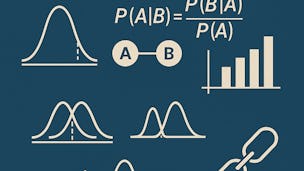
University of Pittsburgh
University of Pittsburgh
Why people choose Coursera for their career

Felipe M.

Jennifer J.

Larry W.

Chaitanya A.
Advance your career with an online degree
Earn a degree from world-class universities - 100% online




¹ Some assignments in this course are AI-graded. For these assignments, your data will be used in accordance with Coursera's Privacy Notice.