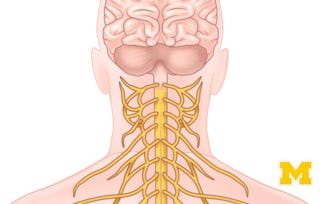
Anatomy of the Head and Spine is the part of a series of courses from Yale covering the anatomy of the entire body as well as the fundamentals of diagnostic imaging. It provides an in-depth exploration of the anatomical structures of the head and spine through a combination of theoretical instruction and virtual laboratory dissections.
Led by Professors Charles Duncan and Bill Stewart, the course begins with foundational knowledge of the spine, spinal cord, and vertebral regions, including their structural features, curvatures, and blood supply.
Subsequent modules focus on the skull, cranial nerves, brain, and associated structures, emphasizing detailed dissections of the cranial vault, facial nerve, and base of the brain. Students will analyze the brain’s lobes, vasculature, and cerebrospinal fluid pathways, as well as the relationships among cranial nerves, dural folds, and venous sinuses.
The course concludes with an examination of the skull base, nasal and paranasal structures, oral and pharyngeal cavities, and the upper airway, providing a comprehensive understanding of head and spine anatomy essential for advanced medical studies and clinical application.
This course teaches the anatomical structures found within the head and spine
What's included
1 video3 readings
Show info about module content
1 video•Total 3 minutes
A Message From Your Instructors•3 minutes
3 readings•Total 30 minutes
Instructor's Note•10 minutes
About the Course•10 minutes
Graphic Content Warning•10 minutes
Spine
Module 2•2 hours to complete
Module details
An introduction to spine and spinal cord.
What's included
11 videos2 readings1 assignment1 plugin
Show info about module content
11 videos•Total 85 minutes
The Spine Part 1•11 minutes
The Spine Part 2•8 minutes
Spinal Cord Part 1•12 minutes
Spinal Cord Part 2•8 minutes
Spinal Column Part 1•8 minutes
Spinal Column Part 2•11 minutes
Expose Spine•3 minutes
Dorsal Brain and Spinal Cord•9 minutes
Expose Ventral Spinal Cord•3 minutes
Ventral Spinal Cord•9 minutes
Removed Spinal Cord•4 minutes
2 readings•Total 20 minutes
Spine Introductory Discussion•10 minutes
Spine Lab Guide•10 minutes
1 assignment•Total 30 minutes
Spine•30 minutes
1 plugin•Total 15 minutes
Digital Practical Exam: Spine•15 minutes
Skull, Face, and Cranium
Module 3•2 hours to complete
Module details
In this module the skull, fetal skull, parotid gland, facial nerve (VII) and brain removal with encountered structures are taught. This volume includes facial nerve (VII) dissection through the parotid gland. Emphasis is made of the cranial nerves encountered in order along skull base from olfactory (I) to hypoglossal (XII) in the course of brain removal.
What's included
8 videos2 readings1 assignment1 plugin
Show info about module content
8 videos•Total 61 minutes
The Head Part 1•9 minutes
The Head Part 2•8 minutes
The Head Part 3•12 minutes
Examination of the Skull•8 minutes
Disarticulated Skull•6 minutes
Fetal Skull•3 minutes
Parotid Gland and Facial Nerve•5 minutes
Brain Removal•9 minutes
2 readings•Total 20 minutes
Head Introductory Discussion Guide•10 minutes
Skull, Face and Cranium Lab Guide•10 minutes
1 assignment•Total 30 minutes
Skull, Face, and Cranium Multiple Choice Quiz•30 minutes
1 plugin•Total 15 minutes
Digital Practical Exam: Skull, Face, and Cranium•15 minutes
The Brain
Module 4•3 hours to complete
Module details
In this lab the structures of the brain are taught. Included in this guide is detailed description of base of brain along with its vascularity, lateral view of the hemispheres and posterior fossa structures and a midline dissection of brain describing the midline hemispheres, diencephalon and venous sinuses.
What's included
10 videos3 readings1 assignment1 plugin
Show info about module content
10 videos•Total 89 minutes
Introduction to the Brain Part 1: Exterior Brain•10 minutes
Introduction to the Brain Part 2: Internal Features•16 minutes
Brainstem Part 1•8 minutes
Brainstem Part 2•16 minutes
Brainstem Part 3: Primary Motor Pathways•5 minutes
Brainstem Part 4: Upper and Lower Motor Neurons•7 minutes
In this lab structures of the skull base, cavernous sinus are taught. The trigeminal nerve branches in the middle fossa are included with the structures of cavernous sinus. The orbit and its contents are presented from superior and inferior perspectives. In situ base of the brain is taught from a complex dissection of skull base.
What's included
17 videos2 readings1 assignment1 plugin
Show info about module content
17 videos•Total 88 minutes
Cranial Nerve Part 1: Olfactory and Optic Nerves•4 minutes
Cranial Nerve Part 2: Optic Nerve (CN 3)•4 minutes
Cranial Nerve Part 3: Optic Nerve (Cont.)•7 minutes
Cranial Nerve Part 4: Eye Movements and Pupillary Response•7 minutes
Cranial Nerve Part 5: Trigeminal Nerve (CN 5)•3 minutes
Cranial Nerve Part 6: Facial Nerve (CN 7)•7 minutes
Cranial Nerve Part 7: Auditory (Vestibulocochlear) Nerve (CN 8)•6 minutes
Cranial Nerve Part 8: Glossopharyngeal (CN 9) and Vagus Nerve (CN 10)•7 minutes
Cranial Nerve Part 9: The Accessory Nerve (CN 11)•3 minutes
Cranial Nerve Part 10: The Hypoglossal Nerve (CN 12)•8 minutes
Digital Practical Exam: Skull Base, Cavernous Sinus •15 minutes
Midline Head
Module 6•7 hours to complete
Module details
In this lab the head is taught. The approach is from a midline sagittal plane dissection of these structures. Skull base, nasal sinuses, nasopharynx, oral cavity, oropharynx and upper airway are emphasized.
What's included
4 videos1 reading2 assignments1 plugin
Show info about module content
4 videos•Total 16 minutes
Midline Head and Neck I•4 minutes
Midline Head and Neck II•3 minutes
Midline Head and Neck III•7 minutes
Upper Airway, by William H. Rosenblatt•2 minutes
1 reading•Total 10 minutes
Midline Head and Neck Lab Guide•10 minutes
2 assignments•Total 360 minutes
Midline Head Multiple Choice Quiz•180 minutes
Final Exam•180 minutes
1 plugin•Total 15 minutes
Digital Practical Exam: Midline Head•15 minutes
Instructors
Instructor ratings
Instructor ratings
We asked all learners to give feedback on our instructors based on the quality of their teaching style.
For more than 300 years, Yale University has inspired the minds that inspire the world. Based in New Haven, Connecticut, Yale brings people and ideas together for positive impact around the globe. A research university that focuses on students and encourages learning as an essential way of life, Yale is a place for connection, creativity, and innovation among cultures and across disciplines.
When will I have access to the lectures and assignments?
To access the course materials, assignments and to earn a Certificate, you will need to purchase the Certificate experience when you enroll in a course. You can try a Free Trial instead, or apply for Financial Aid. The course may offer 'Full Course, No Certificate' instead. This option lets you see all course materials, submit required assessments, and get a final grade. This also means that you will not be able to purchase a Certificate experience.
What will I get if I subscribe to this Specialization?
When you enroll in the course, you get access to all of the courses in the Specialization, and you earn a certificate when you complete the work. Your electronic Certificate will be added to your Accomplishments page - from there, you can print your Certificate or add it to your LinkedIn profile.
Is financial aid available?
Yes. In select learning programs, you can apply for financial aid or a scholarship if you can’t afford the enrollment fee. If fin aid or scholarship is available for your learning program selection, you’ll find a link to apply on the description page.