Coursera

  • Arts and HumanitiesChevron Right
  • BusinessChevron Right
  • Computer ScienceChevron Right
  • Data ScienceChevron Right
  • Information TechnologyChevron Right
  • Life SciencesChevron Right
  • Math and LogicChevron Right
  • Personal Development
  • Physical Science and EngineeringChevron Right
  • Social SciencesChevron Right
  • Language LearningChevron Right
  • Degrees and CertificatesChevron Right

  • Explore all of Coursera
Loupe Copy
  • Browse
  • Search
  • For Enterprise
  • Log In
  • Sign Up
  • Explore
  • For Enterprise
  • Sign Up
  • Log In
Coursera

Exploring Beethoven’s Piano Sonatas

OverviewSyllabusFAQsCreatorsRatings and Reviews
HomeArts and HumanitiesMusic and Art

Exploring Beethoven’s Piano Sonatas

Curtis Institute of Music

About this course: Our relationship to Beethoven is a deep and paradoxical one. For many musicians, he represents a kind of holy grail: His music has an intensity, rigor, and profundity which keep us in its thrall, and it is perhaps unequalled in the interpretive, technical, and even spiritual challenges it poses to performers. At the same time, Beethoven’s music is casually familiar to millions of people who do not attend concerts or consider themselves musically inclined. Two hundred years after his death, he is everywhere in the culture, yet still represents its summit. This course takes an inside-out look at the 32 piano sonatas from the point of view of a performer. Each lecture will focus on one sonata and an aspect of Beethoven’s music exemplified by it. (These might include: the relationship between Beethoven the pianist and Beethoven the composer; the critical role improvisation plays in his highly structured music; his mixing of extremely refined music with rougher elements; and the often surprising ways in which the events of his life influenced his compositional process and the character of the music he was writing.) The course will feature some analysis and historical background, but its perspective is that of a player, not a musicologist. Its main aim is to explore and demystify the work of the performer, even while embracing the eternal mystery of Beethoven’s music itself. This season's Curtis courses are sponsored by Linda Richardson in loving memory of her husband, Dr. Paul Richardson. The Dolfinger-McMahon Foundation supports Curtis's lifelong learning initiatives.


Created by:  Curtis Institute of Music
Curtis Institute of Music
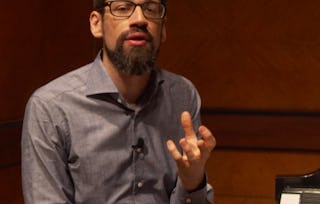
  • Taught by:  Jonathan Biss, Neubauer Family Chair in Piano Studies

    Performance Faculty
Commitment8 hours videos and quizzes
Language
English
How To PassPass all graded assignments to complete the course.
User Ratings
4.8 stars
Average User Rating 4.8See what learners said
Syllabus
WEEK 1
Welcome to Class!
We’re happy that you’ve joined us! The items you see here will enable you to get the most out of this course. Please note that many of the items have been updated to reflect the addition of Jonathan’s newest lectures.
4 readings
  1. Reading: Notes from the Instructor
  2. Reading: Syllabus
  3. Reading: Join the Curtis Online Forum
  4. Reading: Getting to Know You
WEEK 2
How Things Were
To examine the relationship Beethoven had with the piano sonata, we begin by looking at its origins. In this lecture, we will discuss the role of music generally, and of the sonata specifically, in the time of Haydn and Mozart. This lecture will also provide an introduction to the form of the sonata—to the psychological effect sonata structure has on the listener. This background will be necessary to appreciate the innovations Beethoven introduces.
6 videos, 3 readings, 1 practice quiz
  1. Reading: Lesson Notes and Resources (How Things Were)
  2. Video: Music in the Time of Bach
  3. Video: Music in the Time of Haydn and Mozart
  4. Video: Enter Beethoven
  5. Video: Sonata Form in Theory
  6. Video: Sonata Form in Practice
  7. Video: …and the Form of the Sonata
  8. Reading: Lecture Corrections
  9. Practice Quiz: How Things Were
  10. Reading: Mr. Biss Asks...
WEEK 3
The First Thirteen
Beethoven’s work has traditionally been divided into three or four periods. This is problematic, for various reasons, but the first 13 of the 32 sonatas do, in a sense, form a unit. This lecture will focus on Sonata No. 4, Op. 7, which is the largest and altogether one of the most impressive of the early works. Topics will include Beethoven’s use of the piano and the use of the sonata as a “vehicle” for the pianist, the ways in which this and other early sonatas conform to the model established by Haydn and Mozart and the ways in which they do not, and the foreshadowing of the fixations of the later years, while holding, at least on the surface, to the conventions of the time. Topics will include Beethoven’s use of the piano, and the use of the sonata as a “vehicle” for the pianist, the ways in which this and other early sonatas conform to the model established by Haydn and Mozart and the ways in which they do not, and the foreshadowing of the fixations of the later years, while holding, at least on the surface, to the conventions of the time.
4 videos, 3 readings, 1 practice quiz
  1. Reading: Lesson Notes and Resources (The First Thirteen)
  2. Video: Beethoven’s Early Style
  3. Video: Expanding the Scope of the Sonata: Op. 7, 1st Movement
  4. Video: Early Experiments in Metaphysics: Op. 7, 2nd Movement
  5. Video: Respecting and Disrespecting Tradition: Op. 7, 3rd and 4th Movements
  6. Practice Quiz: The First Thirteen
  7. Reading: Mr. Biss Asks...
  8. Reading: Sonata from "The First Thirteen"
WEEK 4
New Paths
Beethoven’s conception of the sonata was perpetually in flux, but the year 1801 is a particularly experimental one. The four sonatas Op. 26 through 28 (Nos. 14 through 17, chronologically) feature the most concrete innovations among the sonatas written up to that point, and are the focus of this lecture. There will be discussion of the relationship between the movements in a classical sonata, and the radical shift it begins to undergo at this point. We will also examine the ways in which these sonatas were influential to future generations of composers, which the earlier works, great as they are, were not. As a special feature for this lecture, a recording by a current Curtis student of the first movement of Op. 28 will be available on Curtis Performs.
5 videos, 4 readings, 1 practice quiz
  1. Reading: Lesson Notes and Resources (New Paths)
  2. Video: Moving Beyond the Early Period
  3. Video: Re-shaping the Sonata: Op. 26
  4. Video: Blurring the Lines Between Fantasy and Sonata: Op. 27, No. 1
  5. Video: Psychological Extremity in Music: Op. 27, No.2
  6. Video: Subtlety and Innovation: Op. 28
  7. Reading: Lecture Correction
  8. Practice Quiz: New Paths
  9. Reading: Mr. Biss Asks...
  10. Reading: Sonatas from "New Paths"
WEEK 5
Crisis
From 1793 until 1809, Beethoven composed at a steady pace. But for the next several years, he stalled dramatically, as he dealt with the onset of his deafness, severely trying personal circumstances, and the struggle to find what would become his late style, which to a remarkable degree involved the total reinvention of his musical language. This lecture examines the intersection of these three issues, and of his life and music more generally. Works discussed come from this comparatively fallow period and will include the Fantasy, Op. 77, which exemplifies the vital role improvisation played in all of Beethoven’s music, and the Sonatas Op. 78, and 81a, the “Lebewohl.” The last of these is one of Beethoven’s only serious experiments with program music, which made it an important reference point for many 19th-century composers. Another topic will be the ways in which the works of this period seem to manipulate time, which was always one of Beethoven’s key fascinations, and becomes ever more critical moving into the late period.
5 videos, 4 readings, 1 practice quiz
  1. Reading: Lesson Notes and Resources (Crisis)
  2. Video: Beethoven’s Mediant Fixation Begins: Op. 31, No. 1
  3. Video: Deafness, Personal Problems, and Searching for a New Way
  4. Video: Beethoven as Improviser: Fantasy, Op. 77
  5. Video: Serenity and Slapstick: Op. 78
  6. Video: Formal Experimentation and Musical Storytelling: Op. 81a
  7. Reading: Lecture Correction
  8. Practice Quiz: Crisis
  9. Reading: Mr. Biss Asks...
  10. Reading: Sonatas from "Crisis"
WEEK 6
Towards Infinity
For this lecture, the focus will be on the Sonata Op. 109, the first of the final three, in which Beethoven’s decades-long grappling with the form comes to its astonishing conclusion. We will also look back at the early period—the Sonata Op. 10, No. 1 (the seventh he wrote) in particular—for the purposes of “zooming out,” and examining the evolution that took place in the interim: an evolution not just of form, but of style, of musical language, of Beethoven’s conception of the role of music. This lecture will also include a discussion of Beethoven’s legacy—specifically, of the way in which his music came to represent simultaneously the highest possible aspiration and the most insurmountable problem for generations of composers who followed him.
4 videos, 3 readings, 1 practice quiz
  1. Reading: Lesson Notes and Resources (Towards Infinity)
  2. Video: Beethoven’s Late Style(s)
  3. Video: Circling Back and Moving Forward: Comparing the First Movements Op. 10, No. 1, and Op. 109
  4. Video: Variations as Psychology: Op. 109’s Finale
  5. Video: Coda: The Sonata after Beethoven
  6. Practice Quiz: Towards Infinity
  7. Reading: Mr. Biss Asks...
  8. Reading: Sonata from "Towards Infinity"
WEEK 7
Op. 2, No. 1, and Op. 10, No. 2
This lecture delves into two of the early sonatas: the F minor, Op. 2, No. 1 (the first of the 32), and the F Major, Op. 10, No. 2. Unlike “The First Thirteen” lecture, which was nominally about the Sonata Op. 7 but sought to address the early period in general, this lecture focuses on the specific characteristics that make each of these works unique; one is predominantly a dramatic piece, whereas the other is highly comic. The lecture is also about Beethoven’s complex relationship with the musical past—how he used it as an inspiration even as he tried to leave it behind.
13 videos, 2 readings, 2 practice quizzes
  1. Reading: Lesson Notes and Resources (Op. 2, No. 1, and Op. 10, No. 2)
  2. Video: Re-introduction
  3. Video: Beethoven at 24: Style and Priorities
  4. Video: Op. 2, No. 1: Wrestling with the Past
  5. Video: Op. 2, No. 1: 1st Mvt.: Mining his Materials
  6. Video: Op. 2, No. 1: 1st Mvt.: Sonata Form in the Minor Mode
  7. Video: Op. 2, No. 1: 2nd Mvt.: Borrowing from Haydn, and Himself
  8. Video: Op. 2, No. 1: 3rd Mvt.: Adding Ambiguity to an Old Form
  9. Video: Op. 2, No. 1: 4th mvt.: Releasing the Shackles
  10. Practice Quiz: Op. 2, No. 1
  11. Video: Op. 10, No. 2: Beethoven’s Humor!
  12. Video: 1st Mvt.: Subverting Expectations
  13. Video: 1st Mvt.: Beethoven as Stubborn Child
  14. Video: 2nd Mvt.: The Menuet/Slow Movement Hybrid
  15. Video: 3rd Mvt.: The Non-fugue
  16. Practice Quiz: Op. 10, No. 2
  17. Reading: Mr. Biss Asks...
WEEK 8
Op. 57: The "Appassionata"
The topic of this lecture is the Sonata Op. 57, commonly known as the "Appassionata"—one of Beethoven’s most iconic works. The sonata’s unusual (for Beethoven) and unrelenting emotional trajectory is a major topic, as is his use of a surprising chord as a sort of "idée fixe," helping to unify the work and drive home its extraordinary character. Another critical topic is the way in which the "Appassionata" exemplifies Beethoven’s unsurpassed resourcefulness—how he can use the slightest of materials to create a vast canvas.
7 videos, 2 readings, 1 practice quiz
  1. Reading: Lesson Notes and Resources (Op. 57)
  2. Video: Beethoven and the Tragic Mode
  3. Video: 1st Mvt.: Musical Economy as Noose-tightening
  4. Video: 1st Mvt.: Musical Economy and Beethoven's Resourcefulness
  5. Video: 1st Mvt.: Unprecedented Intensity, and Delayed Resolution
  6. Video: 2nd Mvt.: A Fragile Serenity
  7. Video: 3rd Mvt.: Relentless Intensity, On a Leash
  8. Video: 3rd Mvt.: …and Unleashed
  9. Practice Quiz: Op. 57
  10. Reading: Mr. Biss Asks...
WEEK 9
Op. 101
This lecture explores the Sonata Op. 101, commonly thought to be the first sonata that belongs to the late period. Major topics include the first movement’s unusual harmonic instability, and the way in which this becomes a source of the music’s character; the way in which the sonata’s scope expands as it goes along, which helps clarify its status as a late period work, and the sonata’s great influence on later composers, Schumann and Mendelssohn in particular.
8 videos, 2 readings, 1 practice quiz
  1. Reading: Lesson Notes and Resources (Op. 101)
  2. Video: Towards a Late Style
  3. Video: 1st Mvt.: Beginning in Mid-thought
  4. Video: 1st Mvt.: Harmonic Instability as a Source of Character
  5. Video: 2nd Mvt.: March!
  6. Video: 2nd Mvt.: Painting in Primary and Secondary Colors
  7. Video: 3rd Mvt.: Creating a Cyclical Form
  8. Video: 3rd Mvt.: Delayed Resolution, Delayed Gratification...
  9. Video: 3rd Mvt.: ...and Ultimate Triumph
  10. Practice Quiz: Op. 101
  11. Reading: Mr. Biss Asks...
WEEK 10
Learning Library
The Learning Library contains supplementary resources to help you during and after this course: lesson notes, suggested readings, and links to streaming audio files for most of the sonatas explored in the course.
3 readings
  1. Reading: Lesson Notes and Resources
  2. Reading: Suggested Readings
  3. Reading: Listen to Sonatas (All)
WEEK 11
Feedback, Please
Please share your experience by taking a few minutes to complete a feedback survey.
1 reading
  1. Reading: Feedback
WEEK 12
Announcements and Events
Check back here for news and events!
6 readings
  1. Reading: Upcoming meet-ups in your area
  2. Reading: New Lectures!
  3. Reading: October 13, 2015 Update--IMPORTANT: Improvement to course structure
  4. Reading: Concert on February 20, 2015 at Rice University in Houston, Texas
  5. Reading: New recording by Jonathan Biss released January 27, 2015
  6. Reading: Beethoven Piano Sonatas Volume 5 is now available!

FAQs
How It Works
Coursework
Coursework

Each course is like an interactive textbook, featuring pre-recorded videos, quizzes and projects.

Help from Your Peers

Connect with thousands of other learners and debate ideas, discuss course material, and get help mastering concepts.

Creators
Curtis Institute of Music
The Curtis Institute of Music educates and trains exceptionally gifted young musicians for careers as performing artists on the highest professional level. Innovative programs encourage students to invent 21st-century musical careers through unique "learn by doing" opportunities and over 150 performances per year in Philadelphia and around the globe. One of the world’s leading conservatories, Curtis provides its 165 students with personalized attention from a celebrated faculty and has produced an impressive number of notable artists since its founding in 1924.
Ratings and Reviews
Rated 4.8 out of 5 of 481 ratings

AF

This course presents a totally interesting view of the Beethoven Sonatas, zeroing in on a few of them since an exhaustive view would take so many more hours to present. Jonathan Biss is a wonderful pianist and lecturer and the course is fascinating. It has helped me tremendously in both my enjoyment of the importance and variety of the sonatas and in re-evaluating my own performances. Thank you so much for this insight, Jonathan Biss - it is invaluable.

Luciano Andrade de Castro

Oh Prof Biss, you're such a great pianist ! Really gifted ! Congratulations!

I'll search some of your recordings.

Very good course. Thanks for the opportunity !

From below the Equator,

Luciano

Graeme Herrington

Outstanding course. Not sure why I haven't (allegedly) finished this since there was nothing due or not finished - however, no great consequence.

HW

This is a fabulous course with insight to Beethoven's sonatas. I've been playing piano for 27 years, and I am learning so much from this course! It was a very enjoyable learning experience. I would recommend this course to everyone.


You May Also Like
Berklee College of Music
Musicianship: Tensions, Harmonic Function, and Modal Interchange
1 course
Berklee College of Music
Musicianship: Tensions, Harmonic Function, and Modal Interchange
View course
Berklee College of Music
Musicianship: Chord Charts, Diatonic Chords, and Minor Keys
1 course
Berklee College of Music
Musicianship: Chord Charts, Diatonic Chords, and Minor Keys
View course
Berklee College of Music
The Art of Music Production
1 course
Berklee College of Music
The Art of Music Production
View course
University of Rochester
The Blues: Understanding and Performing an American Art Form
1 course
University of Rochester
The Blues: Understanding and Performing an American Art Form
View course
Berklee College of Music
The Technology of Music Production
1 course
Berklee College of Music
The Technology of Music Production
View course
Coursera
Coursera provides universal access to the world’s best education, partnering with top universities and organizations to offer courses online.
© 2018 Coursera Inc. All rights reserved.
Download on the App StoreGet it on Google Play
  • Coursera
  • About
  • Leadership
  • Careers
  • Catalog
  • Certificates
  • Degrees
  • For Business
  • For Government
  • Community
  • Partners
  • Mentors
  • Translators
  • Developers
  • Beta Testers
  • Connect
  • Blog
  • Facebook
  • LinkedIn
  • Twitter
  • Google+
  • Tech Blog
  • More
  • Terms
  • Privacy
  • Help
  • Accessibility
  • Press
  • Contact
  • Directory
  • Affiliates