When you enroll in this course, you'll also be enrolled in this Specialization.
Learn new concepts from industry experts
Gain a foundational understanding of a subject or tool
Develop job-relevant skills with hands-on projects
Earn a shareable career certificate
There are 5 modules in this course
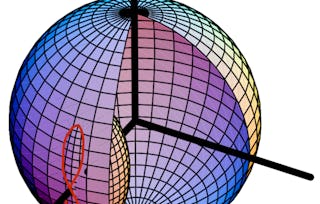
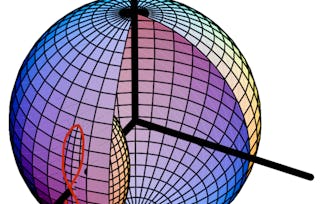
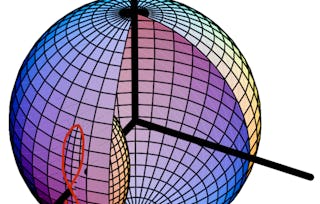
The goal of this capstone spacecraft dynamics project is to employ the skills developed in the rigid body Kinematics, Kinetics and Control courses. An exciting two-spacecraft mission to Mars is considered where a primary mother craft is in communication with a daughter vehicle in another orbit. The challenges include determining the kinematics of the orbit frame and several desired reference frames, numerically simulating the attitude dynamics of the spacecraft in orbit, and implementing a feedback control that then drives different spacecraft body frames to a range of mission modes including sun pointing for power generation, nadir pointing for science gathering, mother spacecraft pointing for communication and data transfer. Finally, an integrated mission simulation is developed that implements these attitude modes and explores the resulting autonomous closed-loop performance.
Tasks 1 and 2 use three-dimensional kinematics to create the mission related orbit simulation and the associated orbit frames. The introductory step ensures the satellite is undergoing the correct motion, and that the orbit frame orientation relative to the planet is being properly evaluated.
Tasks 3 through 5 create the required attitude reference frame for the three attitude pointing modes called sun-pointing, nadir-pointing and GMO-pointing. The reference attitude frame is a critical component to ensure the feedback control drives the satellite to the desired orientation. The control employed remains the same for all three pointing modes, but the performance is different because different attitude reference frames are employed.
Tasks 6 through 7 create simulation routines to first evaluate the attitude tracking error between a body-fixed frame and a particular reference frame of the current attitude mode. Next the inertial attitude dynamics is evaluated through a numerical simulation to be able to numerically analyze the control performance.
Tasks 8-11 simulate the closed-loop attitude performance for the three attitude modes. Tasks 8 through 10 first simulate a single attitude at a time, while tasks 11 develops a comprehensive attitude mission simulation which considers the attitude modes switching autonomously as a function of the spacecraft location relative to the planet.
The material covered is taking from the book "Analytical Mechanics of Space Systems" available at https://arc.aiaa.org/doi/book/10.2514/4.105210.
The goal of this capstone spacecraft dynamics project is to employ the skills developed in the rigid body kinematics, kinetics and control courses. An exciting two-spacecraft mission to Mars is considered where a primary mother craft is in communication with a daughter vehicle in another orbit. The challenges include determining the kinematics of the orbit frame and several desired reference frames, numerically simulating the attitude dynamics of the spacecraft in orbit, and implementing a feedback control that then drives different spacecraft body frames to a range of mission modes including sun pointing for power generation, nadir pointing for science gathering, mother spacecraft pointing for communication and data transfer. Finally, an integrated mission simulation is developed that implements these attitude modes and explores the resulting autonomous closed-loop performance.
What's included
2 videos2 readings1 programming assignment
Show info about module content
2 videos•Total 4 minutes
Capstone Project Introduction•3 minutes
Mission Illustration•1 minute
2 readings•Total 46 minutes
Course Updates and Accessibility Support•1 minute
Mission Instructions•45 minutes
1 programming assignment•Total 180 minutes
Practice•180 minutes
Orbits
Module 2•6 hours to complete
Module details
Tasks 1 and 2 use three-dimensional kinematics to create the mission related orbit simulation and the associated orbit frames. The introductory step ensures the satellite is undergoing the correct motion, and that the orbit frame orientation relative to the planet is being properly evaluated.
What's included
2 assignments2 programming assignments
Show info about module content
2 assignments
Honor Code Agreement•0 minutes
2 programming assignments•Total 360 minutes
Task 1 Validation•180 minutes
Task 2 Validation•180 minutes
Reference Frame Orientation
Module 3•9 hours to complete
Module details
Tasks 3 through 5 create the required attitude reference frame for the three attitude pointing modes called sun-pointing, nadir-pointing and GMO-pointing. The reference attitude frame is a critical component to ensure the feedback control drives the satellite to the desired orientation. The control employed remains the same for all three pointing modes, but the performance is different because different attitude reference frames are employed.
What's included
3 assignments3 programming assignments
Show info about module content
3 assignments
Honor Code Agreement•0 minutes
3 programming assignments•Total 540 minutes
Task 3 Validation•180 minutes
Task 4 Validation•180 minutes
Task 5 Validation•180 minutes
Attitude Evaluation and Simulator
Module 4•7 hours to complete
Module details
Tasks 6 through 7 create simulation routines to first evaluate the attitude tracking error between a body-fixed frame and a particular reference frame of the current attitude mode. Next the inertial attitude dynamics is evaluated through a numerical simulation to be able to numerically analyze the control performance.
What's included
2 assignments2 programming assignments
Show info about module content
2 assignments
Honor Code Agreement•0 minutes
2 programming assignments•Total 420 minutes
Task 6 Validation•120 minutes
Task 7 Validation•300 minutes
Complete the Mission
Module 5•18 hours to complete
Module details
Tasks 8-11 simulate the closed-loop attitude performance for the three attitude modes. Tasks 8 through 10 first simulate a single attitude at a time, while tasks 11 develops a comprehensive attitude mission simulation which considers the attitude modes switching autonomously as a function of the spacecraft location relative to the planet. Please note that the time it will take you to complete this module and the requisite tasks has increased from prior modules.
What's included
4 videos4 assignments4 programming assignments
Show info about module content
4 videos•Total 2 minutes
Task 8 Illustration•0 minutes
Task 9 Illustration•0 minutes
Task 10 Illustration•0 minutes
Task 11 Illustration•1 minute
4 assignments
Honor Code Agreement•0 minutes
4 programming assignments•Total 1,080 minutes
Task 8 Validation•300 minutes
Task 9 Validation•240 minutes
Task 10 Validation•240 minutes
Task 11 Validation•300 minutes
Earn a career certificate
Add this credential to your LinkedIn profile, resume, or CV. Share it on social media and in your performance review.
Instructor
Instructor ratings
Instructor ratings
We asked all learners to give feedback on our instructors based on the quality of their teaching style.
CU Boulder is a dynamic community of scholars and learners on one of the most spectacular college campuses in the country. As one of 34 U.S. public institutions in the prestigious Association of American Universities (AAU), we have a proud tradition of academic excellence, with five Nobel laureates and more than 50 members of prestigious academic academies.
"To be able to take courses at my own pace and rhythm has been an amazing experience. I can learn whenever it fits my schedule and mood."
Jennifer J.
Learner since 2020
"I directly applied the concepts and skills I learned from my courses to an exciting new project at work."
Larry W.
Learner since 2021
"When I need courses on topics that my university doesn't offer, Coursera is one of the best places to go."
Chaitanya A.
"Learning isn't just about being better at your job: it's so much more than that. Coursera allows me to learn without limits."
Learner reviews
4.6
51 reviews
5 stars
76.47%
4 stars
15.68%
3 stars
3.92%
2 stars
0%
1 star
3.92%
Showing 3 of 51
D
DM
4·
Reviewed on Jun 1, 2021
Excellent, comprehensive review of the course - kinetics, kinematics, and control but I removed a star due to the tight tolerances in the answers. I was off by exactly 0.001 and it was marked wrong.
A
AA
5·
Reviewed on Apr 17, 2022
Great application of the knowledge obtained through the course
When will I have access to the lectures and assignments?
To access the course materials, assignments and to earn a Certificate, you will need to purchase the Certificate experience when you enroll in a course. You can try a Free Trial instead, or apply for Financial Aid. The course may offer 'Full Course, No Certificate' instead. This option lets you see all course materials, submit required assessments, and get a final grade. This also means that you will not be able to purchase a Certificate experience.
What will I get if I subscribe to this Specialization?
When you enroll in the course, you get access to all of the courses in the Specialization, and you earn a certificate when you complete the work. Your electronic Certificate will be added to your Accomplishments page - from there, you can print your Certificate or add it to your LinkedIn profile.
Is financial aid available?
Yes. In select learning programs, you can apply for financial aid or a scholarship if you can’t afford the enrollment fee. If fin aid or scholarship is available for your learning program selection, you’ll find a link to apply on the description page.