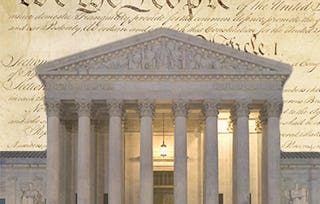
Chemerinsky on Constitutional Law: Individual Rights and Liberties will highlight the construction and interpretation of the U.S. Constitution through the centuries with an emphasis on protections of individual liberties and the evolution of equal protection. You'll learn the history behind the Constitution, cases that formed important precedent, and how changes in interpretation have been dependent on shifts in cultural and political climate as well as the composition of the Supreme Court.
In this course we will investigate the protection of individual rights and liberties and take a look at what rights are and are not protected and investigate several important shifts in jurisprudence. We'll begin by examining the structure of the Constitution's protection of individual rights. We'll then examine the circumstances under which, various rights and liberties can be regulated by the federal, state, and local government. We'll examine when the government can permissibly treat people unequally and when it can't. In our final two lectures, we'll take a close look at what is probably the most famous amendment to the Constitution, the First Amendment.
Join me as we look at the questions both raised and answered by the Constitution and those that interpret it!
By the end of this course, you should be able to:
- Describe the individual liberties protected by the Constitution and account for the history and structure of their protection
- Illustrate compromises found in the Constitution by citing examples and historic background
- Articulate the importance of key cases such as Brown v. Board, Lemon v. Kurtzman, and Lochner v. New York
- Explain how the outcome of cases is often dependent upon the current cultural and political climate as well as the composition of the court by citing particular cases and important shifts in the court's jurisprudence
- Assess the relative suitability of various approaches to constitutional interpretation and analysis
What's included
1 video3 readings
Show info about module content
1 video•Total 3 minutes
Course Introduction•3 minutes
3 readings•Total 70 minutes
Welcome Message•10 minutes
Course Overview•20 minutes
The Constitution of the United States of America•40 minutes
Lecture 6 (in the series) - The Structure of the Constitution's Protection of Individual Liberties
Module 2•2 hours to complete
Module details
How are individual rights protected? In this module we’ll take a look at three of the structures that protect our individual liberties: the state action doctrine, the application of the bill of rights to the states, and the levels of scrutiny principle.
What's included
3 videos1 reading1 assignment
Show info about module content
3 videos•Total 38 minutes
The State Action Doctrine•15 minutes
The State Action Doctrine & Bill of Rights•15 minutes
The Levels of Scrutiny•7 minutes
1 reading•Total 30 minutes
Recommended Reading•30 minutes
1 assignment•Total 30 minutes
Quiz 1: The Structure of the Constitution's Protection of Individual Liberties•30 minutes
Lecture 7 (in the series) - Individual Liberties
Module 3•5 hours to complete
Module details
What rights are enumerated in the Constitution? How has the court's understanding and protection of these rights evolved? In this lecture we'll become familiar with the rights that are both specifically enumerated and implied by the text of the Constitution.
What's included
8 videos1 reading1 assignment1 peer review
Show info about module content
8 videos•Total 127 minutes
Economic Liberties - Part 1•17 minutes
Economic Liberties & Privacy - Part 1•13 minutes
Privacy - Part 2•15 minutes
Privacy - Part 3•22 minutes
Privacy - Part 4•13 minutes
The Right to Vote•17 minutes
Additional Rights•14 minutes
Substantive and Procedural Due Process•16 minutes
1 reading•Total 30 minutes
Recommended Reading•30 minutes
1 assignment•Total 30 minutes
Quiz 2: Individual Liberties•30 minutes
1 peer review•Total 120 minutes
Mini-assignment: Individual Liberties•120 minutes
Lecture 8 (in the series) - Equal Protection
Module 4•4 hours to complete
Module details
In this module we’ll examine how equal protection has been applied to different suspect classifications such as race, gender, citizenship, and more. In addition, we will consider how the court has used levels of scrutiny in order to determine when the government can permissibly discriminate based upon suspect classifications.
What's included
7 videos1 reading1 assignment1 peer review
Show info about module content
7 videos•Total 111 minutes
Equality•14 minutes
Racial Discrimination - Part 1•16 minutes
Racial Discrimination - Part 2•18 minutes
Racial Discrimination - Part 3•14 minutes
Racial Discrimination - Part 4•16 minutes
Sexual Discrimination•15 minutes
Other Forms of Discrimination•17 minutes
1 reading•Total 30 minutes
Recommended Reading•30 minutes
1 assignment•Total 30 minutes
Quiz 3: Equal Protection•30 minutes
1 peer review•Total 60 minutes
Mini-assignment: Equal Protection•60 minutes
Lecture 9 (in the series) - The First Amendment: Expression
Module 5•3 hours to complete
Module details
Why is freedom of speech protected as a fundamental right? What is its importance? In this module we’ll review four possible answers to this question. We’ll also examine the basic principles that guide the Supreme Court’s methodology when examining questions of free speech. Finally, we’ll take a look at the types of speech that have not been traditionally protected and the limitations that can be imposed on where protected forms of speech can be exercised.
What's included
4 videos1 reading1 assignment1 peer review
Show info about module content
4 videos•Total 67 minutes
Why Protect Speech & Methodology of its Protection•18 minutes
The Methodology of Free Speech Protection (continued)•17 minutes
Unprotected Speech•21 minutes
Where Can Free Speech Be Exercised?•11 minutes
1 reading•Total 30 minutes
Recommended Reading•30 minutes
1 assignment•Total 30 minutes
Quiz 4: The First Amendment: Expression•30 minutes
1 peer review•Total 60 minutes
Mini-assignment: Free speech•60 minutes
Lecture 10 (in the series) - The First Amendment: Religion
Module 6•3 hours to complete
Module details
In our final lecture module, we’ll briefly examine the Lemon Test, named after the Lemon v. Kurtzman case in which it was first articulated, to see how the court has evaluated cases regarding the Establishment Clause. We’ll also take a look at how the court decides questions regarding the Free Exercise Clause.
What's included
1 video1 reading1 assignment1 peer review
Show info about module content
1 video•Total 19 minutes
The Establishment and Free Exercise Clauses•19 minutes
1 reading•Total 30 minutes
Recommended Reading•30 minutes
1 assignment•Total 30 minutes
Quiz 5: The First Amendment: Religion•30 minutes
1 peer review•Total 120 minutes
Why the Constitution? 200 Years Later•120 minutes
Conclusion
Module 7•20 minutes to complete
Module details
As the course draws to a final close, we would like to thank you for your participation.
What's included
2 readings
Show info about module content
2 readings•Total 20 minutes
Thank you!•10 minutes
Post-Course Survey•10 minutes
Instructor
Instructor ratings
Instructor ratings
We asked all learners to give feedback on our instructors based on the quality of their teaching style.
Since 1965, the University of California, Irvine has combined the strengths of a major research university with the bounty of an incomparable Southern California location. UC Irvine’s unyielding commitment to rigorous academics, cutting-edge research, and leadership and character development makes the campus a driving force for innovation and discovery that serves our local, national and global communities in many ways.
"To be able to take courses at my own pace and rhythm has been an amazing experience. I can learn whenever it fits my schedule and mood."
Jennifer J.
Learner since 2020
"I directly applied the concepts and skills I learned from my courses to an exciting new project at work."
Larry W.
Learner since 2021
"When I need courses on topics that my university doesn't offer, Coursera is one of the best places to go."
Chaitanya A.
"Learning isn't just about being better at your job: it's so much more than that. Coursera allows me to learn without limits."
Learner reviews
4.9
85 reviews
5 stars
91.76%
4 stars
5.88%
3 stars
1.17%
2 stars
0%
1 star
1.17%
Showing 3 of 85
J
JB
5·
Reviewed on Dec 1, 2020
Erwin is an experienced professor who has a way with the law. He explains in a way that would be easy for a lay person to understand. I hope to learn with him again in the future.

P
PD
5·
Reviewed on Jun 22, 2020
This course is really awesome and give you deep insight into American Constitutional Law and I loved it.
S
SF
5·
Reviewed on Apr 9, 2020
Chermerinsky's classes were the best that I have taken. Very interactive and the fellow students really participated which made the class worth attending.
When will I have access to the lectures and assignments?
To access the course materials, assignments and to earn a Certificate, you will need to purchase the Certificate experience when you enroll in a course. You can try a Free Trial instead, or apply for Financial Aid. The course may offer 'Full Course, No Certificate' instead. This option lets you see all course materials, submit required assessments, and get a final grade. This also means that you will not be able to purchase a Certificate experience.
What will I get if I purchase the Certificate?
When you purchase a Certificate you get access to all course materials, including graded assignments. Upon completing the course, your electronic Certificate will be added to your Accomplishments page - from there, you can print your Certificate or add it to your LinkedIn profile.
Is financial aid available?
Yes. In select learning programs, you can apply for financial aid or a scholarship if you can’t afford the enrollment fee. If fin aid or scholarship is available for your learning program selection, you’ll find a link to apply on the description page.