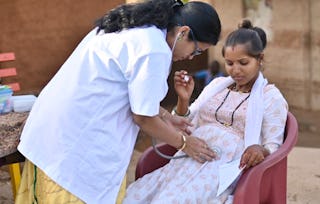
This course will review challenges for maternal and newborn health in the developing world, where a great many women and babies are suffering from complications during pregnancy, childbirth, and the days following birth. Themes covered include the epidemiology of maternal and newborn mortality and morbidity, relevant issues for the global health workforce, community-based interventions to improve maternal and newborn health and survival, and sociocultural dynamics surrounding birth.
This course provides a broad overview of maternal and newborn health issues facing low-income and transitional countries, where more than 2.6 million babies are stillborn and nearly 500,000 women die during childbirth or from pregnancy-related complications each year. In the developing world, many women deliver at home without a skilled care provider, drugs, or technological supports. Maternal and newborn survival can be improved by mobilizing communities and improving access to skilled care.
Through lectures, case studies and readings, course participants will learn about delivery challenges for maternal and newborn health services and how to utilize community-based strategies to improve the health and survival of mothers and babies.
Welcome to Module 1! This course will discuss the global health implications of pregnancy and childbirth in the developing world, where far too many women and babies die from complications during pregnancy, childbirth, and soon after childbirth. Themes covered in this module include an introduction to maternal care, an in-depth look at the numbers, and a look at maternal mortality and morbidity in a global context.
What's included
5 videos3 readings1 assignment
Show info about module content
5 videos•Total 37 minutes
Introduction•10 minutes
A Closer Look at the Numbers •6 minutes
Causes of Death •8 minutes
Signs of Progress •5 minutes
Accelerating the Global Response •8 minutes
3 readings•Total 30 minutes
Course Overview•10 minutes
About Us•10 minutes
Readings & Resources•10 minutes
1 assignment•Total 30 minutes
Introduction to Maternal Mortality and Morbidity in the Global Context•30 minutes
Introduction to Maternal Mortality and Morbidity in the U.S. Context
Module 2•2 hours to complete
Module details
In this module you’ll visit the United States where, believe it or not, maternal mortality rate is actually on the rise! In fact, maternal mortality has doubled in the U.S. during the last two decades. Why is that? And what can be done to reverse this trend? Along the way you’ll meet a physician and her patient who will help us answer some of these questions.
What's included
7 videos1 reading1 assignment
Show info about module content
7 videos•Total 65 minutes
Introduction•11 minutes
Trends and Disparities in U.S. Maternal Mortality •11 minutes
Severe Maternal Morbidity•7 minutes
Primary Prevention of Maternal Deaths •3 minutes
Interview with Diana Childers and Dr. Wendy Book •10 minutes
Secondary Prevention of Maternal Death •11 minutes
When Prevention Fails: Maternal Mortality Review •11 minutes
1 reading•Total 10 minutes
Readings & Resources•10 minutes
1 assignment•Total 30 minutes
Introduction to Maternal Mortality and Morbidity in the US •30 minutes
The Impact of the Health Care Workforce Shortage
Module 3•1 hour to complete
Module details
In this module we’ll be discussing the critical importance of having an adequate and well-trained health workforce for reducing maternal and newborn morbidity and mortality. We’ll be discussing the problems of shortage and maldistribution, as well as some important strategies for addressing these problems such as task shifting and task sharing.
The Effectiveness of Task Shifting & Task Sharing •11 minutes
Policy Issues •7 minutes
1 reading•Total 10 minutes
Readings & Resources•10 minutes
1 assignment•Total 30 minutes
The Impact of the Health Care Workforce Shortage on Maternal and Newborn Care•30 minutes
Emergency Obstetric Care & Health Facility Services
Module 4•1 hour to complete
Module details
In this module, we will learn about a globally recognized package of such interventions called emergency obstetric care, or EmOC. We will spend some time learning about how emergency obstetric care is assessed and monitored at the national and sub-national levels, including quality improvement measures. Lastly, we will consider some key challenges and potential solutions in developing country contexts.
What's included
6 videos1 reading1 assignment
Show info about module content
6 videos•Total 39 minutes
Introduction •6 minutes
EmOC Signal Functions•7 minutes
United Nations Process Indicators for Monitoring EmOC •9 minutes
EmOC Monitoring and Assessment •5 minutes
Quality Improvement in EmOC •3 minutes
Challenges to EmOC Implementation in Developing Country Contexts•8 minutes
1 reading•Total 10 minutes
Readings & Resources•10 minutes
1 assignment•Total 30 minutes
Emergency Obstetric Care: Health Facility Services that Support Maternal Health and Survival•30 minutes
Improving Maternal Care through Community-Based Interventions
Module 5•2 hours to complete
Module details
This module will take a new turn - how ordinary citizens can be mobilized to effectively take action to improve health for mothers and babies. You will learn about participatory learning and action. You will learn what research studies have to say about the effectiveness of this kind of approach. Also, you will get a chance to see specific examples of the outcomes of community mobilization in two settings, one in Atlanta, Georgia in the U.S., and one in the Caribbean country on the island of Hispaniola, the Dominican Republic.
What's included
6 videos1 reading1 assignment
Show info about module content
6 videos•Total 51 minutes
Introduction •12 minutes
Participatory Learning and Action in Practice•7 minutes
Effectiveness Research•8 minutes
Center for Black Women's Wellness •9 minutes
Dominican Republic: Community-Based Participatory Research Project •7 minutes
Essentials for Sustained Empowerment •8 minutes
1 reading•Total 10 minutes
Readings & Resources•10 minutes
1 assignment•Total 30 minutes
Improving Maternal and Newborn Care through Community-Based Interventions•30 minutes
Case Study in Ethiopia: Educating the Community and Training Front-Line Community Health Workers
Module 6•3 hours to complete
Module details
Welcome to the last module! In this module, you will receive an overview of the Maternal and Newborn Health in Ethiopia Partnership (referred to as MaNHEP). Also, you will learn about the Ethiopian context regarding maternal health; the overall goal of the MaNHEP project and its key partners and supports; where the project was situated within Ethiopia; the assumptions that serve as the basis for the project’s intervention; the project evaluation; and a summary of results. Finally, we will take a step back to examine the strengths of the project and its potential for scale-up and possible application elsewhere.
Emory University, located in Atlanta, Georgia, is one of the world's leading research universities. Its mission is to create, preserve, teach and apply knowledge in the service of humanity.
When will I have access to the lectures and assignments?
To access the course materials, assignments and to earn a Certificate, you will need to purchase the Certificate experience when you enroll in a course. You can try a Free Trial instead, or apply for Financial Aid. The course may offer 'Full Course, No Certificate' instead. This option lets you see all course materials, submit required assessments, and get a final grade. This also means that you will not be able to purchase a Certificate experience.
What will I get if I purchase the Certificate?
When you purchase a Certificate you get access to all course materials, including graded assignments. Upon completing the course, your electronic Certificate will be added to your Accomplishments page - from there, you can print your Certificate or add it to your LinkedIn profile.
Is financial aid available?
Yes. In select learning programs, you can apply for financial aid or a scholarship if you can’t afford the enrollment fee. If fin aid or scholarship is available for your learning program selection, you’ll find a link to apply on the description page.