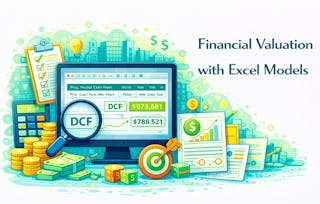
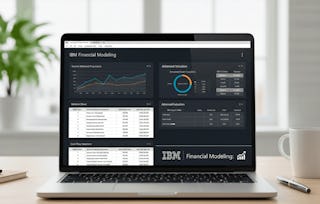
This course is a comprehensive, step-by-step learning journey into the practical construction and interpretation of financial models, designed around the real-world case of Big Books Corp. Participants will learn how to analyze historical data, calculate key financial drivers, and forecast segment-wise revenues, expenses, and cash flows. The course guides learners through constructing income statements, balance sheets, and cash flow statements, progressing into evaluating capital expenditures, depreciation schedules, and working capital cycles.
As the course advances, learners will compute valuation metrics such as Net Present Value (NPV), Free Cash Flow to the Firm (FCFF), and Free Cash Flow to Equity (FCFE), culminating in the creation of a Discounted Cash Flow (DCF) model. They will then apply relative valuation techniques, including EV/Revenue and EV/EBITDA multiples, to compare peer companies, and interpret share prices under multiple forecast scenarios.
This course not only builds technical modeling expertise using Excel, but also strengthens the learner’s ability to evaluate financial performance, interpret valuation outputs, and apply strategic thinking to real business contexts. By the end, learners will be able to confidently design, construct, and assess comprehensive valuation models used in investment banking, equity research, and corporate finance.
This module introduces learners to the business structure of Big Books Corp and lays the foundation for constructing a robust financial model. It begins by examining the company's revenue streams and segment-wise performance over time. Learners will explore how to apply growth assumptions for forecasting sales and understand the fundamental purpose and strategic significance of financial models. The module then transitions into calculating total revenue across segments and preparing for cost-based modeling. By the end of this module, learners will be equipped to evaluate historical performance, forecast future revenues, and contextualize financial modeling in real-world investment analysis.
What's included
6 videos3 assignments
Show info about module content
6 videos•Total 59 minutes
Overview of Big Books Corp•3 minutes
Segment Wise Revenue Calculations•8 minutes
Revenue Forecasting - Notebook Segment•11 minutes
Purpose of Buiding a Financial Model•13 minutes
Calculating the Total Revenue from All Segments•13 minutes
Calculating Cost of Sales•12 minutes
3 assignments•Total 50 minutes
Company and Revenue Overview•10 minutes
Financial Modeling Foundation•10 minutes
Introduction and Revenue Forecasting•30 minutes
Operating Expenses and Linkages
Module 2•2 hours to complete
Module details
This module focuses on the operational expenditure elements that influence profitability within a financial model. Learners will explore techniques to project SG&A expenses using rational, defensible assumptions and link those expenses with revenue in a structured income statement. The module also covers key asset components such as Gross PPE and capital expenditures, introducing the logic of depreciation and segment-wise Capex forecasting. By the end of this module, learners will be able to structure interconnected expense and asset flows within a cohesive financial framework.
What's included
5 videos3 assignments
Show info about module content
5 videos•Total 58 minutes
Calculating SG and A Expenses•8 minutes
Linking Revenue and Expenses•11 minutes
Depreciation and Gross PPE•15 minutes
Understanding Capital Expenditure•13 minutes
Calculating Segment wise Capex•11 minutes
3 assignments•Total 50 minutes
SG&A and Financial Linkages•10 minutes
Depreciation and Capital Expenditure Basics•10 minutes
Operating Expenses and Linkages•30 minutes
Depreciation and Amortization
Module 3•2 hours to complete
Module details
This module builds on capital expenditure modeling by introducing learners to the concepts and calculations behind depreciation and amortization in financial forecasting. It begins with deriving capital expenditures from PPE values and walks through asset-specific depreciation schedules, including machinery and automobiles. The module then transitions into amortization of intangible assets and explains how these non-cash expenses are linked into financial statements. By the end, learners will understand how to generate, validate, and integrate depreciation and amortization schedules into a comprehensive financial model.
What's included
5 videos3 assignments
Show info about module content
5 videos•Total 45 minutes
Depreciation Inputs•11 minutes
Depreciation Calculation - Machinery and Equipments•6 minutes
Depreciation Calculations Continued•10 minutes
Amortization Calculations•12 minutes
Linking Depreciation and Amortization•7 minutes
3 assignments•Total 50 minutes
Detailed Depreciation Calculations•10 minutes
Amortization and Linkages•10 minutes
Depreciation and Amortization•30 minutes
Cash Flow and Working Capital
Module 4•2 hours to complete
Module details
This module introduces learners to the process of constructing the cash flow statement and managing working capital within a financial model. It begins by guiding learners through the indirect method of building the cash flow statement using data from the income statement and balance sheet. The module then transitions into the fundamentals of working capital — including its components, historical linkage, and forecasting logic — culminating in the understanding of the cash conversion cycle and the impact of changes in current assets and liabilities on overall cash flow. By the end of the module, learners will be equipped to analyze, project, and integrate working capital effectively in dynamic financial models.
What's included
6 videos3 assignments
Show info about module content
6 videos•Total 73 minutes
Building the Cash Flow Statement•12 minutes
Understanding Working Capital•15 minutes
Linking the Historical Working Capital Balances•11 minutes
What is Cash Conversion Cycle•13 minutes
Projecting Working Capital Balances•12 minutes
Increase and Decrease in Working Capital•10 minutes
3 assignments•Total 50 minutes
Building the Cash Flow Statement•10 minutes
Working Capital Dynamics•10 minutes
Cash Flow and Working Capital•30 minutes
Equity and Financing Activities
Module 5•2 hours to complete
Module details
This module focuses on modeling equity and debt-related components of a financial model, particularly the capital structure. Learners begin by forecasting share repurchase activities and understanding their effect on treasury stock and shares outstanding. The module then transitions into handling other assets and liabilities, projecting debt balances, and computing interest income and expense. It concludes with integrating these elements into the income statement, balance sheet, and cash flow statement. By the end of the module, learners will be able to structure and link equity and financing assumptions across financial reports to ensure consistency and accuracy.
What's included
7 videos3 assignments
Show info about module content
7 videos•Total 75 minutes
Share Repurchase Forecast•9 minutes
Share Repurchase Forecast Continued•11 minutes
Shares Outstanding•13 minutes
Other Assets and Liabilities•11 minutes
Forecasting Debt•13 minutes
Interest Expense and Interest Income•10 minutes
Completing the Missing Links•7 minutes
3 assignments•Total 50 minutes
Share Repurchase and Capital Structure•10 minutes
Liabilities and Debt Forecasting•10 minutes
Equity and Financing Activities•30 minutes
Valuation Introduction – DCF Approach
Module 6•2 hours to complete
Module details
This module introduces learners to valuation fundamentals with a focus on the Discounted Cash Flow (DCF) method. It begins by ensuring the model is structurally sound using a dashboard review, then transitions into DCF mechanics—covering Free Cash Flow to the Firm (FCFF), backward calculation methods, and Free Cash Flow to Equity (FCFE). The module emphasizes the significance of forecasting cash flows, understanding capital structure adjustments, and interpreting Net Operating Profit After Tax (NOPAT) to derive firm and equity value. Learners complete the module with a foundational ability to apply and evaluate a DCF valuation in practical financial models.
What's included
7 videos3 assignments
Show info about module content
7 videos•Total 72 minutes
Checking the Dashboard•9 minutes
DCF Analysis Overview•9 minutes
Free Cash Flow to the Firm•11 minutes
Free Cash Flow to the Firm Continued•11 minutes
Free Cash Flow to the Firm- Backward Calculation•15 minutes
Free Cash Flow to Equity•8 minutes
Net Operating Profit After Tax•10 minutes
3 assignments•Total 50 minutes
DCF and Free Cash Flow•10 minutes
FCFF and FCFE•10 minutes
Valuation Introduction – DCF Approach•30 minutes
Advanced Valuation Metrics
Module 7•2 hours to complete
Module details
This module builds upon foundational valuation techniques and introduces advanced applications critical for equity valuation. It focuses on completing the DCF (Discounted Cash Flow) model by aligning enterprise value with equity value and interpreting capital structure implications. Learners explore the derivation and interpretation of Beta, risk-free rate, cost of capital, and WACC (Weighted Average Cost of Capital), enabling them to assess investment risk and accurately estimate the value of a business. Through hands-on integration of market-based inputs and theoretical principles, this module reinforces precision in financial model assumptions and valuation outputs.
What's included
7 videos3 assignments
Show info about module content
7 videos•Total 68 minutes
Complete Equity Business•10 minutes
Building the DCF Model•10 minutes
Risk-free Rate and Beta•13 minutes
Cost of Capital Calculation•9 minutes
WACC Calculation•8 minutes
Beta Calculation•8 minutes
Understanding the WACC Concept•10 minutes
3 assignments•Total 50 minutes
Equity Value and DCF Completion•10 minutes
WACC and Enterprise Value•10 minutes
Advanced Valuation Metrics•30 minutes
Valuation Outputs and Comparables
Module 8•2 hours to complete
Module details
This module provides a comprehensive understanding of final valuation outputs and their practical interpretations. Learners explore how to derive enterprise value and share price from DCF models and apply comparative valuation techniques using market multiples such as EV/Revenue and EV/EBITDA. The module emphasizes how to bridge intrinsic valuation with relative benchmarks and equips learners with the tools to evaluate company value through both forecast-driven and market-driven approaches. This dual approach strengthens analytical skills necessary for real-world valuation scenarios.
What's included
7 videos3 assignments
Show info about module content
7 videos•Total 69 minutes
NPV of Explicit Period•13 minutes
Enterprise Value•13 minutes
Share Price- Forecast 1 and 2•10 minutes
Share Price- Forecast 1 and 2 Continued•11 minutes
Relative Valuation•8 minutes
EV to Revenue•6 minutes
EV to EBITDA•7 minutes
3 assignments•Total 50 minutes
Enterprise Value and Share Price•10 minutes
Market Multiples and Relative Valuation•10 minutes
Valuation Outputs and Comparables•30 minutes
Instructor
Instructor ratings
Instructor ratings
We asked all learners to give feedback on our instructors based on the quality of their teaching style.
Welcome to EDUCBA, a place where knowledge is limitless! We provide a wide selection of instructive and engaging programmes designed to empower students of all ages and experiences. From the convenience of your home, start a revolutionary educational experience with our cutting-edge technologies courses and experienced instructors.
"To be able to take courses at my own pace and rhythm has been an amazing experience. I can learn whenever it fits my schedule and mood."
Jennifer J.
Learner since 2020
"I directly applied the concepts and skills I learned from my courses to an exciting new project at work."
Larry W.
Learner since 2021
"When I need courses on topics that my university doesn't offer, Coursera is one of the best places to go."
Chaitanya A.
"Learning isn't just about being better at your job: it's so much more than that. Coursera allows me to learn without limits."
Learner reviews
4.7
97 reviews
5 stars
77.31%
4 stars
21.64%
3 stars
0%
2 stars
0%
1 star
1.03%
Showing 3 of 97
D
DM
5·
Reviewed on May 11, 2026
The curriculum covers everything from historical analysis to advanced forecasting techniques. It’s a complete toolkit for anyone tasked with evaluating a company’s future potential.
K
KS
5·
Reviewed on Dec 26, 2025
Really enjoyed the logical flow and practical focus. The forecast drivers and normalization adjustments were explained better here than anywhere else I’ve seen.
R
RA
5·
Reviewed on Dec 1, 2025
Great course with clear explanations and practical examples. It makes financial modeling easy to understand and helps beginners learn forecasting confidently.
When will I have access to the lectures and assignments?
To access the course materials, assignments and to earn a Certificate, you will need to purchase the Certificate experience when you enroll in a course. You can try a Free Trial instead, or apply for Financial Aid. The course may offer 'Full Course, No Certificate' instead. This option lets you see all course materials, submit required assessments, and get a final grade. This also means that you will not be able to purchase a Certificate experience.
What will I get if I purchase the Certificate?
When you purchase a Certificate you get access to all course materials, including graded assignments. Upon completing the course, your electronic Certificate will be added to your Accomplishments page - from there, you can print your Certificate or add it to your LinkedIn profile.
Is financial aid available?
Yes. In select learning programs, you can apply for financial aid or a scholarship if you can’t afford the enrollment fee. If fin aid or scholarship is available for your learning program selection, you’ll find a link to apply on the description page.