An introduction to physics in the context of everyday objects.
Start here!
What's included
1 video2 readings1 assignment
Show info about module content
1 video•Total 5 minutes
Introduction to How Things Work•5 minutes
2 readings•Total 20 minutes
Suggested Readings•10 minutes
Translations•10 minutes
1 assignment•Total 42 minutes
Preliminary Assessment•42 minutes
Skating
Module 2•1 hour to complete
Module details
Professor Bloomfield examines the principle of inertia through skate boarding. Objects at rest tend to remain at rest while objects in motion, tend to remain in motion. Why does a stationary skater remain stationary? Why does a moving skater tend to continue moving? How can we describe the fluid, effortless motion of a coasting skater? How does a skater start, stop, or turn? Why does a skater need ice or wheels in order to skate? Physics concepts covered include Newton's first and second laws and 5 physical quantities: position, velocity, acceleration, force, and mass.
What's included
7 videos1 assignment
Show info about module content
7 videos•Total 49 minutes
Skating Introduction•4 minutes
Why Does a Motionless Skater Tend to Remain Motionless?•9 minutes
Why Does a Moving Skater Tend to Continue Moving?•5 minutes
How Can We Describe the Fluid, Effortless Motion of a Coasting Skater?•9 minutes
How Does a Skater Start, Stop, or Turn?•17 minutes
Why Does a Skater Need Ice or Wheels in Order to Skate?•5 minutes
Skating Summary•1 minute
1 assignment•Total 30 minutes
Skating•30 minutes
Falling Balls
Module 3•2 hours to complete
Module details
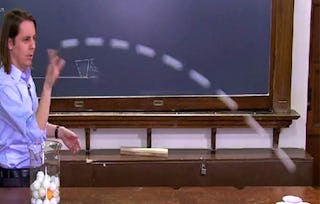
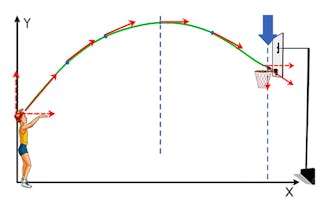
Professor Bloomfield examines the physics concepts of gravity, weight, constant acceleration, and projectile motion working with falling balls.
What's included
8 videos1 assignment
Show info about module content
8 videos•Total 111 minutes
Falling Balls Introduction•7 minutes
Why Does a Dropped Ball Fall Downward?•5 minutes
How Differently do Different Balls Fall?•14 minutes
How Would a Ball Fall on the Moon?•10 minutes
How Does a Falling Ball Move After it is Dropped?•25 minutes
How Can a Ball Move Upward and Still be Falling?•21 minutes
How Does a Ball's Horizontal Motion Affect its Fall?•26 minutes
Falling Balls Summary•3 minutes
1 assignment•Total 30 minutes
Falling Balls•30 minutes
Ramps
Module 4•2 hours to complete
Module details
Professor Bloomfield examines the physics concepts of Newton's third law including conserved quantities, support forces, work, energy, and mechanical advantage working with ramps.
What's included
7 videos1 assignment
Show info about module content
7 videos•Total 85 minutes
Ramps Introduction•5 minutes
Why Doesn't a Wagon Fall Through a Sidewalk?•11 minutes
Why Does a Sidewalk Perfectly Support a Wagon?•8 minutes
How Does a Wagon Move as You Let it Roll Freely on a Ramp?•12 minutes
Why is it More Exhausting to Lift a Wagon Up Than to Lower a Wagon Down?•30 minutes
Why is it Easier to Pull a Wagon Up a Ramp Than to Lift it Up a Ladder?•15 minutes
Ramps Summary•4 minutes
1 assignment•Total 30 minutes
Ramps•30 minutes
Seesaws
Module 5•2 hours to complete
Module details
Professor Bloomfield illustrates the physics concepts of rotational versus translational motion, Newton's law of rotation, and 5 physical quantities: angular position, angular velocity, angular acceleration, torque, and rotational mass using seesaws.
What's included
8 videos1 assignment
Show info about module content
8 videos•Total 119 minutes
Seesaws Introduction•5 minutes
How Does a Balanced Seesaw Move?•17 minutes
Why Does a Seesaw Need a Pivot?•14 minutes
Why Does a Lone Seesaw Rider Plummet to the Ground?•23 minutes
Why do the Riders' Weights and Positions Affect the Seesaw's Motion?•20 minutes
Why Do the Riders' Distances from the Pivot Affect the Seesaw's Responsiveness?•17 minutes
How Do the Seesaw's Riders Affect One Another?•19 minutes
Seesaws Summary•3 minutes
1 assignment•Total 30 minutes
Seesaws•30 minutes
Wheels
Module 6•2 hours to complete
Module details
Professor Bloomfield illustrates the physics concept of frictional forces through experiments with wheels.
What's included
8 videos1 assignment
Show info about module content
8 videos•Total 111 minutes
Wheels Introduction•4 minutes
Why Does a Wagon Need Wheels?•10 minutes
Why is Sliding a Box Across the Floor Usually Hardest at the Start?•21 minutes
How is Energy Wasted as a Box Skids to a Stop?•18 minutes
How Do Wheels Help a Wagon Coast?•20 minutes
How do Powered Wheels Propel a Bicycle or Car Forward?•18 minutes
How is Energy Present in a Wheel?•18 minutes
Wheels Summary•3 minutes
1 assignment•Total 30 minutes
Wheels•30 minutes
Bumper Cars
Module 7•2 hours to complete
Module details
Professor Bloomfield examines the physics concepts of momentum, impulse, angular momentum, angular impulse, and the relationship between potential energy and force using bumper cars.
What's included
7 videos1 assignment
Show info about module content
7 videos•Total 99 minutes
Bumper Cars Introduction•5 minutes
Does a Moving Bumper Car Carry a Force?•18 minutes
How is Momentum Transferred From One Bumper Car to Another?•24 minutes
Does a Spinning Bumper Car Carry a Torque?•17 minutes
How is Angular Momentum Transferred From One Bumper Car to Another?•16 minutes
How Does a Bumper Car Move on an Uneven Floor?•15 minutes
Bumper Cars Summary•4 minutes
1 assignment•Total 30 minutes
Bumper Cars•30 minutes
Final
Module 8•1 hour to complete
Module details
This is the final exam.
What's included
1 video1 assignment
Show info about module content
1 video•Total 2 minutes
Closing out How Things Work and Keeping In Touch•2 minutes
1 assignment•Total 30 minutes
Final Assessment•30 minutes
Instructor
Instructor ratings
Instructor ratings
We asked all learners to give feedback on our instructors based on the quality of their teaching style.
A premier institution of higher education, The University of Virginia offers outstanding academics, world-class faculty, and an inspiring, supportive environment. Founded by Thomas Jefferson in 1819, the University is guided by his vision of discovery, innovation, and development of the full potential of students from all walks of life. Through these courses, global learners have an opportunity to study with renowned scholars and thought leaders.
"To be able to take courses at my own pace and rhythm has been an amazing experience. I can learn whenever it fits my schedule and mood."
Jennifer J.
Learner since 2020
"I directly applied the concepts and skills I learned from my courses to an exciting new project at work."
Larry W.
Learner since 2021
"When I need courses on topics that my university doesn't offer, Coursera is one of the best places to go."
Chaitanya A.
"Learning isn't just about being better at your job: it's so much more than that. Coursera allows me to learn without limits."
Learner reviews
4.8
3,077 reviews
5 stars
86.11%
4 stars
10.50%
3 stars
2.04%
2 stars
0.52%
1 star
0.81%
Showing 3 of 3077
N
NN
4·
Reviewed on Jun 12, 2022
I thoroughly enjoyed this course as prof was clear, slow-paced, and highly entertaining as well. Thank you prof for this course and I hope many others will get to learn physics at home!
D
DK
5·
Reviewed on Jun 26, 2020
tremendous efforts done by the Professor, not only for students but also for the parent who really wish to impart the practical knowledge of basics of physics to their children!!!Thanks a lot.
M
MM
5·
Reviewed on Sep 17, 2015
A brilliant teacher makes a course easy, makes you wish learning his lessons without too much effort from your side, this being the case here, I really enjoy this course and I find it useful.
When will I have access to the lectures and assignments?
To access the course materials, assignments and to earn a Certificate, you will need to purchase the Certificate experience when you enroll in a course. You can try a Free Trial instead, or apply for Financial Aid. The course may offer 'Full Course, No Certificate' instead. This option lets you see all course materials, submit required assessments, and get a final grade. This also means that you will not be able to purchase a Certificate experience.
What will I get if I purchase the Certificate?
When you purchase a Certificate you get access to all course materials, including graded assignments. Upon completing the course, your electronic Certificate will be added to your Accomplishments page - from there, you can print your Certificate or add it to your LinkedIn profile.
Is financial aid available?
Yes. In select learning programs, you can apply for financial aid or a scholarship if you can’t afford the enrollment fee. If fin aid or scholarship is available for your learning program selection, you’ll find a link to apply on the description page.