When you enroll in this course, you'll also be enrolled in this Specialization.
Learn new concepts from industry experts
Gain a foundational understanding of a subject or tool
Develop job-relevant skills with hands-on projects
Earn a shareable career certificate
There are 5 modules in this course
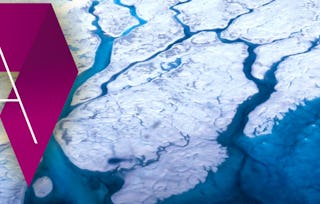
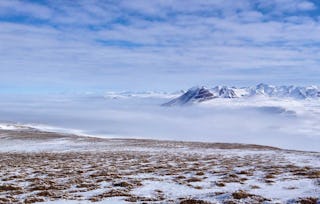
In this course you will first learn about the Arctic as a geographic region, the peoples the Arctic, and the long history of Arctic settlement and exploration. Attention then turns to key features of the Arctic environment – its climate and weather, features of the ocean, sea ice, lands and the Greenland Ice Sheet, and some of the rapid changes being observed.
Learning Objectives: Appreciate the long history of the Arctic and its
peoples. Recognize and recall the physical geography of the Arctic, including
major features of the Arctic Ocean and Arctic lands. Describe the key climate and
environmental elements of the Arctic, including its sea ice cover, patterns of
temperature, precipitation, snow cover, land ice, permafrost and vegetation, the
physical processes giving rise to these features, and how they are changing.
With so much going on in the Arctic, it can be a challenge to decide where to start. This week we provide an overview of the Arctic as a geographic region, followed by some of the pronounced changes unfolding in the North, such as rapid warming, the shrinking sea ice cover and thawing permafrost. History provides context. As such, we need to explore how we built our knowledge of the Arctic, starting with the sometimes tragic ends of early explorers searching for the fabled Northwest Passage, then moving through the Cold War and into the present.
What's included
5 videos2 readings1 assignment1 discussion prompt
Show info about module content
5 videos•Total 56 minutes
The Arctic as a System: Course Overview•6 minutes
The Arctic as a Geographic Region•11 minutes
The Rapidly Changing Arctic•13 minutes
Building our Knowledge-Early Explorations and Events•13 minutes
Building our Knowledge-Cold War to the Modern Era•13 minutes
2 readings•Total 4 minutes
Course Updates and Accessibility Support•1 minute
CIRES on Coursera•3 minutes
1 assignment•Total 15 minutes
Introduction to the Arctic•15 minutes
1 discussion prompt•Total 10 minutes
A Little About Yourself•10 minutes
Arctic Climate Basics
Module 2•1 hour to complete
Module details
To understand the Arctic system and the profound changes taking place, we need to become familiar with some of the basic climate drivers and features of the region, starting with solar energy, polar night, and the midnight sun. Attention then turns to patterns of temperature, precipitation and cloudiness and how they vary across the Arctic.
What's included
4 videos1 assignment
Show info about module content
4 videos•Total 54 minutes
Solar Energy, Polar Nights, and the Midnight Sun•12 minutes
Temperature - Regional and Seasonal Variations•14 minutes
Precipitation - Regional and Seasonal Variations•14 minutes
Clouds and Cloud Radiative Effects•14 minutes
1 assignment•Total 30 minutes
Arctic Climate Basics•30 minutes
The Arctic Ocean
Module 3•1 hour to complete
Module details
A defining feature of the Arctic is that it is a largely ice-covered ocean surrounded by land. While by area, it is the smallest of the world's oceans, it is by far the most interesting of them all. This week, we focus on the Arctic Ocean starting with some basics - its shallow seas and deep basins, and then move on to discuss the Arctic Ocean's floating ice cover. As we will learn, the Arctic sea ice cover, which ranges from a thin veneer to more than five meters thick, grows and shrinks with the seasons. The ice cover is in near constant motion, with ice flows squeezing together to form pressure ridges and pulling apart to form leads. Unlike other oceans, the Arctic Ocean has an intriguing vertical structure, with fresh cold water at the top and warm salty water below.
What's included
4 videos1 assignment
Show info about module content
4 videos•Total 54 minutes
Arctic Ocean Basics•16 minutes
Sea Ice Melt & Growth•15 minutes
Sea Ice Deformation•9 minutes
Sea Ice & Ocean Circulation•15 minutes
1 assignment•Total 30 minutes
The Arctic Ocean•30 minutes
The Arctic Lands
Module 4•1 hour to complete
Module details
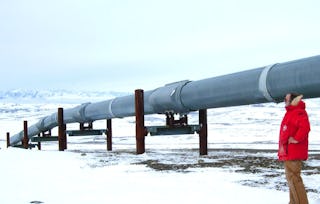
The Arctic lands are much more than treeless, windswept tundra. Greenland, the largest island in the world, is mostly covered by an ice sheet up to 3,200 meters thick. It is losing mass and contributing to sea level rise. While much of the Arctic lands are indeed covered by tundra, the Arctic is also home to large swaths of forest and extensive mountain ranges. Some very large rivers drain into the Arctic Ocean, discharging massive amounts of fresh water. Almost all of the Arctic lands are covered with perennially frozen ground called permafrost. However, this permafrost is now thawing, changing the landscape and putting infrastructure at risk.
What's included
4 videos1 assignment
Show info about module content
4 videos•Total 48 minutes
The Greenland Ice Sheet•14 minutes
Tundra & Boreal Forest•10 minutes
River Systems•11 minutes
Permafrost-Characteristics and Distribution •13 minutes
1 assignment•Total 30 minutes
The Arctic Lands•30 minutes
The Arctic Atmosphere
Module 5•1 hour to complete
Module details
While blizzards, whiteouts and extreme winter cold are a part of living in the Arctic, summer thunderstorms are common over land. Arctic weather is varied and fascinating, but the Arctic region plays a bigger role in the climate system by helping to shape weather patterns across the Northern Hemisphere. Arctic weather and climate is also shaped by teleconnections, such as the North Atlantic Oscillation, that link weather conditions across widely separated locations. Another important framework for understanding the Arctic is its energy budget, which refers to the flows of energy into and out of the Arctic and between the atmospheric ocean.
What's included
4 videos1 assignment
Show info about module content
4 videos•Total 55 minutes
Arctic Weather•14 minutes
Role of the Arctic in the Large-Scale Circulation•11 minutes
Atmospheric Teleconnections•14 minutes
Arctic Energy Budget•16 minutes
1 assignment•Total 30 minutes
Week 5 Quiz •30 minutes
Earn a career certificate
Add this credential to your LinkedIn profile, resume, or CV. Share it on social media and in your performance review.
Instructor
Instructor ratings
Instructor ratings
We asked all learners to give feedback on our instructors based on the quality of their teaching style.
CU Boulder is a dynamic community of scholars and learners on one of the most spectacular college campuses in the country. As one of 34 U.S. public institutions in the prestigious Association of American Universities (AAU), we have a proud tradition of academic excellence, with five Nobel laureates and more than 50 members of prestigious academic academies.
OK
Explore more from Environmental Science and Sustainability
When will I have access to the lectures and assignments?
To access the course materials, assignments and to earn a Certificate, you will need to purchase the Certificate experience when you enroll in a course. You can try a Free Trial instead, or apply for Financial Aid. The course may offer 'Full Course, No Certificate' instead. This option lets you see all course materials, submit required assessments, and get a final grade. This also means that you will not be able to purchase a Certificate experience.
What will I get if I subscribe to this Specialization?
When you enroll in the course, you get access to all of the courses in the Specialization, and you earn a certificate when you complete the work. Your electronic Certificate will be added to your Accomplishments page - from there, you can print your Certificate or add it to your LinkedIn profile.
Is financial aid available?
Yes. In select learning programs, you can apply for financial aid or a scholarship if you can’t afford the enrollment fee. If fin aid or scholarship is available for your learning program selection, you’ll find a link to apply on the description page.