Welcome to the Introduction to Embedded Systems Software and Development Environments. This course is focused on giving you real world coding experience and hands on project work with ARM based Microcontrollers. You will learn how to implement software configuration management and develop embedded software applications. Course assignments include creating a build system using the GNU Toolchain GCC, using Git version control, and developing software in Linux on a Virtual Machine. The course concludes with a project where you will create your own build system and firmware that can manipulate memory.
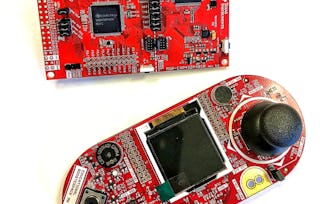
The second course in this 2 course series , Embedded Software and Hardware Architecture, will use hardware tools to program and debug microcontrollers with bare-metal firmware. Using a Texas Instruments MSP432 Development Kit, you will configure a variety of peripherals, write numerous programs, and see your work execute on your own embedded platform!
Module 1 will introduce the learner to the components of your embedded system software development process. This module will be a quick overview for many topics with detailed analysis to follow in later modules and courses. We start with defining the hardware and software building blocks of Embedded Systems which will include a C-programming refresher. Next you will learn about the important tools a developer will need to use to help design, build and manage their designs. This includes development environments, version control and the hardware kits to install on. Learners will install and use a Virtual machine to complete Week 1 Application Assignment.
What's included
10 videos1 reading1 assignment1 peer review
Show info about module content
10 videos•Total 77 minutes
0. Introduction to the Course•4 minutes
1. Introduction to the Module•4 minutes
2. Introduction to Embedded Systems•5 minutes
3. Embedded Software Engineering•8 minutes
4. C-Programming Review•11 minutes
5. Introduction to Software Configuration Management•6 minutes
6. C Standardization and Team Coding Standards•8 minutes
7. Development Environments Overview•9 minutes
8. Development Kits and Documentation•10 minutes
9. Version Control•12 minutes
1 reading•Total 1 minute
Course Updates and Accessibility Support•1 minute
1 assignment•Total 28 minutes
Week 1 Quiz•28 minutes
1 peer review•Total 60 minutes
Week 1 Application Assignment•60 minutes
Compilation with GCC and GNU Make
Module 2•3 hours to complete
Module details
Module 2 will introduce the learner to the software development build system. Most software engineers are very knowledgeable about their build system as we need them to translate our high-level software languages to our architecture specific implementations. There are some important platform and architecture concepts that are introduced in the build system to help enforce good software design techniques. Learners will create their own build systems and utilize build tools to analyze their embedded software implementations.
What's included
9 videos1 assignment1 peer review
Show info about module content
9 videos•Total 81 minutes
1. Introduction to Build Systems using GNU Toolsets•7 minutes
2. Compiling and Invoking GCC•11 minutes
3. Preprocessor Directives•10 minutes
4. Creating Header and Implementation Files•10 minutes
5. Linkers•11 minutes
6. Make•9 minutes
7. Makefiles Part 1•7 minutes
8. Makefiles Part 2•10 minutes
9. Other Useful GNU Bin Tools•6 minutes
1 assignment•Total 30 minutes
Week 2 Quiz•30 minutes
1 peer review•Total 60 minutes
Week 2 Application Assignment•60 minutes
Memory Types, Segments and Management
Module 3•2 hours to complete
Module details
Module 3 will begin to introduce important embedded concepts like the memory systems in their design. Learners will understand how the software to hardware mapping occurs for their designs including differentiating between your program code and your program data. Memory systems have many platform and architecture dependencies, and you will begin to learn about some of the fundamental concepts a software engineer needs to know to utilize all parts of an embedded system’s memory.
What's included
8 videos2 readings2 assignments
Show info about module content
8 videos•Total 64 minutes
1. Introduction to Memory Organization•7 minutes
2. Memory Architectures•8 minutes
3. Memory Segments•7 minutes
4. Data Memory•8 minutes
5. Special Keywords (Const, Extern & Static)•8 minutes
6. The Stack•9 minutes
7. The Heap•7 minutes
8. Code Memory•9 minutes
2 readings•Total 20 minutes
Programming Assignment Instructions•10 minutes
Programming Assignment Quiz Solution•10 minutes
2 assignments•Total 60 minutes
Week 3 Quiz•30 minutes
Programming Assignment Quiz•30 minutes
Course 1 Final Assessment
Module 4•1 hour to complete
Module details
During this week you are to going to combine what you have learned in modules 1-3 to write some memory manipulation software, incorporate into your build system and then run some test functions. At the end of the assignment you will perform a detailed code review of other learners’ software. Reviewing other learners code is very important for both your growth of software design but also for the coder to gain valuable feedback. Professional software engineering regularly go through software reviews when developing code.
What's included
1 peer review
Show info about module content
1 peer review•Total 60 minutes
Expanded Build System and Memory•60 minutes
Instructor
Instructor ratings
Instructor ratings
We asked all learners to give feedback on our instructors based on the quality of their teaching style.
CU Boulder is a dynamic community of scholars and learners on one of the most spectacular college campuses in the country. As one of 34 U.S. public institutions in the prestigious Association of American Universities (AAU), we have a proud tradition of academic excellence, with five Nobel laureates and more than 50 members of prestigious academic academies.
"To be able to take courses at my own pace and rhythm has been an amazing experience. I can learn whenever it fits my schedule and mood."
Jennifer J.
Learner since 2020
"I directly applied the concepts and skills I learned from my courses to an exciting new project at work."
Larry W.
Learner since 2021
"When I need courses on topics that my university doesn't offer, Coursera is one of the best places to go."
Chaitanya A.
"Learning isn't just about being better at your job: it's so much more than that. Coursera allows me to learn without limits."
Learner reviews
4.5
652 reviews
5 stars
69.77%
4 stars
19.08%
3 stars
4.58%
2 stars
2.44%
1 star
4.12%
Showing 3 of 652
G
GG
5·
Reviewed on Jul 16, 2020
This course is very well taught. As a beginner with MCU's, I learned many things. The assessments are interesting and challenging. Great course!
A
AA
4·
Reviewed on Sep 21, 2017
The instructor is good, explains clearly and simply and looks friendly.The subtitles in Lecture 4 from lesson 1 is not correct at all.So far so good.Thanks Coursera !
S
SK
5·
Reviewed on Oct 9, 2019
The course was excellent for me, as a beginner. Of course, the learning curve was steep and the assignments challenging, but I learnt a lot. Thanks you Coursera and University of Colorado, Boulder.
Can I use a different, but similar development board in this specialization?
The specialization supports assignments and grading only on the MSP432 development board. The course material can translate to other development kits and students are welcome to take this course with their own embedded system, but grading will only be supported and graded with only the MSP432.
And just a reminder that the first course of the specialization doesn’t require you to order any hardware. You will need to obtain the following microcontroller development kit to use for project work in later courses of the specialization: Texas Instruments Launchpad - MSP432p401r. This evaluation kit is available for about $13 US dollars. More information about ordering the kit will be provided in the course.
When will I have access to the lectures and assignments?
To access the course materials, assignments and to earn a Certificate, you will need to purchase the Certificate experience when you enroll in a course. You can try a Free Trial instead, or apply for Financial Aid. The course may offer 'Full Course, No Certificate' instead. This option lets you see all course materials, submit required assessments, and get a final grade. This also means that you will not be able to purchase a Certificate experience.
What will I get if I subscribe to this Specialization?
When you enroll in the course, you get access to all of the courses in the Specialization, and you earn a certificate when you complete the work. Your electronic Certificate will be added to your Accomplishments page - from there, you can print your Certificate or add it to your LinkedIn profile.
Is financial aid available?
Yes. In select learning programs, you can apply for financial aid or a scholarship if you can’t afford the enrollment fee. If fin aid or scholarship is available for your learning program selection, you’ll find a link to apply on the description page.