The focus and themes of the Introduction to Calculus course address the most important foundations for applications of mathematics in science, engineering and commerce. The course emphasises the key ideas and historical motivation for calculus, while at the same time striking a balance between theory and application, leading to a mastery of key threshold concepts in foundational mathematics.
Students taking Introduction to Calculus will:
• gain familiarity with key ideas of precalculus, including the manipulation of equations and elementary functions (first two weeks),
• develop fluency with the preliminary methodology of tangents and limits, and the definition of a derivative (third week),
• develop and practice methods of differential calculus with applications (fourth week),
• develop and practice methods of the integral calculus (fifth week).
This module begins by looking at the different kinds of numbers that fall on the real number line, decimal expansions and approximations, then continues with an exploration of manipulation of equations and inequalities, of sign diagrams and the use of the Cartesian plane.
What's included
10 videos8 readings9 assignments
Show info about module content
10 videos•Total 109 minutes
Welcome and introduction to Precalculus•4 minutes
Real line, decimals and significant figures•15 minutes
The Theorem of Pythagoras and properties of the square root of 2•11 minutes
Algebraic expressions, surds and approximations•11 minutes
Equations and inequalities•17 minutes
Sign diagrams, solution sets and intervals (Part 1)•10 minutes
Sign diagrams, solution sets and intervals (Part 2)•11 minutes
Coordinate systems•9 minutes
Distance and absolute value•6 minutes
Lines and circles in the plane•14 minutes
8 readings•Total 160 minutes
Notes: Real line, decimals and significant figures•20 minutes
Notes: The Theorem of Pythagoras and properties of the square root of 2•20 minutes
Notes: Algebraic expressions, surds and approximations•20 minutes
Notes: Equations and inequalities•20 minutes
Notes: Sign diagrams, solution sets and intervals•20 minutes
Notes: Coordinate systems•20 minutes
Notes: Distance and absolute value•20 minutes
Notes: Lines and circles in the plane•20 minutes
9 assignments•Total 300 minutes
Module 1 quiz•60 minutes
Real line, decimals and significant figures •30 minutes
The Theorem of Pythagoras and properties of the square root of 2 •30 minutes
Algebraic expressions, surds and approximations •30 minutes
Equations and inequalities •30 minutes
Sign diagrams, solution sets and intervals•30 minutes
Coordinate systems •30 minutes
Distance and absolute value •30 minutes
Lines and circles in the plane •30 minutes
Functions (Useful and important repertoire)
Module 2•13 hours to complete
Module details
This module introduces the notion of a function which captures precisely ways in which different quantities or measurements are linked together. The module covers quadratic, cubic and general power and polynomial functions; exponential and logarithmic functions; and trigonometric functions related to the mathematics of periodic behaviour. We create new functions using composition and inversion and look at how to move backwards and forwards between quantities algebraically, as well as visually, with transformations in the xy-plane.
What's included
13 videos12 readings13 assignments
Show info about module content
13 videos•Total 142 minutes
Introduction to Module 2•2 minutes
Parabolas and quadratics•12 minutes
The quadratic formula•11 minutes
Functions as rules, with domain, range and graph•12 minutes
Polynomial and power functions•14 minutes
Composite functions•7 minutes
Inverse functions•12 minutes
The exponential function•13 minutes
The logarithmic function•9 minutes
Exponential growth and decay•13 minutes
Sine, cosine and tangent•10 minutes
The unit circle and trigonometry•17 minutes
Inverse circular functions•12 minutes
12 readings•Total 235 minutes
Notes: Parabolas and quadratics•20 minutes
Notes: The quadratic formula•20 minutes
Notes: Functions as rules, with domain, range and graph•20 minutes
Notes: Polynomial and power functions•20 minutes
Notes: Composite functions•20 minutes
Notes: Inverse functions•20 minutes
Notes: The exponential function•20 minutes
Notes: The logarithmic function•15 minutes
Notes: Exponential growth and decay•20 minutes
Notes: Sine, cosine and tangent•20 minutes
Notes: The unit circle and trigonometry•20 minutes
Notes: Inverse circular functions•20 minutes
13 assignments•Total 420 minutes
Module 2 quiz•60 minutes
Parabolas and quadratics•30 minutes
The quadratic formula•30 minutes
Functions as rules, with domain, range and graph•30 minutes
Polynomial and power functions•30 minutes
Composite functions•30 minutes
Inverse functions•30 minutes
The exponential function•30 minutes
The logarithmic function•30 minutes
Exponential growth and decay•30 minutes
Sine, cosine and tangent•30 minutes
The unit circle and trigonometry•30 minutes
Inverse circular functions•30 minutes
Introducing the differential calculus
Module 3•12 hours to complete
Module details
This module introduces techniques of differential calculus. We look at average rates of change which become instantaneous, as time intervals become vanishingly small, leading to the notion of a derivative. We then explore techniques involving differentials that exploit tangent lines. The module introduces Leibniz notation and shows how to use it to get information easily about the derivative of a function and how to apply it.
What's included
12 videos10 readings11 assignments
Show info about module content
12 videos•Total 132 minutes
Introduction to Module 3•2 minutes
Slopes and average rates of change•10 minutes
Displacement, velocity and acceleration•11 minutes
Tangent lines and secants•11 minutes
Different kinds of limits•12 minutes
Limit laws•15 minutes
Limits and continuity•10 minutes
The derivative as a limit•11 minutes
Finding derivatives from first principles•15 minutes
Leibniz notation•15 minutes
Differentials and applications (Part 1)•13 minutes
Differentials and applications (Part 2)•8 minutes
10 readings•Total 200 minutes
Notes: Slopes and average rates of change•20 minutes
Notes: Displacement, velocity and acceleration•20 minutes
Notes: Tangent lines and secants•20 minutes
Notes: Different kinds of limits•20 minutes
Notes: Limit laws•20 minutes
Notes: Limits and continuity•20 minutes
Notes: The derivative as a limit•20 minutes
Notes: Finding derivatives from first principles•20 minutes
Notes: Leibniz notation•20 minutes
Notes: Differentials and applications•20 minutes
11 assignments•Total 360 minutes
Module 3 quiz•60 minutes
Slopes and average rates of change•30 minutes
Displacement, velocity and acceleration•30 minutes
Tangent lines and secants•30 minutes
Different kinds of limits•30 minutes
Limit laws•30 minutes
Limits and continuity•30 minutes
The derivative as a limit•30 minutes
Finding derivatives from first principles•30 minutes
Leibniz notation•30 minutes
Differentials and applications•30 minutes
Properties and applications of the derivative
Module 4•14 hours to complete
Module details
This module continues the development of differential calculus by introducing the first and second derivatives of a function. We use sign diagrams of the first and second derivatives and from this, develop a systematic protocol for curve sketching. The module also introduces rules for finding derivatives of complicated functions built from simpler functions, using the Chain Rule, the Product Rule, and the Quotient Rule, and how to exploit information about the derivative to solve difficult optimisation problems.
What's included
14 videos13 readings14 assignments
Show info about module content
14 videos•Total 155 minutes
Introduction to Module 4•2 minutes
Increasing and decreasing functions•11 minutes
Sign diagrams•12 minutes
Maxima and minima•12 minutes
Concavity and inflections•11 minutes
Curve sketching•16 minutes
The Chain Rule•10 minutes
Applications of the Chain Rule•14 minutes
The Product Rule•9 minutes
Applications of the Product Rule•9 minutes
The Quotient Rule•9 minutes
Application of the Quotient Rule•10 minutes
Optimisation•13 minutes
The Second Derivative Test•16 minutes
13 readings•Total 260 minutes
Notes: Increasing and decreasing functions•20 minutes
Notes: Sign diagrams•20 minutes
Notes: Maxima and minima•20 minutes
Notes: Concavity and inflections•20 minutes
Notes: Curve sketching•20 minutes
Notes: The Chain Rule•20 minutes
Notes: Applications of the Chain Rule•20 minutes
Notes: The Product Rule•20 minutes
Notes: Applications of the Product Rule•20 minutes
Notes: The Quotient Rule•20 minutes
Notes: Application of the Quotient Rule•20 minutes
Notes: Optimisation•20 minutes
Notes: The Second Derivative Test•20 minutes
14 assignments•Total 440 minutes
Module 4 quiz•60 minutes
Increasing and decreasing functions•30 minutes
Sign diagrams•20 minutes
Maxima and minima•30 minutes
Concavity and inflections•30 minutes
Curve sketching•30 minutes
The Chain Rule•30 minutes
Applications of the Chain Rule•30 minutes
The Product Rule•30 minutes
Applications of the Product Rule•30 minutes
The Quotient Rule•30 minutes
Application of the Quotient Rule•30 minutes
Optimisation•30 minutes
The Second Derivative Test•30 minutes
Introducing the integral calculus
Module 5•11 hours to complete
Module details
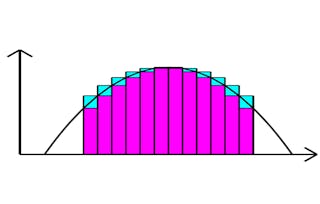
This fifth and final module introduces integral calculus, looking at the slopes of tangent lines and areas under curves. This leads to the Fundamental Theorem of Calculus. We explore the use of areas under velocity curves to estimate displacement, using averages of lower and upper rectangular approximations. We then look at limits of approximations, to discover the formula for the area of a circle and the area under a parabola. We then develop methods for capturing precisely areas under curves, using Riemann sums and the definite integral. The module then introduces indefinite integrals and the method of integration by substitution. Finally, we discuss properties of odd and even functions, related to rotational and reflectional symmetry, and the logistic function, which modifies exponential growth.
What's included
14 videos10 readings9 assignments
Show info about module content
14 videos•Total 162 minutes
Introduction to Module 5•2 minutes
Inferring displacement from velocity•15 minutes
Areas bounded by curves•17 minutes
Riemann sums and definite integrals•18 minutes
The Fundamental Theorem of Calculus and indefinite integrals•17 minutes
Connection between areas and derivatives (Part 1)•9 minutes
Connection between areas and derivatives (Part 2)•10 minutes
Integration by substitution (Part 1)•11 minutes
Integration by substitution (Part 2)•8 minutes
Odd and even functions (Part 1)•10 minutes
Odd and even functions (Part 2)•10 minutes
The logistic function (Part 1)•13 minutes
The logistic function (Part 2)•6 minutes
The escape velocity of a rocket•15 minutes
10 readings•Total 190 minutes
Notes: Inferring displacement from velocity•20 minutes
Notes: Areas bounded by curves•20 minutes
Notes: Riemann sums and definite integrals•20 minutes
Notes: The Fundamental Theorem of Calculus and indefinite integrals•20 minutes
Notes: Connection between areas and derivatives•20 minutes
Notes: Integration by substitution•20 minutes
Notes: Odd and even functions•20 minutes
Notes: The logistic function•20 minutes
Notes: The escape velocity of a rocket•20 minutes
Formula Sheet•10 minutes
9 assignments•Total 300 minutes
Module 5 quiz•60 minutes
Inferring displacement from velocity•30 minutes
Areas bounded by curves•30 minutes
Riemann sums and definite integrals•30 minutes
The Fundamental Theorem of Calculus and indefinite integrals•30 minutes
Connection between areas and derivatives•30 minutes
Integration by substitution•30 minutes
Odd and even functions•30 minutes
The logistic function•30 minutes
Instructor
Instructor ratings
Instructor ratings
We asked all learners to give feedback on our instructors based on the quality of their teaching style.
Our excellence in research and teaching makes the University of Sydney one of the top universities in Australia and highly ranked among the best universities in the world. In 2020, we were ranked second in the Times Higher Education (THE) University Impact Rankings, and first in Australia in the QS Graduate Employability Rankings.
"To be able to take courses at my own pace and rhythm has been an amazing experience. I can learn whenever it fits my schedule and mood."
Jennifer J.
Learner since 2020
"I directly applied the concepts and skills I learned from my courses to an exciting new project at work."
Larry W.
Learner since 2021
"When I need courses on topics that my university doesn't offer, Coursera is one of the best places to go."
Chaitanya A.
"Learning isn't just about being better at your job: it's so much more than that. Coursera allows me to learn without limits."
Learner reviews
4.8
3,963 reviews
5 stars
87.20%
4 stars
10.24%
3 stars
1.16%
2 stars
0.55%
1 star
0.83%
Showing 3 of 3963
A
AF
5·
Reviewed on Apr 8, 2022
An excellent course, especially if like me you had done some calculus in the past and wanted a refresher. David is an excellent, clear, and attentive tutor. I can't recommend him enough. Many thanks.
A
AR
5·
Reviewed on Apr 2, 2020
Amazing Explanations..... I love how the course is sequenced and it provides not only the mechanical solutions to calculus but also the theories behind each module and topics... Great Course
A
AS
5·
Reviewed on Oct 3, 2021
Professor Easdown is an excellent instructor. He has an obvious passion for the subject and teaches with great enthusiasm. His explanations are clear and examples are helpful.Thank you!
When will I have access to the lectures and assignments?
To access the course materials, assignments and to earn a Certificate, you will need to purchase the Certificate experience when you enroll in a course. You can try a Free Trial instead, or apply for Financial Aid. The course may offer 'Full Course, No Certificate' instead. This option lets you see all course materials, submit required assessments, and get a final grade. This also means that you will not be able to purchase a Certificate experience.
What will I get if I purchase the Certificate?
When you purchase a Certificate you get access to all course materials, including graded assignments. Upon completing the course, your electronic Certificate will be added to your Accomplishments page - from there, you can print your Certificate or add it to your LinkedIn profile.
Is financial aid available?
Yes. In select learning programs, you can apply for financial aid or a scholarship if you can’t afford the enrollment fee. If fin aid or scholarship is available for your learning program selection, you’ll find a link to apply on the description page.