Most of the phenomena in the world around you are, at the fundamental level, based on physics, and much of physics is based on mechanics. Mechanics begins by quantifying motion, and then explaining it in terms of forces, energy and momentum. This allows us to analyse the operation of many familiar phenomena around us, but also the mechanics of planets, stars and galaxies.
This on-demand course is recommended for senior high school and beginning university students and anyone with a curiosity about basic physics. (The survey tells us that it's often used by science teachers, too.)
The course uses rich multimedia tutorials to present the material: film clips of key experiments, animations and worked example problems, all with a friendly narrator. You'll do a range of interesting practice problems, and in an optional component, you will use your ingenuity to complete at-home experiments using simple, everyday materials.
You will need some high-school mathematics: arithmetic, a little algebra, quadratic equations, and the sine, cosine and tangent functions from trigonometry. The course does not use calculus. However, we do provide a study aid introducing the calculus that would accompany this course if it were taught in a university.
By studying mechanics in this course, you will understand with greater depth many of the wonders around you in everyday life, in technology and in the universe at large. Meanwhile, we think you'll have some fun, too.
This module introduces the foundational tools and concepts needed to study mechanics. You’ll learn how physicists describe the physical world using units, significant figures, vectors, and estimation techniques. These essential skills will help you interpret measurements, analyze motion, and solve physics problems accurately. You’ll also learn how physicists make useful approximations to understand real-world phenomena, from everyday objects to planets and galaxies.
What's included
5 videos2 readings6 assignments
Show info about module content
5 videos•Total 23 minutes
Course Welcome •2 minutes
Lesson 1.1: Introduction and Context •4 minutes
Lesson 1.2: Units and Significant Figures •8 minutes
Lesson 1.3: Vectors and Scalars•4 minutes
Lesson 1.4: Estimating•5 minutes
2 readings•Total 13 minutes
Course structure and grading•3 minutes
Week 1 Study Aids•10 minutes
6 assignments•Total 180 minutes
Introduction and Context•30 minutes
Units and Significant Figures•30 minutes
Vectors and Scalars•30 minutes
Estimating •30 minutes
Start of course survey •30 minutes
Week 1 Test•30 minutes
Velocity and Acceleration
Module 2•3 hours to complete
Module details
In this module, you’ll begin your study of kinematics—the description of motion. You’ll learn how to represent motion using graphs and equations, and how velocity and acceleration describe how objects move and change speed over time. You’ll explore motion in a straight line and learn how to analyze relative motion between observers. These tools form the basis for understanding more complex motion in later modules.
What's included
4 videos1 reading5 assignments
Show info about module content
4 videos•Total 24 minutes
Lesson 2.1: Graphing Displacement and Velocity•9 minutes
Lesson 2.2: Acceleration•7 minutes
Lesson 2.3: Relating Velocity, Acceleration and Displacement•3 minutes
Lesson 2.4: Relative Motion•5 minutes
1 reading•Total 10 minutes
Week 2 Study Aids•10 minutes
5 assignments•Total 124 minutes
Graphing Displacement and Velocity•30 minutes
Acceleration •30 minutes
Relating Velocity, Acceleration and Displacement•4 minutes
Relative Motion •30 minutes
Week 2 Test •30 minutes
Motion in Two Dimensions
Module 3•3 hours to complete
Module details
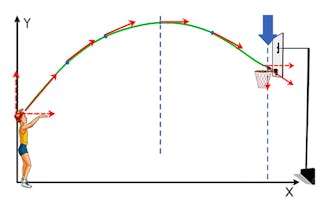
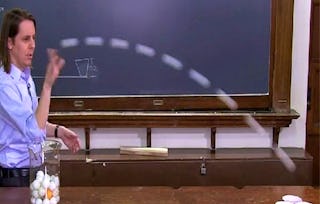
This module extends your understanding of motion to two dimensions. You’ll explore projectile motion, including objects falling under gravity and moving through the air, and learn how horizontal and vertical motion combine. You’ll also study uniform circular motion, which describes the motion of planets, satellites, and many everyday systems. These concepts will help you analyze realistic motion beyond simple straight-line movement.
What's included
4 videos1 reading6 assignments
Show info about module content
4 videos•Total 25 minutes
Lesson 3.1: Projectiles, Falling Vertically Under Gravity •8 minutes
Lesson 3.2: Combining Vertical and Horizontal Motion•4 minutes
Lesson 3.3: Trajectories and Range•7 minutes
Lesson 3.4: Uniform Circular Motion•7 minutes
1 reading•Total 10 minutes
Week 3 Study Aids•10 minutes
6 assignments•Total 138 minutes
Projectiles, Falling Vertically Under Gravity•14 minutes
Combining Vertical and Horizontal Motion •30 minutes
Trajectories and Range •30 minutes
Uniform Circular Motion •4 minutes
Accelerations in the Wild (optional)•30 minutes
Week 3 Test •30 minutes
Newton's Laws of Motion
Module 4•3 hours to complete
Module details
This module introduces Newton’s three laws of motion, which explain how forces affect motion. You’ll learn how forces cause acceleration, how motion depends on reference frames, and how forces always occur in pairs. These principles allow you to explain and predict motion in systems ranging from everyday objects to engineering structures and astronomical bodies.
What's included
7 videos1 reading6 assignments
Show info about module content
7 videos•Total 35 minutes
Lesson 4.1: Newton's Laws of Motion•5 minutes
Lesson 4.2: Inertial and Non-inertial Frames•6 minutes
Lesson 4.3: Newton's Third Law•3 minutes
Lesson 4.4: Calculating Total Force•8 minutes
Lesson 4.5: Practice Problems•7 minutes
Historical Interlude•4 minutes
The Syllogism •1 minute
1 reading•Total 10 minutes
Week 4 Study Aids•10 minutes
6 assignments•Total 158 minutes
Newton's Laws of Motion •30 minutes
Inertial and Non-inertial Frames •30 minutes
Newton's Third Law•12 minutes
Calculating Total Force•30 minutes
Practice Problems•30 minutes
Week 4 Test•26 minutes
Weight, Friction and Spring Forces
Module 5•3 hours to complete
Module details
In this module, you’ll explore important forces encountered in everyday life. You’ll learn the difference between mass and weight, and how gravity acts on objects. You’ll study elastic forces using Hooke’s law and examine contact forces such as normal force and friction. These concepts will help you understand how objects interact when pushed, pulled, stretched, or in contact with surfaces.
What's included
4 videos1 reading5 assignments
Show info about module content
4 videos•Total 23 minutes
Lesson 5.1: Weight versus Mass•8 minutes
Lesson 5.2: Springs and Hooke's Law•3 minutes
Lesson 5.3: Normal and Frictional Forces•7 minutes
Lesson 5.4: Friction Problems •5 minutes
1 reading•Total 10 minutes
Week 5 Study Aids•10 minutes
5 assignments•Total 150 minutes
Weight versus Mass•30 minutes
Springs and Hooke's Law•30 minutes
Normal and Frictional Forces•30 minutes
Friction Problems•30 minutes
Week 5 Test•30 minutes
Work, Energy and Power
Module 6•4 hours to complete
Module details
This module introduces the powerful concepts of work, energy, and power. You’ll learn how energy is transferred and transformed, and how energy conservation helps explain motion without directly calculating forces. You’ll explore kinetic and potential energy, conservative and non-conservative forces, and how power describes the rate at which work is done. These ideas connect physics to real-world applications, from human movement to machines and technology.
What's included
5 videos1 reading7 assignments
Show info about module content
5 videos•Total 31 minutes
Lesson 6.1: What is Work?•7 minutes
Lesson 6.2: Work and Kinetic Energy•7 minutes
Lesson 6.3: Work and Potential Energy•5 minutes
Lesson 6.4: Energy Conservation•6 minutes
Lesson 6.5: Energy, Work and Power•7 minutes
1 reading•Total 10 minutes
Week 6 Study Aids•10 minutes
7 assignments•Total 180 minutes
What is Work? •30 minutes
Work and Kinetic Energy•6 minutes
Work and Potential Energy•30 minutes
Energy Conservation•30 minutes
Energy, Work and Power•30 minutes
Slip Sliding Away (optional)•30 minutes
Week 6 Test•24 minutes
Momentum and Collisions
Module 7•2 hours to complete
Module details
In this module, you’ll learn about momentum and how it helps explain collisions and interactions between objects. You’ll study impulse, conservation of momentum, and the difference between elastic and inelastic collisions. These principles allow physicists to analyze events ranging from sports and vehicle safety to particle physics and space exploration.
What's included
4 videos1 reading5 assignments
Show info about module content
4 videos•Total 23 minutes
Lesson 7.1: Momentum and Collisions•5 minutes
Lesson 7.2: Impulse and More About Collisions•6 minutes
Lesson 7.3: Centre of Mass, Elastic and Inelastic Collisions•6 minutes
Centre of Mass, Elastic and Inelastic Collisions•4 minutes
Problems Involving Collisions•6 minutes
Week 7 Test •18 minutes
Gravity
Module 8•3 hours to complete
Module details
This final module explores gravity—the force that governs motion on Earth and throughout the universe. You’ll learn how gravity determines weight, orbits, and the motion of planets and satellites. You’ll explore gravitational potential energy, escape velocity, and how gravity shapes stars, galaxies, and black holes. This module connects the physics you’ve learned to the large-scale structure of the universe.
UNSW Sydney, based in Sydney Australia, was established in 1949 and is one of Australia’s leading research and teaching universities with more than 50,000 students from over 120 countries. UNSW Sydney aspires to provide students with an outstanding educational experience, which both reflects our strong traditions of excellence, innovation and social justice, and builds on our strengths in scientific, technological and professional disciplines.
When will I have access to the lectures and assignments?
To access the course materials, assignments and to earn a Certificate, you will need to purchase the Certificate experience when you enroll in a course. You can try a Free Trial instead, or apply for Financial Aid. The course may offer 'Full Course, No Certificate' instead. This option lets you see all course materials, submit required assessments, and get a final grade. This also means that you will not be able to purchase a Certificate experience.
What will I get if I purchase the Certificate?
When you purchase a Certificate you get access to all course materials, including graded assignments. Upon completing the course, your electronic Certificate will be added to your Accomplishments page - from there, you can print your Certificate or add it to your LinkedIn profile.
Is financial aid available?
Yes. In select learning programs, you can apply for financial aid or a scholarship if you can’t afford the enrollment fee. If fin aid or scholarship is available for your learning program selection, you’ll find a link to apply on the description page.