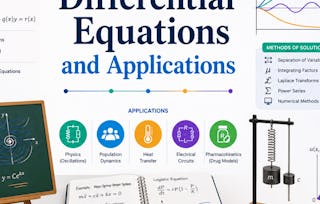
This introductory courses on (Ordinary) Differential Equations are mainly for the people, who need differential equations mostly for the practical use in their own fields. So we try to provide basic terminologies, concepts, and methods of solving various types of differential equations as well as a rudimentary but indispensable knowledge of the underlying theory and some related applications.
The prerequisites of the courses is one- or two- semester calculus course and some exposure to the elementary theory of matrices like determinants, Cramer’s Rule for solving linear systems of equations, eigenvalues and eigenvectors.
What's included
9 videos1 assignment
Show info about module content
9 videos•Total 77 minutes
1-1 What is a Differentiable Equation?•5 minutes
1-2 Order and Normal Form•6 minutes
1-3 Linear and Nonlinear Equations•6 minutes
1-4 Solution•6 minutes
1-5 Implicit Solution•11 minutes
1-6 Types of Solutions•12 minutes
1-7 Initial Value Problem•10 minutes
1-8 Picard’s Theorem I•10 minutes
1-9 Picard’s Theorem II•10 minutes
1 assignment•Total 30 minutes
Quiz1•30 minutes
First Order Differential Equation 1
Module 2•2 hours to complete
Module details
What's included
9 videos1 assignment
Show info about module content
9 videos•Total 85 minutes
2-1 Separable Equations•7 minutes
2-2 Separable Equations - Ex’s 1 & 2•8 minutes
2-3 Separable Equations - Ex’s 3 & 4•9 minutes
2-4 Integrating Factor•12 minutes
2-5 Does IVP Have a Unique Solution?•6 minutes
2-6 Exact Equations I•9 minutes
2-7 Exact Equations II•18 minutes
2-8 Exact Equations – Ex. 1•10 minutes
2-9 Exact Equations – Ex. 2•5 minutes
1 assignment•Total 30 minutes
Quiz2•30 minutes
FIRST ORDER DEFERENTIAL EQUATION 2
Module 3•2 hours to complete
Module details
What's included
12 videos1 assignment
Show info about module content
12 videos•Total 104 minutes
3-1 Integrating Factor I•8 minutes
3-2 Integrating Factor II•7 minutes
3.3 Integrating Factor III•11 minutes
3-4 Substitutions, Ex 1•8 minutes
3-5 Homogeneous Equations•10 minutes
3-6 Substitutions Ex's 2 & 3•10 minutes
3-7 Bernoulli Equation•9 minutes
3-8 Equations with Linear Coefficients•9 minutes
3-9 Equations with Linear Coefficients - Ex. 5•8 minutes
3-10 Ricatti's Equation - Ex. 6•10 minutes
3-11 Clairaut's Equation•8 minutes
3-12 Clairaut's Equation - Ex. 7•7 minutes
1 assignment•Total 30 minutes
Quiz 3•30 minutes
Mathematical Modeling and Applications
Module 4•1 hour to complete
Module details
What's included
5 videos1 assignment
Show info about module content
5 videos•Total 54 minutes
4-1 Radioactive Decay•12 minutes
4-2 Population Dynamics I•9 minutes
4-3 Population Dynamics II•8 minutes
4-4 Population Dynamics III•14 minutes
4-5 Population Dynamics IV•11 minutes
1 assignment•Total 30 minutes
Quiz4•30 minutes
LINEAR SECOND ORDER EQUATIONS 1
Module 5•1 hour to complete
Module details
What's included
5 videos1 assignment
Show info about module content
5 videos•Total 56 minutes
5-1 Linear differential equations•7 minutes
5-2 Superposition Principle•7 minutes
5-3 Unique Existence of Solution•3 minutes
5-4 Linear independence•10 minutes
5-5 Wronskian test•28 minutes
1 assignment•Total 30 minutes
Quiz5•30 minutes
Linear Second order equations 2
Module 6•2 hours to complete
Module details
What's included
9 videos1 assignment
Show info about module content
9 videos•Total 81 minutes
6-1 Fundamental set of solutions•9 minutes
6-2 General solutions•13 minutes
6-3 Nonhomogeneous equations I•8 minutes
6-4 Nonhomogeneous equations II•5 minutes
6-5 Reduction of order I•11 minutes
6-6 Reduction of order II•8 minutes
6-7 Homogeneous linear equations with constant coefficients•15 minutes
6-8 Homogeneous linear equations – Example•5 minutes
6-9 Higher order equations•7 minutes
1 assignment•Total 30 minutes
Quiz6•30 minutes
Linear Second order equations 3
Module 7•1 hour to complete
Module details
What's included
5 videos1 assignment
Show info about module content
5 videos•Total 54 minutes
7-1 Differential polynomials – Ex. 1•8 minutes
7-2 Annihilator – Ex. 2•10 minutes
7-3 Method of undetermined coefficients I•9 minutes
7-4 Method of undetermined coefficients II – Ex. 3•17 minutes
7-5 Method of undetermined coefficients - Ex. 4•10 minutes
1 assignment•Total 30 minutes
Quiz7•30 minutes
Linear Second order equations 4
Module 8•1 hour to complete
Module details
What's included
4 videos1 assignment
Show info about module content
4 videos•Total 46 minutes
8-1 Variation of parameters I•14 minutes
8-2 Variation of parameters II•9 minutes
8-3 Variation of parameters III – Ex. 1•9 minutes
8-4 Variation of parameters IV – Ex. 2•13 minutes
1 assignment•Total 30 minutes
Quiz8•30 minutes
APPLICATIONS OF SECOND ORDER EQUATIONS
Module 9•1 hour to complete
Module details
What's included
5 videos1 assignment
Show info about module content
5 videos•Total 44 minutes
9-1 Spring-mass system•7 minutes
9-2 Free undamped motion – Ex. 1•8 minutes
9-3 Free & Forced damped motion•13 minutes
9-4 Spring-mass system – Ex’s 2 & 3•9 minutes
9-5 Pendulum•7 minutes
1 assignment•Total 30 minutes
Quiz9•30 minutes
Instructors
Instructor ratings
Instructor ratings
We asked all learners to give feedback on our instructors based on the quality of their teaching style.
The Korea Advanced Institute of Science and Technology (KAIST) was established in 1971 by the Korean government as the nation’s first research-intensive graduate school for science, engineering and technology. It has now grown into one of the world’s best universities, delivering top notch education and research programs for undergraduate and graduate students. KAIST encourages interdisciplinary and convergent research across a wide spectrum of disciplines, as well as strong collaborations with industry and global institutions.
OK
Explore more from Math and Logic
K
Korea Advanced Institute of Science and Technology(KAIST)
"To be able to take courses at my own pace and rhythm has been an amazing experience. I can learn whenever it fits my schedule and mood."
Jennifer J.
Learner since 2020
"I directly applied the concepts and skills I learned from my courses to an exciting new project at work."
Larry W.
Learner since 2021
"When I need courses on topics that my university doesn't offer, Coursera is one of the best places to go."
Chaitanya A.
"Learning isn't just about being better at your job: it's so much more than that. Coursera allows me to learn without limits."
Learner reviews
4.7
1,438 reviews
5 stars
81.02%
4 stars
14.73%
3 stars
2.43%
2 stars
0.83%
1 star
0.97%
Showing 3 of 1438
J
JL
5·
Reviewed on Jul 15, 2021
It was very informative and has several examples which makes it easier to understand and solve problems. The pace of this course is 'just right' and it does not make one feel too bored to study it.
C
CC
5·
Reviewed on Jul 11, 2020
I enjoyed this course. I'm always glad to see advanced Math courses when they become available.Thanks to the professor.
E
EH
5·
Reviewed on Jan 5, 2018
It's a really amazing course. Really glad that I take. Some of the video has little sound, but overall it's really good and clear.
Yes. One must be familiar with the basic differential and integral calculus, which are the main contents of college level introductory Calculus course. Although the course does not require more than high school linear algebra, it will be very helpful if one has a little bit of knowledge on Linear Algebra such as the determinant of a square matrix, linear (in)dependence of vectors, and Cramer’s rule of solving a determined system of simultaneous linear algebraic equations.
"The beginner should not be discouraged if he finds that he does not have the prerequisites for reading the prerequisites.' from P. R. Halmos, I want to be a mathematician, Math. Assoc. America, 1985.
Q2. What are the main goals of the course?
The course is designed to introduce basic theory, techniques, and applications of differential equations to beginners in the field, who would like to continue their study in the subjects such as natural sciences, engineering, and economics etc. The course is emphasizing methods and techniques of solving certain differential equations.
When will I have access to the lectures and assignments?
To access the course materials, assignments and to earn a Certificate, you will need to purchase the Certificate experience when you enroll in a course. You can try a Free Trial instead, or apply for Financial Aid. The course may offer 'Full Course, No Certificate' instead. This option lets you see all course materials, submit required assessments, and get a final grade. This also means that you will not be able to purchase a Certificate experience.
What will I get if I purchase the Certificate?
When you purchase a Certificate you get access to all course materials, including graded assignments. Upon completing the course, your electronic Certificate will be added to your Accomplishments page - from there, you can print your Certificate or add it to your LinkedIn profile.
Is financial aid available?
Yes. In select learning programs, you can apply for financial aid or a scholarship if you can’t afford the enrollment fee. If fin aid or scholarship is available for your learning program selection, you’ll find a link to apply on the description page.