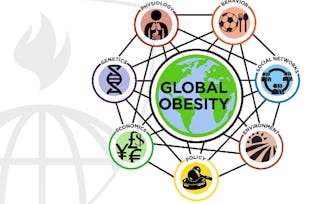
In this course, we’ll look at the facts and misconceptions around obesity and discuss key physiological and psychological concepts around the brain’s control of appetite and body weight. We’ll consider the biological and environmental pressures that make it easy to gain weight (and hard to lose it!). Most importantly, we'll give you the opportunity to reflect on your own knowledge and assumptions around the subject.
We deliver course materials as a mixture of videos, audio-only MOOCcasts, and a selection of short readings. There are short weekly quizzes, a peer-reviewed exercise, and discussion activities on the forum. These will help you prepare for the final project. In it, you are invited to demonstrate your evidence-informed understanding and express how you'll develop it beyond the course.
The course features Citizen Science projects. We'll collect data from you (anonymously, of course) and use it to drive participant-led discussions of controversial ideas. In this way, we hope to explore ideas around diet and obesity. These projects also give a taste of how scientific evidence is collected and interpreted by scientists, and give some indication how much there still is to discover and understand.
Learners can apply for Financial Aid directly with Coursera to assist with the cost of accessing the full course and gaining a certificate for successfully completing the course.
This week we'll discuss what we know about diet, appetite and obesity. But, and perhaps more importantly, we'll point out the gaps in our knowledge.
What's included
4 videos3 readings1 assignment
Show info about module content
4 videos•Total 30 minutes
Rules of engagement•3 minutes
Why is obesity a problem?•8 minutes
What do we know about appetite and obesity? Part 1•10 minutes
What do we know about appetite and obesity? Part 2•7 minutes
3 readings•Total 23 minutes
About the course•3 minutes
MOOCcast 1.1: The Scientific Method•10 minutes
MOOCcast 1.2: Science, evidence and the media•10 minutes
1 assignment•Total 10 minutes
Week 1 quiz•10 minutes
Physiology and Stress
Module 2•2 hours to complete
Module details
This week we discuss some aspects of the physiology of obesity and learn how so-called "food addiction", stress and early-life experience can affect our eating choices.
Included is an optional assignment where you can explore barriers to healthy eating. This assignment is not graded but does use the same interface as the Week 4 assessment. As such, you may find it useful to use it as practice for the "real thing".
What's included
2 videos3 readings1 assignment1 peer review
Show info about module content
2 videos•Total 17 minutes
The physiology of appetite•9 minutes
Early-life experience•8 minutes
3 readings•Total 30 minutes
MOOCcast 2.1: Is food an addictive substance?•10 minutes
MOOCcast 2.2: Is eating a behavioural addiction?•10 minutes
MOOCcast 2.3: Stress, eating and dieting•10 minutes
1 assignment•Total 15 minutes
Week 2 quiz•15 minutes
1 peer review•Total 60 minutes
Reflecting on Barriers to Healthier Eating•60 minutes
Psychology and Behaviour
Module 3•1 hour to complete
Module details
This week we discuss some aspects of the psychology of appetite control and learn how portion sizes and food insecurity might affect our behaviours.
What's included
2 videos2 readings1 assignment
Show info about module content
2 videos•Total 20 minutes
The psychology of appetite•10 minutes
Economic approaches to obesity•9 minutes
2 readings•Total 20 minutes
MOOCcast 3.1: Portion size and meal size•10 minutes
MOOCcast 3.2: Food insecurity•10 minutes
1 assignment•Total 15 minutes
Week 3 quiz•15 minutes
Consolidation and Discussion
Module 4•2 hours to complete
Module details
This week online material will be posted ad hoc as we consolidate and discuss what we've already learned. This week's main tasks are a quiz on the scientific method and the peer-reviewed assignment. Please note you can attempt the Week 4 quiz only once.
What's included
1 reading1 assignment1 peer review
Show info about module content
1 reading•Total 10 minutes
Post-Course Survey•10 minutes
1 assignment•Total 10 minutes
Week 4 quiz•10 minutes
1 peer review•Total 120 minutes
Making a Plan of Action•120 minutes
Instructor
Instructor ratings
Instructor ratings
We asked all learners to give feedback on our instructors based on the quality of their teaching style.
Edinburgh. Extraordinary futures await. As a top 50 global university, the University of Edinburgh offers an exceptional online learning experience, making high-quality education accessible to all. Whatever excites you, whatever your ambition, whatever makes you ‘you’, we know one thing; nothing ordinary comes from this extraordinary place. Enhance your knowledge, skills and employability by enrolling on a University of Edinburgh Coursera course.
When will I have access to the lectures and assignments?
To access the course materials, assignments and to earn a Certificate, you will need to purchase the Certificate experience when you enroll in a course. You can try a Free Trial instead, or apply for Financial Aid. The course may offer 'Full Course, No Certificate' instead. This option lets you see all course materials, submit required assessments, and get a final grade. This also means that you will not be able to purchase a Certificate experience.
What will I get if I purchase the Certificate?
When you purchase a Certificate you get access to all course materials, including graded assignments. Upon completing the course, your electronic Certificate will be added to your Accomplishments page - from there, you can print your Certificate or add it to your LinkedIn profile.
Is financial aid available?
Yes. In select learning programs, you can apply for financial aid or a scholarship if you can’t afford the enrollment fee. If fin aid or scholarship is available for your learning program selection, you’ll find a link to apply on the description page.