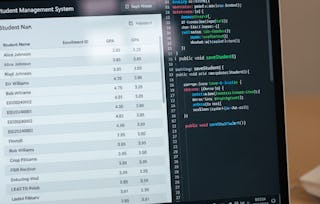
By completing this course, learners will be able to analyze real-world requirements, design data models using Java POJO classes, implement menu-driven console applications, apply robust input validation with regular expressions, and develop automated unit tests using JUnit to ensure code reliability.

Develop a Java Library Management System with JUnit

Gain insight into a topic and learn the fundamentals.
5 hours to complete
Flexible schedule
Learn at your own pace
What you'll learn
Design data models using Java POJO classes and collections.
Implement menu-driven console applications with validation.
Develop and execute JUnit tests to ensure code reliability.
Skills you'll gain
- Test Script Development
- Data Validation
- Java
- User Interface (UI)
- Object Oriented Design
- Verification And Validation
- Quality Assurance
- Software Engineering
- Unit Testing
- Data Modeling
- Application Development
- Object Oriented Programming (OOP)
- Software Quality Assurance
- Software Development
- Program Development
- Systems Development
- Test Case
- Software Testing
Tools you'll learn
Details to know

Shareable certificate
Add to your LinkedIn profile
Assessments
8 assignments
Taught in English
Recently updated!
February 2026
See how employees at top companies are mastering in-demand skills


Why people choose Coursera for their career

Felipe M.
Learner since 2018
"To be able to take courses at my own pace and rhythm has been an amazing experience. I can learn whenever it fits my schedule and mood."

Jennifer J.
Learner since 2020
"I directly applied the concepts and skills I learned from my courses to an exciting new project at work."

Larry W.
Learner since 2021
"When I need courses on topics that my university doesn't offer, Coursera is one of the best places to go."

Chaitanya A.
"Learning isn't just about being better at your job: it's so much more than that. Coursera allows me to learn without limits."