Computer Vision Courses
Computer vision courses can help you learn image processing, object detection, facial recognition, and video analysis. You can build skills in feature extraction, image classification, and deep learning techniques. Many courses introduce tools like OpenCV, TensorFlow, and PyTorch, that support implementing algorithms and developing applications that leverage artificial intelligence and AI for visual data interpretation.
Popular Computer Vision Courses and Certifications
 Status: Free
Skills you'll gain: Application Programming Interface (API), Microsoft Azure, Computer Vision, Artificial Intelligence and Machine Learning (AI/ML), User Accounts, Image Analysis, Artificial Intelligence, Cloud Solutions, Cloud Computing, Software Development
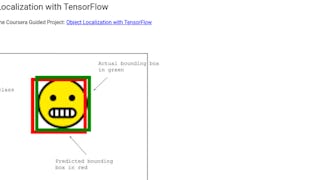
Skills you'll gain: Tensorflow, Keras (Neural Network Library), Image Analysis, Computer Vision, Artificial Neural Networks, Applied Machine Learning, Deep Learning, Machine Learning, Python Programming
Skills you'll gain: PyTorch (Machine Learning Library), Image Analysis, Deep Learning, Computer Vision, Python Programming
Skills you'll gain: PyTorch (Machine Learning Library), Image Analysis, Computer Vision, Applied Machine Learning, Deep Learning, Python Programming

Skills you'll gain: Keras (Neural Network Library), Tensorflow, Image Analysis, Artificial Neural Networks, Deep Learning, Machine Learning Methods, Computer Vision, Machine Learning
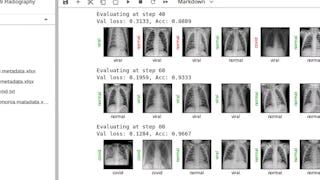
Skills you'll gain: PyTorch (Machine Learning Library), Image Analysis, Deep Learning, Artificial Neural Networks, Medical Imaging, Machine Learning, Computer Vision, X-Ray Computed Tomography
What brings you to Coursera today?

Skills you'll gain: Exploratory Data Analysis, Deep Learning, Plot (Graphics), Artificial Neural Networks, Matplotlib, Data Cleansing, Data Analysis, Tensorflow, Natural Language Processing, Data Processing, Data Manipulation, Python Programming, Machine Learning
Skills you'll gain: Keras (Neural Network Library), Deep Learning, Image Analysis, Tensorflow, Computer Vision, Machine Learning Methods, Applied Machine Learning, Artificial Neural Networks, Predictive Modeling, Machine Learning, Data Processing, Python Programming

Skills you'll gain: Image Analysis, Amazon Web Services, Image Quality, Computer Vision, Anomaly Detection, Software Quality Assurance, Data Science, Machine Learning, Cloud Computing

Coursera
Skills you'll gain: Hypertext Markup Language (HTML), Front-End Web Development, Web Design and Development, Web Development, Web Development Tools, Web Applications, Web Content, Integrated Development Environments
Skills you'll gain: Text Mining, Data Cleansing, PyTorch (Machine Learning Library), Data Manipulation, Data Processing, Performance Tuning, Deep Learning, Natural Language Processing, Machine Learning

Skills you'll gain: No-Code Development, Mobile Development, Google Sheets, Application Development, Application Design, Application Deployment, Data Structures, User Accounts, Personalized Service, User Feedback, Web Development, Marketing
Searches related to computer vision
In summary, here are 10 of our most popular computer vision courses
- Build a computer vision app with Azure Cognitive Services: Microsoft
- Object Localization with TensorFlow: Coursera
- Deep Learning with PyTorch : Image Segmentation : Coursera
- Aerial Image Segmentation with PyTorch : Coursera
- Basic Image Classification with TensorFlow: Coursera
- Detecting COVID-19 with Chest X-Ray using PyTorch: Coursera
- Fake News Detection with Machine Learning: Coursera
- Explainable AI: Scene Classification and GradCam Visualization : Coursera
- Build Image Quality Inspection using AWS Lookout for Vision: Coursera
- Introduction to HTML: Coursera










