Beginner Artificial Intelligence Courses
Artificial intelligence (AI) courses can help you learn machine learning algorithms, natural language processing, and computer vision techniques. You can build skills in data analysis, model evaluation, and ethical considerations in AI applications. Many courses introduce tools like TensorFlow, PyTorch, and Scikit-learn, that support implementing AI projects and analyzing data effectively.
Popular Beginner Artificial Intelligence Courses and Certifications
Skills you'll gain: Responsible AI, Machine Learning Methods, Generative AI Agents, Generative AI, Generative Model Architectures, Prompt Engineering Tools, AI literacy, AI Enablement, Risking, Retrieval-Augmented Generation, LLM Application, AI powered creativity, AI Workflows, Agentic systems, Agentic Workflows, Natural Language Processing

Google
Skills you'll gain: Generative AI, AI Enablement, Artificial Intelligence and Machine Learning (AI/ML), AI literacy, Model Training, Machine Learning, Innovation, Critical Thinking
SkillsBooster Academy
Skills you'll gain: ChatGPT, Prompt Engineering, Prompt Patterns, Email Automation, Infographics, OpenAI, AI literacy, Multimodal Prompts, Generative AI, Generative AI Agents, Research, AI Workflows, Content Creation, Context Engineering, Planning, Document Management, Time Management, Social Media Content, Project Documentation, Image Analysis
DeepLearning.AI
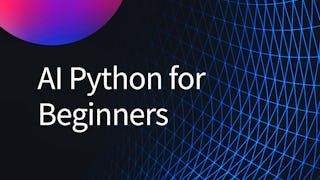
Skills you'll gain: Large Language Modeling, Prompt Engineering, LLM Application, Artificial Intelligence, Jupyter, Python Programming, Data Analysis, Artificial Intelligence and Machine Learning (AI/ML), Generative AI Agents, AI Integrations, Data Literacy, Application Development, Scripting, Programming Principles, Automation, Computer Programming, Application Programming Interface (API), Package and Software Management, Data Structures

SkillsBooster Academy
Skills you'll gain: Claude Code, Anthropic Claude, Vibe coding, Figma (Design Software), AI Workflows, AI Orchestration, Prompt Engineering, Software Development Tools, AI Integrations, Marketing Automation, Organizational Skills, Business Writing, Design, Generative AI, AI Security, User Interface and User Experience (UI/UX) Design, Code Review, Artificial Intelligence, Web Design, Strategic Thinking

What brings you to Coursera today?
Google
Skills you'll gain: Prompt Patterns, AI powered creativity, AI literacy, Artificial Intelligence, Generative AI, AI Personalization, Model Evaluation, Google Workspace
John Wiley & Sons
Skills you'll gain: Artificial Intelligence and Machine Learning (AI/ML), Artificial Intelligence, Machine Learning Methods, Generative AI, ChatGPT, Machine Learning Algorithms, Machine Learning, Natural Language Processing, Artificial Neural Networks, Applied Machine Learning, Large Language Modeling, Supervised Learning, Computer Vision, Unsupervised Learning, Deep Learning, Responsible AI, Automation, Reinforcement Learning, Robotics, Predictive Modeling

University of Illinois Urbana-Champaign
Skills you'll gain: Generative AI, Generative Model Architectures, Generative Adversarial Networks (GANs), Deep Learning, Responsible AI, Machine Learning Methods, Artificial Intelligence, Data Ethics, Machine Learning, Machine Learning Algorithms, AI literacy, Artificial Neural Networks, Convolutional Neural Networks, Regression Analysis, Law, Regulation, and Compliance, Classification Algorithms, Regulation and Legal Compliance

Politecnico di Milano
Skills you'll gain: Machine Learning Methods, Unsupervised Learning, Supervised Learning, Machine Learning Algorithms, Machine Learning, Applied Machine Learning, Intellectual Property, AI literacy, Responsible AI, Artificial Intelligence and Machine Learning (AI/ML), Legal Risk, Reinforcement Learning, Artificial Intelligence, General Data Protection Regulation (GDPR), Infrastructure Architecture, Dimensionality Reduction, Cloud Platforms, Deep Learning, Social Impact, Artificial Neural Networks

Knowledge Accelerators
Skills you'll gain: AI literacy, Productivity, LLM Application, Generative AI, AI Workflows, Microsoft Windows, Business Communication
Birla Institute of Technology & Science, Pilani
Skills you'll gain: Artificial Intelligence, Artificial Intelligence and Machine Learning (AI/ML), Reinforcement Learning, Computational Logic, Agentic systems, Bayesian Network, Decision Intelligence, Machine Learning, Bayesian Statistics, AI literacy, Markov Model, Algorithms, Computational Thinking, Probability, Model Optimization, Probability & Statistics, Probability Distribution

University of Pennsylvania
Skills you'll gain: Agentic systems, Artificial Intelligence, Algorithms, AI literacy, Python Programming, Responsible AI, Theoretical Computer Science
What brings you to Coursera today?
Best Beginner Artificial Intelligence courses from Google
Top-rated Beginner Artificial Intelligence courses offered by Google on Coursera.
- Introduction to AIGoogleBeginner1 - 4 WeeksGoogle
- AI FundamentalsGoogleBeginner1 - 3 MonthsGoogle
Best Beginner Artificial Intelligence certificate programs
Earn a certificate in Beginner Artificial Intelligence from top universities and companies.
- Claude AI Tools for BeginnersSkillsBooster AcademyBeginner3 - 6 MonthsSpecialization
- Artificial Intelligence: an OverviewPolitecnico di MilanoBeginner3 - 6 MonthsSpecialization
Best Beginner Artificial Intelligence courses for beginners
Top-rated beginner-friendly Beginner Artificial Intelligence courses with no prerequisites.
- Introduction to Artificial Intelligence (AI)IBMBeginner1 - 4 WeeksNo prerequisites
- Introduction to ChatGPT for BeginnersSkillsBooster AcademyBeginner1 - 3 MonthsNo prerequisites
- AI Python for BeginnersDeepLearning.AIBeginner1 - 4 WeeksNo prerequisites










