Library Courses
Library courses can help you learn cataloging, reference services, information literacy, and digital resource management. You can build skills in research techniques, data organization, and community outreach. Many courses introduce tools like integrated library systems and online databases, that support managing collections and providing access to information.
Popular Library Courses and Certifications
Skills you'll gain: Digital pedagogy, Education Software and Technology, Learning Management Systems, digital literacy
University of California, Davis
Skills you'll gain: Dashboard Creation, Dashboard, Data Storytelling, Tableau Software, Data Presentation, Data Visualization, Advanced Analytics, Stakeholder Analysis, Interactive Data Visualization, Data Visualization Software, Data Literacy, Exploratory Data Analysis, Data Ethics, Data Analysis, Graphing, Visualization (Computer Graphics), Data Mapping, Requirements Analysis, Data Wrangling, Storyboarding
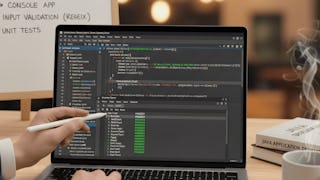
Skills you'll gain: JUnit, Java Programming, Unit Testing, Java, Test Script Development, Software Testing, Quality Assurance, Software Quality Assurance, Test Case, Software Development, Application Development, Data Validation, System Design and Implementation, User Interface (UI), Data Modeling
The University of North Carolina at Chapel Hill
Skills you'll gain: Data Sharing, Data Management, Data Storage, File Management, Data Security, Metadata Management, Data Integrity, Data Ethics, Data Access, Version Control

Pearson
Skills you'll gain: Surveys, Research, Research Methodologies, Qualitative Research, Investigation, Critical Thinking, Research Design, Data Collection, Interviewing Skills, Writing, Trustworthiness, Reliability

What brings you to Coursera today?

Skills you'll gain: Data Visualization, Prompt Engineering Tools, Prompt Patterns, AI powered creativity, AI literacy, AI Personalization, Generative AI, Timelines, LLM Application, Agentic Workflows, Spreadsheet Software, Ideation, Artificial Intelligence, Business Correspondence, Complex Problem Solving, Report Writing, Solution Design, Document Management, Critical Thinking, Machine Learning

Edureka
Skills you'll gain: Retrieval-Augmented Generation, Vector Databases, LangChain, Embeddings, Generative AI, LLM Application, Model Evaluation, Semantic Web, Computer Vision, Application Deployment, Large Language Modeling, Image Analysis, Artificial Intelligence, Prompt Engineering, Natural Language Processing, Performance Tuning, Data Processing, System Monitoring, Python Programming, Application Programming Interface (API)

Meta
Skills you'll gain: Jest (JavaScript Testing Framework), React.js, Web Development Tools, UI Components, Unit Testing, Mobile Development Tools, Code Reusability, JavaScript Frameworks, Frontend Integration, Webpack, Front-End Web Development, Application Development, Software Design Patterns, Javascript, Web Applications, Dataflow, Data Access, Hypertext Markup Language (HTML), Data Sharing, User Interface (UI)

Skills you'll gain: Object Oriented Design, Object Oriented Programming (OOP), File I/O, Program Development, Software Development, Automation, Data Structures, Code Reusability, Maintainability, File Management, Python Programming, Scalability, Scripting Languages, Data Persistence, JSON, Problem Solving
University of Michigan
Skills you'll gain: Anatomy, Cardiology, Neurology, Pulmonology, Medical Terminology, Biology

Skills you'll gain: File I/O, File Systems, File Management, Python Programming, System Programming, System Software, Mathematical Software, Test Data, OS Process Management, Arithmetic

Microsoft
Skills you'll gain: Microsoft Copilot, Generative AI, Responsible AI, Microsoft Teams, Microsoft Excel, Prompt Patterns, AI Orchestration, Analytics, AI literacy, Data Analysis, Prompt Engineering, AI Workflows, LLM Application, Email Automation, Advanced Analytics, Performance Reporting, Collaboration, Project Coordination, Proposal Development, Content Creation
What brings you to Coursera today?
Best free Library courses
High-quality free Library courses you can start today.
- Setting Up a Digital Library with EPICCourseraBeginnerLess Than 2 HoursFree
- Research Data Management and SharingThe University of North Carolina at Chapel HillMixed1 - 3 MonthsFree
Best Library courses from EDUCBA
Top-rated Library courses offered by EDUCBA on Coursera.
- Develop a Java Library Management System with JUnitEDUCBAMixed1 - 4 WeeksEDUCBA
- Advanced Python: OOP, File Handling & LibrariesEDUCBAMixed1 - 4 WeeksEDUCBA
Best Library certificate programs
Earn a certificate in Library from top universities and companies.
- Data Visualization with TableauUniversity of California, DavisBeginner3 - 6 MonthsSpecialization
- Google Prompting EssentialsGoogleBeginner1 - 4 WeeksSpecialization
- Video RAGEdurekaBeginner1 - 3 MonthsSpecialization
Best Library courses for beginners
Top-rated beginner-friendly Library courses with no prerequisites.
- AnatomyUniversity of MichiganBeginner3 - 6 MonthsNo prerequisites
- Microsoft AI Business ProfessionalMicrosoftBeginner3 - 6 MonthsNo prerequisites










