When you enroll in this course, you'll also be asked to select a specific program.
Learn new concepts from industry experts
Gain a foundational understanding of a subject or tool
Develop job-relevant skills with hands-on projects
Earn a shareable career certificate
There are 5 modules in this course
Companies of all sizes use Figma, making it a top requirement for a UX/UI career. Creating wireframes and interactive prototypes reduces development time by 20% by aligning teams and identifying issues early.
This course is your gateway to mastering the fundamentals of wireframing, prototyping, and usability testing with Figma, giving you job-ready skills and hands-on experience employers look for in a UX/UI designer.
During this course, you’ll gain hands-on experience using Figma, learning the essentials of building structured wireframes, user flows, and interactive prototypes, including gesture-based-UI. You’ll also explore Gestalt principles to build strong visual hierarchy, structure content through effective information architecture, and take a mobile-first design approach.
Through real-world challenges and usability testing, you’ll refine the designs you work on based on feedback and gain the confidence to solve UX problems with clarity and purpose. At the end of the course, in the final project, you’ll create a polished, high-fidelity prototype and your own reusable design system. Great to talk about in interviews!
If you’re looking to get hands-on using Figma for wireframing and prototyping, enroll today!
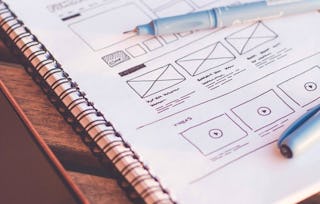
In this module, you will be introduced to fundamental wireframing techniques using Figma, covering essential tools, workflows, and design principles. You will also explore the Figma interface, core wireframing concepts (paper, low-fi, and mid-fi), and practical applications of Gestalt principles in UX design. Through hands-on labs, you will create and refine wireframes while developing efficient Figma workflows. The module emphasizes best practices for structuring layouts, using grids, and applying psychological design principles to create effective low-fidelity prototypes.
What's included
10 videos3 readings3 assignments9 plugins
Show info about module content
10 videos•Total 56 minutes
Course Introduction•3 minutes
Introduction to Figma Interface •5 minutes
Figma Basics: Frames, Shapes, and Components •3 minutes
Working with Grids in Figma•6 minutes
Understanding Wireframes and Their Types•7 minutes
Demo Video: Getting Started with Figma •5 minutes
Creating and Digitizing Paper Wireframes•6 minutes
Low-Fidelity Wireframing in Figma•7 minutes
Introduction to Gestalt Principles•6 minutes
Applying Gestalt Principles in UX/UI Design•7 minutes
3 readings•Total 8 minutes
Course Overview•4 minutes
Summary and Highlights: Getting Started with Figma Wireframes •2 minutes
Summary and Highlights: Effective Wireframing Practices •2 minutes
3 assignments•Total 41 minutes
Practice Quiz: Getting Started with Figma Wireframes•10 minutes
Practice Quiz: Effective Wireframing Practices•10 minutes
Graded Quiz: Wireframing Fundamentals with Figma•21 minutes
9 plugins•Total 115 minutes
Reading: How to Make the Most of this Course•2 minutes
Reading: Figma Tips and Shortcuts for Beginners •4 minutes
Reading: Figma Basics for Beginners •5 minutes
Lab: Setting Up a Wireframe in Figma •30 minutes
Lab: Create a Low-Fi Wireframe for a Mobile App•30 minutes
How Gestalt Principles Improve UX•5 minutes
Lab: Enhancing Wireframes Using Gestalt Principles•30 minutes
Reading: When to Use Paper, Low-Fi, and Mid-Fi Wireframes •4 minutes
Glossary: Wireframing Fundamentals with Figma •5 minutes
Prototyping and Usability Testing
Module 2•3 hours to complete
Module details
This module provides a comprehensive exploration of UX prototyping and evaluation methodologies. You will learn various prototyping approaches from paper sketches to interactive digital prototypes, gaining hands-on experience creating clickable mid-fidelity prototypes in Figma. The module then shifts focus to testing and evaluation strategies, covering usability testing methods, heuristic evaluation techniques, and data-driven design iteration. Through practical labs, you will apply these concepts by building functional prototypes and conducting professional design evaluations.
What's included
9 videos2 readings3 assignments5 plugins
Show info about module content
9 videos•Total 59 minutes
Introduction to Prototyping•8 minutes
Creating Interactive Low-Fi Prototypes in Figma •5 minutes
Understanding Clickable Prototypes and Transitions •5 minutes
Interactive Prototyping Tips •5 minutes
Prototype Presentation Techniques •6 minutes
Introduction to Usability Testing Methods •8 minutes
Heuristic Evaluation for UX Designs •7 minutes
Analyzing Usability Test Results •7 minutes
Iterating UX Designs After Testing •7 minutes
2 readings•Total 4 minutes
Summary and Highlights: Prototyping Methods and Techniques •2 minutes
Summary and Highlights: Testing and Evaluation Strategies •2 minutes
3 assignments•Total 41 minutes
Practice Quiz: Prototyping Methods and Techniques•10 minutes
Practice Quiz: Testing and Evaluation Strategies•10 minutes
Graded Quiz: Prototyping and Usability Testing•21 minutes
5 plugins•Total 87 minutes
Lab: Build a Clickable Mid-Fi Prototype in Figma•35 minutes
Reading: Prototyping Methods and Tools •7 minutes
Lab: Conducting a Heuristic Evaluation for a Prototype•30 minutes
Module Glossary: Prototyping and Usability Testing •5 minutes
UI Patterns and Design Systems
Module 3•4 hours to complete
Module details
In this module, you will explore foundational and advanced techniques for creating effective user interfaces across web and mobile platforms. You will also examine UI components, design patterns, and best practices for layouts while gaining hands-on experience in developing style guides, mood boards, and component libraries. The module also covers responsive and adaptive design principles, including mobile-first strategies, breakpoints, fluid layouts, and accessibility considerations. Through practical labs, you will apply these concepts by designing responsive wireframes and adaptive interfaces that ensure seamless user experiences across devices.
What's included
10 videos2 readings3 assignments7 plugins
Show info about module content
10 videos•Total 73 minutes
UI Components and Design Patterns in Mobile and Web •8 minutes
Best Practices for UI Layouts •6 minutes
Introduction to Design Systems •8 minutes
Creating a Moodboard and Style Guide •7 minutes
Building a Component Library in Figma •7 minutes
Designing for Different Screen Sizes •8 minutes
Breakpoints and Fluid Layouts in UI •7 minutes
Cross-Device UI Considerations •7 minutes
Mobile-First Design Strategy •8 minutes
Accessibility in Responsive UI •7 minutes
2 readings•Total 5 minutes
Summary and Highlights: UI Elements and Design Patterns•3 minutes
Summary and Highlights: Responsive and Adaptive UI Design •2 minutes
3 assignments•Total 41 minutes
Practice Quiz: UI Elements and Design Patterns•10 minutes
Practice Quiz: Responsive and Adaptive UI Design•10 minutes
Graded Quiz: UI Patterns and Design Systems•21 minutes
7 plugins•Total 129 minutes
Lab: Creating a Style Guide in Figma•40 minutes
Reading: Common Mobile and Web UI Patterns •8 minutes
Reading: The Role of Design Systems in UX •6 minutes
Lab: Hi-Fidelity Design Using a Style Guide•30 minutes
Module Glossary: UI Patterns and Design Systems •5 minutes
Interactive and Gesture-Based UI
Module 4•3 hours to complete
Module details
In this module, you will explore advanced UI/UX design techniques for modern digital interfaces, focusing on touch and gesture-based interactions and transitioning from mid-fidelity to high-fidelity prototypes. You will also examine the best practices for designing intuitive gesture-based navigation, mobile-specific interactions, and advanced gesture patterns. Additionally, you will learn how to enhance user experience through high-fidelity prototyping, micro-interactions, and animated UI components. Finally, the hands-on labs will provide practical experience in implementing gesture-based interactions and creating polished, interactive prototypes using industry-standard tools.
What's included
8 videos2 readings3 assignments5 plugins
Show info about module content
8 videos•Total 57 minutes
Designing for Touch and Gesture Inputs •8 minutes
UX Principles for Gesture-Based Navigation •7 minutes
Module Glossary: Interactive and Gesture-Based UI •5 minutes
Final Project, Final Exam, and Course Wrap-Up
Module 5•4 hours to complete
Module details
In this module, you’ll complete a hands-on final project where you’ll design a responsive eBook Public Library. You’ll create high-fidelity mockups, build a working prototype, and submit everything for peer review. This is a chance to put your skills into practice and create a project you can include in your portfolio.
You’ll also review key concepts with a course wrap-up, explore a clickable glossary of terms, and take the final exam to check your understanding before finishing the course.
In a world marked by relentless evolution, versatility, adaptability, and interdisciplinary skills are key to thriving professionally. At SkillUp, we focus on designing outcome-driven skill-development programs that transform lives and careers worldwide.
Whether it’s landing your first job, advancing in your career, mastering efficiency in your role, or making breakthroughs in diverse careers, our courses equip you with the skills and confidence to set you up to hit the ground running.
Combining sound instructional design, engaging multimedia, and real-world problem-solving, we create learning journeys that build knowledge step by step. We present learners with open-ended, real-world problems that help them apply acquired knowledge as they progress through their learning journey. This also allows learners to develop critical thinking, problem-solving, and collaborative skills.
Our courses, specializations, professional certificates, and virtual and blended learning programs help learners and organizations upskill on the world’s latest technologies, functional domains, and human skills.
This course is suitable for anyone who wants to design and prototype user experiences and interfaces. This includes those who want to become UI/UX Designers, Front-end, Web and Mobile Developers. To get the most from this course, you need to have a basic understanding of UX/UI principles and design.
Do I need prior design experience to enroll in this course?
Although no prior hands-on design experience is required, it is recommended that you have an understanding of fundamental design principles which you can gain by completing the previous courses in the IBM UI/UX Designer Professional Certificate or the SkillUp UI/UX Design Specialization.
Why is prototyping essential in UX/UI design?
Prototyping enables designers to visualize and test their ideas before full-scale development. It facilitates early identification of issues, promotes user feedback, and allows for rapid iteration, ultimately leading to a more refined and user-friendly product.
Will I gain practical experience with design tools during the course?
Yes. Throughout the course, you will work extensively with Figma, a popular industry-standard design tool, to develop wireframes and interactive prototypes, thereby acquiring valuable, real-world technical skills.
When will I have access to the lectures and assignments?
To access the course materials, assignments and to earn a Certificate, you will need to purchase the Certificate experience when you enroll in a course. You can try a Free Trial instead, or apply for Financial Aid. The course may offer 'Full Course, No Certificate' instead. This option lets you see all course materials, submit required assessments, and get a final grade. This also means that you will not be able to purchase a Certificate experience.
What will I get if I subscribe to this Certificate?
When you enroll in the course, you get access to all of the courses in the Certificate, and you earn a certificate when you complete the work. Your electronic Certificate will be added to your Accomplishments page - from there, you can print your Certificate or add it to your LinkedIn profile.