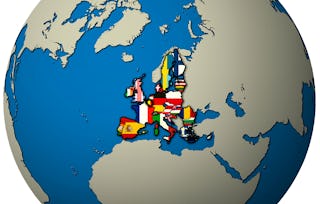
People have become more critical of EU policy and often seem to prefer local policy solutions in response to globalisation problems. How do you experience EU policy? Does it help? And if not, how can we change this? In this course, we learn how the European Union prepares and decides on policy, and how policy is transferred to member states and implemented by various authorities, including regional and local governments. We discuss the challenges of the European multi-level governance structure. We also focus on the main causes of policy failure or success. On this journey, we focus on actual policy and present the views of various experts: how easy is it to establish yourself in another EU-country? How do governments make sure that the air you breathe is clean? And who is responsible?
You will be able to do research together in your own local setting. Research on implementation in which you can make comparisons between different countries or areas. If you live outside the EU, this is not a problem. We have developed assignments in such a way that you can do research in your area and compare your findings with others.
This MOOC has been rated as one of the best MOOCs of 2017 and is currently in the Top 50 MOOCs of All Time of Class Central
So, are you curious? Please join: 'EU policy and implementation: making Europe work'. Watch our trailer video at https://www.youtube.com/watch?v=n3nSN9R3VR4
Great that you are joining us! In this course you will learn about the fascinating process of European policy-making and implementation. Before you start studying we invite you to go through our introduction module first. Please introduce yourself on the forum to meet your fellow learners. If you encounter any difficulties while studying, please let us know on the forum. For technical difficulties or questions regarding the course certificate, you can always contact the Coursera Learner Helpdesk. Good luck and we hope you will enjoy studying in this course!
What's included
3 videos4 readings1 discussion prompt1 plugin
Show info about module content
3 videos•Total 10 minutes
Trailer•2 minutes
Course introduction•6 minutes
How to succeed in your online class?•2 minutes
4 readings•Total 22 minutes
Course syllabus•5 minutes
Honors Track Syllabus•5 minutes
How we grade your quizzes and assignments•10 minutes
Meet the instructors & the team•2 minutes
1 discussion prompt•Total 15 minutes
Introduce yourself•15 minutes
1 plugin•Total 2 minutes
Discover The World at Leiden University [video]•2 minutes
Understanding policy and the European policy process
Module 2•16 hours to complete
Module details
The course starts by introducing the main concepts such as policy and the policy process, and includes a discussion of what decision-making is. It is shown that in making a decision the decided outcome is not always the most socially desirable state of affairs. This is important to understand in order to appreciate the imperfections of decision-making at the various levels of the European policy process. Furthermore, we explore the European multi-level policy process, as a starting point for the more specialized lectures in the subsequent weeks. In this week, students are also introduced to the policy dossiers to make their choice.
What is the problem? Residence rights and posting dossiers•17 minutes
What is the problem? Air quality dossier•7 minutes
Walkthrough for your assignment 1: Example for Air Quality dossier•7 minutes
4 readings•Total 105 minutes
Required readings•45 minutes
The Honors Track•10 minutes
Honors Track: Do you join us in our research? (Get your ID)•5 minutes
Required readings supporting the dossiers•45 minutes
8 assignments•Total 755 minutes
Research Assignment 1: What is the problem? Residence rights dossier•60 minutes
Research Assignment 1: What is the problem? Posting dossier•60 minutes
Research Assignment 1: What is the problem? Air quality dossier•60 minutes
Test your policy knowledge: exercise 1•30 minutes
How do we understand policy?•180 minutes
How do we understand decision-making?•180 minutes
End quiz week 1•180 minutes
Finish this module•5 minutes
2 discussion prompts•Total 25 minutes
Reflect on the European policy cycle•15 minutes
Motivate your choice of dossier on the forum•10 minutes
EU Decision-making
Module 3•17 hours to complete
Module details
Focusing on EU decision-making, the main question is: what can go wrong in the European decision-making process over legal measures? The lectures pay attention to the role of sectoral interests in the EU, and time. Policymakers often seem to be in a hurry, which may impact the choices that are made. Furthermore, in the last lecture we turn our perspective to the international context within which the EU operates. International agreements, for example, can be yet another source for further European legislation.
What can go wrong with EU decision-making?•6 minutes
Sectoral interests in the European Union•7 minutes
Brussels is always in a hurry•7 minutes
EU policymaking from an international perspective•6 minutes
What is the European policy? Residence rights and posting dossiers•19 minutes
What is the European policy? Air quality dossier•7 minutes
Walkthrough for assignment 2: Example for air quality dossier•6 minutes
4 readings•Total 120 minutes
Required reading: What can go wrong with EU decision-making•30 minutes
Required reading: Sectoral interest in the EU•30 minutes
Required reading: Brussels is always in a hurry•45 minutes
Required reading: EU policymaking from an international perspective•15 minutes
8 assignments•Total 845 minutes
Research Assignment 2: What are the goals? Residence rights dossier•90 minutes
Research Assignment 2: What are the goals? Posting dossier•90 minutes
Research Assignment 2: What are the goals? Air quality dossier•90 minutes
Test your policy knowledge: exercise 2•30 minutes
Sectoral interests in the European Union•180 minutes
Brussels is always in a hurry•180 minutes
End quiz week 2•180 minutes
Finish this module•5 minutes
1 discussion prompt•Total 10 minutes
Proposition about problem solving•10 minutes
Transposition
Module 4•14 hours to complete
Module details
Once legal measures have been adopted, the question arises as to what will happen next? For EU directives, the formal requirements need to be transformed into national legislation by member states. We discuss both a legal and a policy perspective on transposition, which provide rather different perspectives on this work. Adopted legal measures may also require further specification, which brings us to the preparation and adoption of delegated and implementing acts. For these acts the European Commission plays an important role. Finally, we look into the role of the European Commission as an actor overseeing transposition in the member states. Does the Commission act as the ‘guardian of the treaties’?
Transposition as behavior: a policy perspective on domestic actors•8 minutes
The Commission shaping European policy•7 minutes
The Commission as the guardian of the treaties•8 minutes
How is the European policy transposed? Residence rights and posting dossier•24 minutes
How is the European policy transposed? Air quality dossier•14 minutes
4 readings•Total 180 minutes
Required reading: Transposition as interpretation•60 minutes
Required reading: Transposition as behavior: a policy perspective on domestic actors•30 minutes
Required reading: The Commission shaping European policy•45 minutes
Required reading: The Commission as the guardian of the treaties•45 minutes
7 assignments•Total 480 minutes
Research assignment 3: How is the policy formulated? Residence rights dossier•90 minutes
Research assignment 3: How is the policy formulated? Air quality dossier•90 minutes
Transposition as interpretation•30 minutes
Transposition as behavior•30 minutes
The Commission shaping European policy•30 minutes
End quiz week 3•180 minutes
Test your policy knowledge: final quiz•30 minutes
2 discussion prompts•Total 100 minutes
National priorities and transposition•90 minutes
How to do legal research?•10 minutes
Implementation
Module 5•19 hours to complete
Module details
What can go wrong with implementation? In this week, we focus on the main causes of policy failure and success by discussing three different groups of theories. These address systemic features, such as time, capacity and culture, institutional or normative features related to groups and behavioral features. Each group of possible features is briefly explained and discussed in the lectures. Furthermore, attention is given to the involvement of regional and local governments in the implementation of European policy within member states, which provides yet another challenge to European policy implementation.
What's included
10 videos5 readings10 assignments
Show info about module content
10 videos•Total 126 minutes
What can go wrong with implementation?•7 minutes
Time, capacity and culture•8 minutes
Policy fit and related explanations•8 minutes
Behavioral explanations: interests and veto players•8 minutes
Involvement of regional and local governments in implementation•6 minutes
How is implementation nationally organized? Residents rights and posting dossiers•23 minutes
How is implementation nationally organized? Air quality dossier•14 minutes
How is the European policy implemented? Residents rights and posting dossiers•28 minutes
How is the European policy implemented? Air quality dossier•21 minutes
Walkthrough for assignment 4: Implementation (Air quality dossier)•4 minutes
5 readings•Total 255 minutes
Required reading: What can go wrong with implementation?•60 minutes
Required reading: Time, capacity and culture•45 minutes
Required reading: Policy fit and related explanations•45 minutes
Required reading: Behavioral explanations: interests and veto players•45 minutes
Required reading: Involvement of regional and local governments in implementation•60 minutes
10 assignments•Total 786 minutes
Research Assignment 4: How is the policy implemented? Residence rights dossier•120 minutes
Research Assignment 4: How is the policy implemented? Posting dossier•120 minutes
Research Assignment 4: How is the policy implemented? Air quality dossier•120 minutes
Time, capacity and culture•21 minutes
Policy fit and related explanations•30 minutes
Behavioral explanations: interests and veto players•30 minutes
Wiki on the organization of implementation•45 minutes
End quiz week 4•180 minutes
Implementation•0 minutes
Redesigning EU policymaking
Module 6•12 hours to complete
Module details
Having experienced the European policy process from European lawmaking to regional and perhaps local implementation, the last week reflects on ways to improve EU policymaking. How can EU policy, but also the policy process be redesigned? What is currently discussed in Brussels? And what are the options? The students will first be introduced to the Better Regulation Agenda of the European Commission, which also aims to improve policymaking. Three different directions of change are discussed in the lectures: (a) the ambition to close the European policy cycle by connecting ex-post evaluations with consultations and impact assessments as tools to prepare for new legislation; (b) introducing more experimentation to obtain better results, and (c) focusing on decentralization as a way of bringing back policymaking power to member states, regional governments or even local government.
Leiden University is one of Europe's foremost research universities. This prominent position gives our graduates a leading edge and prepares them for careers both within and outside of academia. Leiden University is the oldest university in the Netherlands, founded in 1575. Our motto is: Praesidium Libertatis (Bastion of Liberty) - Freedom of spirit, thought and expression. Leiden University has a campus in Leiden and The Hague, with 7 faculties, 47 Bachelor Programmes, 79 Master Programmes and nearly 30,000 students.
"To be able to take courses at my own pace and rhythm has been an amazing experience. I can learn whenever it fits my schedule and mood."
Jennifer J.
Learner since 2020
"I directly applied the concepts and skills I learned from my courses to an exciting new project at work."
Larry W.
Learner since 2021
"When I need courses on topics that my university doesn't offer, Coursera is one of the best places to go."
Chaitanya A.
"Learning isn't just about being better at your job: it's so much more than that. Coursera allows me to learn without limits."
Learner reviews
4.4
199 reviews
5 stars
63.68%
4 stars
23.38%
3 stars
6.96%
2 stars
2.48%
1 star
3.48%
Showing 3 of 199
M
MM
5·
Reviewed on Aug 16, 2017
Great course! It offers you important knowledge about the EU policy making process and shows and explains you the tools you need for a good analysis and which will help you to get the best results.
A
AO
5·
Reviewed on Nov 12, 2021
i give 5star very interesing course thumbs up 👍 EU policy and implementation🤩🤩
O
OS
5·
Reviewed on Aug 19, 2024
Amazing for people who want an insight about international politics even if they're not in university
When will I have access to the lectures and assignments?
To access the course materials, assignments and to earn a Certificate, you will need to purchase the Certificate experience when you enroll in a course. You can try a Free Trial instead, or apply for Financial Aid. The course may offer 'Full Course, No Certificate' instead. This option lets you see all course materials, submit required assessments, and get a final grade. This also means that you will not be able to purchase a Certificate experience.
What will I get if I purchase the Certificate?
When you purchase a Certificate you get access to all course materials, including graded assignments. Upon completing the course, your electronic Certificate will be added to your Accomplishments page - from there, you can print your Certificate or add it to your LinkedIn profile.
Is financial aid available?
Yes. In select learning programs, you can apply for financial aid or a scholarship if you can’t afford the enrollment fee. If fin aid or scholarship is available for your learning program selection, you’ll find a link to apply on the description page.