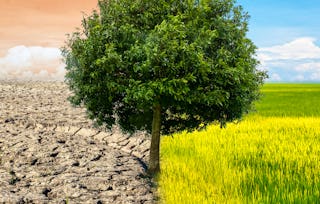
This class describes the science of global warming and the forecast for humans’ impact on Earth’s climate. Intended for an audience without much scientific background but a healthy sense of curiosity, the class brings together insights and perspectives from physics, chemistry, biology, earth and atmospheric sciences, and even some economics—all based on a foundation of simple mathematics (algebra).
What you will find in this class.
What's included
1 video4 readings
Show info about module content
1 video•Total 4 minutes
Video Introduction•4 minutes
4 readings•Total 40 minutes
Resources•10 minutes
Debriefing Quizzes•10 minutes
Explainer Assignments•10 minutes
A Supplemental Class to This One•10 minutes
Heat, Light, and Energy
Module 2•3 hours to complete
Module details
A primer on how to use units to describe numbers when describing temperature, energy, and light. Even if you don't plan on doing calculations yourself, understanding how units work will help to follow the rest of the lectures in the class. If you are interested in practicing your analysis skills, using units to guide calculations, there are some exercises in the Part II of this class.
What's included
6 videos2 assignments1 peer review
Show info about module content
6 videos•Total 28 minutes
Using Units•4 minutes
Units of Energy•5 minutes
Heat•4 minutes
Units of Light•3 minutes
Light•6 minutes
Blackbody Radiation•6 minutes
2 assignments•Total 60 minutes
Optional Problems: How Much Coal to Run a Light Bulb•30 minutes
Optional Problems: Comparing Energy Prices•30 minutes
1 peer review•Total 120 minutes
What is heat and how can you warm up something in space?•120 minutes
First Climate Model
Module 3•2 hours to complete
Module details
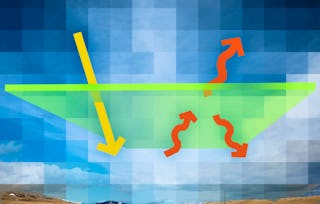
The balance of energy flow, as incoming sunlight and outgoing infrared, allow us to create our first simple climate model, including a simple greenhouse effect. There are two extended exercises in Part II of this class, one an analytical (algebraic) model of the equilibrium temperature of a planet, the other a numerical model of how that temperature might evolve through time.
What's included
2 videos4 assignments
Show info about module content
2 videos•Total 18 minutes
Naked Planet Climate Model•8 minutes
The Greenhouse Effect •10 minutes
4 assignments•Total 86 minutes
Optional Layer Model Problem: How Hot is the Moon?•4 minutes
Optional Layer Model Problem 2: A Stronger Greenhouse Effect•22 minutes
Optional Layer Model Problem 3: Nuclear Winter•30 minutes
Quiz 1•30 minutes
Greenhouse Gases and the Atmosphere
Module 4•1 hour to complete
Module details
The Layer Model above assumes that the pane of glass representing the atmosphere absorbs all of the infrared radiation that hits it and that it radiates at all infrared wavelengths. In other words, the layer model atmosphere is an infrared blackbody, but transparent in the visible. In reality, greenhouse gases are not "black" at all; they are very choosy about which frequencies of light they absorb and emit. This selective absorption of infrared light by greenhouse gases leads to the band saturation effect, which makes rare, trace gases like methane disproportionally powerful relative to higher-concentration gases like CO₂.
What's included
2 videos1 assignment
Show info about module content
2 videos•Total 20 minutes
Greenhouse Gas Physics•8 minutes
The Band Saturation Effect•13 minutes
1 assignment•Total 30 minutes
Model Greenhouse Gases in the Atmosphere•30 minutes
The Structure of the Atmosphere
Module 5•1 hour to complete
Module details
The greenhouse effect works because the air in the upper atmosphere is colder than the ground, so that absorption and re-emission of IR by greenhouse gases decreases the amount of energy leaving the planet to space. Here we explore the physics responsible for keeping the upper atmosphere cold.
What's included
4 videos1 assignment
Show info about module content
4 videos•Total 30 minutes
Atmospheric Temperature Structure•9 minutes
Pressure in a Standing Fluid•11 minutes
Water Vapor and Latent Heat•9 minutes
Moist Convection•2 minutes
1 assignment•Total 10 minutes
Model the Lapse Rate and Greenhouse Effect•10 minutes
Weather and Climate
Module 6•1 hour to complete
Module details
Another property of the real world, missing in our model so far, is that the real world is not everywhere the same temperature, and the heat fluxes to and from space do not necessarily balance at any given time or location. This is because the winds in the atmosphere and the currents in the ocean carry heat around, in general from the hot tropics up to the cold high latitudes.
What's included
4 videos1 assignment
Show info about module content
4 videos•Total 18 minutes
Heat Transport•3 minutes
Coriolis Acceleration•5 minutes
Geostrophic Motion•5 minutes
The Turbulent Cascade•3 minutes
1 assignment•Total 30 minutes
Quiz 2•30 minutes
Feedbacks
Module 7•6 hours to complete
Module details
Feedbacks are loops of cause-and-effect that can either stabilize Earth's climate or amplify future climate changes. There is an exercise in Part II of this class where you solve for a planet's temperature by iteration, and in the process demonstrate a runaway ice albedo feedback that might have led to the Snowball Earth climate state 700 million years ago.
What's included
6 videos7 assignments1 peer review
Show info about module content
6 videos•Total 34 minutes
Positive and Negative Feedback•5 minutes
Ice Albedo Feedback•2 minutes
Water Vapor Feedback•7 minutes
Clouds•9 minutes
Aerosols•6 minutes
Climate Sensitivity•5 minutes
7 assignments•Total 204 minutes
Model Sunlight, Albedo, and Climate•30 minutes
Extract the Water Vapor Feedback from Climate Model Results•30 minutes
Model Clouds 1: IR•30 minutes
Model Clouds 2: Full-spectrum•30 minutes
Model Aerosols and Climate•30 minutes
Calculate the Climate Sensitivity•24 minutes
Quiz 3•30 minutes
1 peer review•Total 120 minutes
What are positive and negative feedbacks?•120 minutes
The Carbon Cycle
Module 8•2 hours to complete
Module details
Now we shift gears in a major way — away from climate physics (you now have seen its main ingredients) to the emergent miracle that is the carbon cycle on Earth. Not only is carbon the chemical element of life, it is also the means of storing life's energy. We will look at how carbon cycles through the land, the oceans, and the deep earth, going in and out of the atmosphere -- and how that stabilizes the earth's climate.
What's included
9 videos4 assignments
Show info about module content
9 videos•Total 48 minutes
The Weathering CO₂ Thermostat•9 minutes
The Goldilocks Planets•4 minutes
The Oceans in the Carbon Cycle•5 minutes
The Land Biosphere in the Carbon Cycle•5 minutes
The Battery of the Biosphere•5 minutes
Oxidation and Reduction of Carbon•6 minutes
Coal•4 minutes
Oil•7 minutes
Natural Gas•3 minutes
4 assignments•Total 78 minutes
Model the Global Carbon Cycle•30 minutes
Model Ocean/Land CO₂ Uptake with ISAM•12 minutes
Model Intended vs. Greenhouse Yields•6 minutes
Quiz 4•30 minutes
The Perturbed Carbon Cycle
Module 9•6 hours to complete
Module details
On the carbon locked up in fossil fuels and what happens when we burn those fuels. In Part II of this class, you can create a simple but somewhat realistic model of Earth's temperature evolution in the coming decades, in response to the release of CO2 (or in the sudden stop of emissions in a scenario called "The world without us").
What's included
7 videos5 assignments2 peer reviews
Show info about module content
7 videos•Total 37 minutes
Forecasting Future Emissions•4 minutes
Where Our Carbon Is Going•3 minutes
Ocean Buffer Chemistry•6 minutes
The Perturbed Carbon Cycle•3 minutes
Methane as a Greenhouse Gas•9 minutes
The Long CO₂ Tail•6 minutes
Why the CO₂ Tail Matters•7 minutes
5 assignments•Total 150 minutes
Model Hubbert's Peak•30 minutes
Model Kaya Identity•30 minutes
Model Methane and Slugulator•30 minutes
Model the Long Tail•30 minutes
Quiz 5•30 minutes
2 peer reviews•Total 180 minutes
Fossilizing a Carbon Atom•60 minutes
Burning a Carbon Atom•120 minutes
Looking for a Human Impact on Climate
Module 10•3 hours to complete
Module details
You have now seen the ideas behind the forecast for a human impact on Earth's climate. The next question is: Do we see it happening today? It turns out that the "smoking gun" for a human impact on climate is the global average temperature record since about the 1970's. In order to interpret that temperature change, we need to consider it within the context of natural climate changes in Earth's geologic past.
What's included
10 videos6 assignments1 peer review
Show info about module content
10 videos•Total 45 minutes
Land Surface Temperature Records•4 minutes
Sea Surface Temperature Records•3 minutes
Satellite Temperature Records•2 minutes
The Smoking Gun: Warming Since the 1970s•7 minutes
Paleoclimate and Proxy Measurements•4 minutes
Tree Rings•4 minutes
Borehole Temperatures•3 minutes
Oxygen Isotopes•5 minutes
Solar Intensity and the Hockey Stick•6 minutes
Glacial - Interglacial Cycles•6 minutes
6 assignments•Total 86 minutes
Make Maps of Climate Models Warming•30 minutes
Look for the Smoking Gun•10 minutes
Browse the Global Glacier Length Data•4 minutes
Model Borehole Temperatures•4 minutes
Analyze Recent Solar Intensity Changes•8 minutes
Quiz 6•30 minutes
1 peer review•Total 60 minutes
Is it Warming? Is It Us? How Do We Know?•60 minutes
Potential Impacts
Module 11•7 hours to complete
Module details
This unit we focus on the potential impacts of continued business-as-usual CO2 emissions. This is also the topic of the Working Group 2 volume of the IPCC reports (the Working Group 1 report is on the scientific basis, which is what we've been studying so far this course). You may find this material distressing, but hang on, because next week we'll go over "Mitigation", which is what it takes to avoid climate change (treated in the Working Group 3 report). Remember that most of the carbon we're worried about is still in the ground, so these impacts are inevitable only if we continue to decide to make them so. In Part II of this class, you can create a simple ice sheet model of your own.
What's included
12 videos9 assignments1 peer review
Show info about module content
12 videos•Total 30 minutes
Global Weirding•4 minutes
Monsoons•2 minutes
Vegetation•3 minutes
Impacts of Sea Level•2 minutes
Antarctic Ice Sheet•3 minutes
Greenland Ice Sheet•4 minutes
Paleo Sea Level Changes•2 minutes
Water Vapor and Storminess•1 minute
Hurricanes•3 minutes
Extreme Weather•2 minutes
Ecosystem Impacts•3 minutes
Human Impacts•2 minutes
9 assignments•Total 242 minutes
Water Stress in Climate Model Results•30 minutes
Model Permafrost•30 minutes
Model Changes in Sea Level•30 minutes
Play with an Ice Sheet Model, ISM•30 minutes
Short vs Long Term Sea Level Change•12 minutes
Find the Increase in Low-Level Humidity in Models•30 minutes
Extract AR5 Model Lapse Rates•30 minutes
Model Hurricanes•30 minutes
Quiz 7•20 minutes
1 peer review•Total 120 minutes
Global Weirding•120 minutes
Mitigation
Module 12•7 hours to complete
Module details
The last unit of the class finds us considering the options for avoiding, or "mitigating," a human impact on Earth's climate. Bottom line: I think it would be a challenge that humankind could beat if we decided to. If there hypothetically were no more coal on Earth, our potential to alter the climate would be much less. Finding energy sources in that world would not be an existential threat would just be a business opportunity. The hard part, in my opinion, is making that decision.
What's included
8 videos1 reading8 assignments2 peer reviews
Show info about module content
8 videos•Total 38 minutes
Stabilization Scenarios•2 minutes
Temperature Targets•2 minutes
Slug Theory•6 minutes
Geoengineering: CO₂ Capture and Sequestration•7 minutes
Geoengineering: Solar Radiation Management•4 minutes
Economics of Climate Change•9 minutes
Mitigation: Short-Term•4 minutes
Mitigation: Long-Term•4 minutes
1 reading•Total 10 minutes
Survey on Attitudes toward MOOC technology•10 minutes
8 assignments•Total 212 minutes
Model Stabilization Scenarios•2 minutes
Model Temperature Targets•30 minutes
How well does Slugulator do at Slug Theory?•30 minutes
Model CO2 Sequestration•30 minutes
Model SRM Geoengineering•30 minutes
How Many Wedges?•30 minutes
How Much Carbon-Free Energy by 2100?•30 minutes
Quiz 8•30 minutes
2 peer reviews•Total 180 minutes
Is there Hope for the 11-year-old?•120 minutes
Term Project: Explore Climate Data and Models•60 minutes
Instructor
Instructor ratings
Instructor ratings
We asked all learners to give feedback on our instructors based on the quality of their teaching style.
One of the world's premier academic and research institutions, the University of Chicago has driven new ways of thinking since our 1890 founding. Today, UChicago is an intellectual destination that draws inspired scholars to our Hyde Park and international campuses, keeping UChicago at the nexus of ideas that challenge and change the world.
OK
Explore more from Environmental Science and Sustainability
"To be able to take courses at my own pace and rhythm has been an amazing experience. I can learn whenever it fits my schedule and mood."
Jennifer J.
Learner since 2020
"I directly applied the concepts and skills I learned from my courses to an exciting new project at work."
Larry W.
Learner since 2021
"When I need courses on topics that my university doesn't offer, Coursera is one of the best places to go."
Chaitanya A.
"Learning isn't just about being better at your job: it's so much more than that. Coursera allows me to learn without limits."
Learner reviews
4.6
460 reviews
5 stars
76.95%
4 stars
12.82%
3 stars
4.56%
2 stars
1.52%
1 star
4.13%
Showing 3 of 460
R
RC
5·
Reviewed on Jun 26, 2020
A detailed and really knowledgable course. The course structure and the knowledge shared by Prof. David made learning simple and interesting. The assignments are also very well structured.
R
RH
5·
Reviewed on Mar 18, 2016
I found this course very interesting and informative and it has helped me understand and debate climate change to a much greater capacity
S
SL
5·
Reviewed on Oct 5, 2016
A great introductory course into Global Warming as well as modelling which gives you a better insight into what is actually happening with our planet. Started another course and it all fits in.
When will I have access to the lectures and assignments?
To access the course materials, assignments and to earn a Certificate, you will need to purchase the Certificate experience when you enroll in a course. You can try a Free Trial instead, or apply for Financial Aid. The course may offer 'Full Course, No Certificate' instead. This option lets you see all course materials, submit required assessments, and get a final grade. This also means that you will not be able to purchase a Certificate experience.
What will I get if I purchase the Certificate?
When you purchase a Certificate you get access to all course materials, including graded assignments. Upon completing the course, your electronic Certificate will be added to your Accomplishments page - from there, you can print your Certificate or add it to your LinkedIn profile.
Is financial aid available?
Yes. In select learning programs, you can apply for financial aid or a scholarship if you can’t afford the enrollment fee. If fin aid or scholarship is available for your learning program selection, you’ll find a link to apply on the description page.