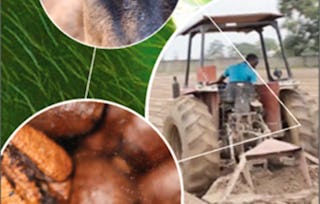
This course provides an overview of the issue of postharvest loss of grains by exploring essential physical, technical, and social dimensions of postharvest supply chains and loss prevention methods globally.
Each year, estimates suggest that 1/3 of all food produced is lost or wasted, making postharvest loss a critical global food security and sustainability issue of today. Key knowledge areas are presented including:
-An overview of postharvest loss
-Supply chain activities such as harvesting, drying, and storage
-Economics and markets
-An introduction to the network of actors working in this field
We face the immense challenge of feeding over 9 billion people by the year 2050. To meet these demands, yields will have to more than double using the same amount of natural resources. In recent years, postharvest loss has been recognized by major institutions including the US government, the United Nations, the CGIAR Research Consortium, and several others as a significant opportunity to impact food security and improve livelihoods. Despite this increased attention, a lack of knowledge, technical capacity, and resources remain obstacles for stakeholders worldwide to act on these issues. This course will, for the first time, provide you as professionals, practitioners, and students, with a comprehensive introduction to postharvest loss processes and begin building capacity for loss prevention worldwide.
In this module, you will become familiar with the course, your instructor, your classmates, and our learning environment.
What is Postharvest Loss and Why is it a Global Issue?•12 minutes
4 readings•Total 40 minutes
Syllabus•10 minutes
About the Discussion Forums•10 minutes
Updating Your Profile•10 minutes
Social Media•10 minutes
1 assignment•Total 30 minutes
Orientation Quiz•30 minutes
1 discussion prompt•Total 10 minutes
Getting to Know Your Classmates•10 minutes
1 plugin•Total 15 minutes
Welcome! Please tell us about yourself.•15 minutes
Week 1: Problem: Global Postharvest Loss
4 hours to complete
Module details
This module will provide you with an overview of the issue of postharvest loss (PHL) and how this impacts global food security and sustainability. It will also define the postharvest supply chain.
What's included
3 videos2 readings1 assignment1 peer review
Show info about module content
3 videos•Total 41 minutes
1.1. Food Insecurity: An Overview and Some Potential Solutions •17 minutes
1.2. Role of Water in Food Security: Global Perspectives•16 minutes
1.3. Overview of the Postharvest Supply Chain and the Role of Mechanization •9 minutes
2 readings•Total 20 minutes
Week 1 Overview•10 minutes
Week 1 Readings and Resources•10 minutes
1 assignment•Total 30 minutes
Week 1 Quiz•30 minutes
1 peer review•Total 120 minutes
Week 1 Peer Assessment•120 minutes
Week 2: Causes: Major Causes & Encounters for PHL
4 hours to complete
Module details
This module will introduce you to technical, social, and economic factors and situations that lead to postharvest losses. Harvesting, drying, and storage phases will be specifically covered as stages that are both vital in the grain supply chain and in which a great deal of postharvest losses are experienced.
What's included
6 videos2 readings1 assignment1 peer review
Show info about module content
6 videos•Total 81 minutes
2.1. Overview of Grain Harvesting: Methods, Equipment, and Losses •21 minutes
2.2.1. Grain Drying: Basic Principles of Drying •10 minutes
2.2.2. Grain Drying: Drying Methods •11 minutes
2.2.3. Grain Cleaning: Methods and Equipment •8 minutes
2.3. Grain Storage and Management •13 minutes
2.4 The Economics of Postharvest Loss: Structural Issues •18 minutes
2 readings•Total 20 minutes
Week 2 Overview•10 minutes
Week 2 Readings and Resources•10 minutes
1 assignment•Total 40 minutes
Week 2 Quiz•40 minutes
1 peer review•Total 120 minutes
Week 2 Peer Assessment•120 minutes
Week 3: Solutions: A Prevention Framework for PHL
5 hours to complete
Module details
This module will introduce you to a conceptual framework for how losses can be prevented. Theories, methods, and case examples on prevention will be covered.
What's included
9 videos2 readings1 assignment1 peer review
Show info about module content
9 videos•Total 95 minutes
3.1. The Economics of Loss •14 minutes
3.2.1. Asking the Most Useful Questions •11 minutes
3.2.2. Tale of Two Cases: What Has Worked and What Hasn't Worked •9 minutes
3.2.3. Enabling Good Decisions by Creating a Market-Like Environment •5 minutes
3.3. Effective Extension for the Prevention of Postharvest Losses •13 minutes
3.4. Working in Subsistence Marketplaces •7 minutes
3.5. Modernizing Extension and Advisory Services •13 minutes
In this module you will explore how the international community is responding to the issue of postharvest loss. The module will cover the current state of the postharvest loss prevention field, as well as provide background as to how it developed. Some key projects, initiatives, and approaches will be highlighted.
What's included
5 videos2 readings2 assignments1 plugin
Show info about module content
5 videos•Total 50 minutes
4.1.1. Food Security on the Modern International Agenda •6 minutes
4.1.2. Trends in International Awareness of Postharvest Loss: From Kissinger to 2015 •9 minutes
4.2. Solving Problems as an International Community: Benefits and Challenges of Collaborating for Food Loss Reduction •12 minutes
4.3. SAVE FOOD Partnership and the Community of Practice on Food Loss Reduction •8 minutes
4.4. The ADM Institute Approach to Postharvest Loss Prevention •15 minutes
2 readings•Total 20 minutes
Week 4 Overview•10 minutes
Week 4 Readings and Resources•10 minutes
2 assignments•Total 116 minutes
Week 4 Quiz•40 minutes
Final Quiz•76 minutes
1 plugin•Total 15 minutes
How was the course?•15 minutes
Instructor
Instructor ratings
Instructor ratings
We asked all learners to give feedback on our instructors based on the quality of their teaching style.
The University of Illinois at Urbana-Champaign is a world leader in research, teaching and public engagement, distinguished by the breadth of its programs, broad academic excellence, and internationally renowned faculty and alumni. Illinois serves the world by creating knowledge, preparing students for lives of impact, and finding solutions to critical societal needs.
OK
Explore more from Environmental Science and Sustainability
"To be able to take courses at my own pace and rhythm has been an amazing experience. I can learn whenever it fits my schedule and mood."
Jennifer J.
Learner since 2020
"I directly applied the concepts and skills I learned from my courses to an exciting new project at work."
Larry W.
Learner since 2021
"When I need courses on topics that my university doesn't offer, Coursera is one of the best places to go."
Chaitanya A.
"Learning isn't just about being better at your job: it's so much more than that. Coursera allows me to learn without limits."
Learner reviews
4.7
178 reviews
5 stars
74.71%
4 stars
24.15%
3 stars
0.56%
2 stars
0.56%
1 star
0%
Showing 3 of 178
L
LL
5·
Reviewed on Nov 17, 2020
The online course is good for students and even professionals. This will help upskill the student and review past knowledge for the professionals. Thank you so much
M
MI
5·
Reviewed on Feb 11, 2021
course is very easy. I enjoy this course. This course is very good and more knowledgeable and informational.
S
SA
5·
Reviewed on Oct 13, 2020
Now I know that just Production is not enough.Through this course, I gained enough and deep understanding on how Losses happen, solutions.Very well organized course with quality and clear content s.
When will I have access to the lectures and assignments?
To access the course materials, assignments and to earn a Certificate, you will need to purchase the Certificate experience when you enroll in a course. You can try a Free Trial instead, or apply for Financial Aid. The course may offer 'Full Course, No Certificate' instead. This option lets you see all course materials, submit required assessments, and get a final grade. This also means that you will not be able to purchase a Certificate experience.
What will I get if I purchase the Certificate?
When you purchase a Certificate you get access to all course materials, including graded assignments. Upon completing the course, your electronic Certificate will be added to your Accomplishments page - from there, you can print your Certificate or add it to your LinkedIn profile.
Is financial aid available?
Yes. In select learning programs, you can apply for financial aid or a scholarship if you can’t afford the enrollment fee. If fin aid or scholarship is available for your learning program selection, you’ll find a link to apply on the description page.