Mathematics Courses
Mathematics courses cover topics such as algebra, calculus, geometry, statistics, and discrete math. You can learn to solve equations, analyze data, and understand mathematical theories. Tools like graphing calculators and software such as MATLAB or R may also be introduced to help visualize concepts and perform calculations.
Popular Mathematics Courses and Certifications

Emory University
Skills you'll gain: Regression Analysis, Data Visualization, Data Storytelling, Statistical Visualization, Business Mathematics, Descriptive Statistics, General Mathematics, Microsoft Excel, Statistics, Excel Formulas, Statistical Analysis, Statistical Methods, Algebra, Probability & Statistics, Calculus, Applied Mathematics, Business
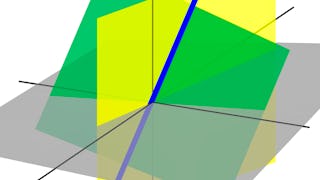
Johns Hopkins University
Skills you'll gain: Linear Algebra, Algebra, Advanced Mathematics, Engineering Analysis, Applied Mathematics, Mathematical Theory & Analysis, Geometry

Northeastern University
Skills you'll gain: Statistical Analysis, Statistical Methods, Statistical Hypothesis Testing, Dimensionality Reduction, Statistics, Probability & Statistics, Linear Algebra, Statistical Inference, Digital Signal Processing, Biological Engineering, Image Analysis, Experimentation, Biomedical Engineering, Applied Mathematics, Regression Analysis, Feature Engineering, Unsupervised Learning, Data Transformation

Deep Teaching Solutions
Skills you'll gain: Student Engagement, Differentiated Instruction, Lifelong Learning, Persistence, Learning Theory, Problem Solving
Skills you'll gain: Education Software and Technology, Mathematics Education

University of Glasgow
Skills you'll gain: Model Training, Model Evaluation, Matlab, Data Preprocessing, Model Optimization, Scientific Visualization, Artificial Intelligence and Machine Learning (AI/ML), Machine Learning Methods, Statistical Methods, Machine Learning Software, Mathematical Software, Statistical Machine Learning, Data Wrangling, Applied Mathematics, Data Validation, Data Processing, Mathematical Modeling, Artificial Neural Networks, Engineering Analysis, Engineering Design Process
University of London
Skills you'll gain: Combinatorics, Probability & Statistics, Data Analysis, Advanced Mathematics, Linear Algebra, Mathematics and Mathematical Modeling, Mathematical Theory & Analysis, Geometry, Applied Mathematics, Statistics, Statistical Analysis, Statistical Methods, Probability, Algorithms, Algebra, Descriptive Statistics

Johns Hopkins University
Skills you'll gain: Data Literacy, Data Analysis, Applied Mathematics, Mathematical Modeling, Data Modeling, Systems Of Measurement, Correlation Analysis, Regression Analysis, Trigonometry

University of Colorado System
Skills you'll gain: Cryptography, Arithmetic, Algorithms, Applied Mathematics, Probability, Computer Science

University of Alberta
Skills you'll gain: Computational Thinking, Video Game Development, Game Design, Software Quality (SQA/SQC), Problem Solving, Programming Principles, Computer Programming, Program Development, Algorithms, Python Programming, Computer Science, Debugging, Test Planning, Functional Testing, Other Programming Languages
Johns Hopkins University
Skills you'll gain: Trigonometry, Probability, Data Analysis, Probability & Statistics, Statistical Analysis, Advanced Mathematics, Algebra, Probability Distribution, Descriptive Statistics, Mathematical Modeling, Graphing, Applied Mathematics, Statistics, Geometry, Arithmetic

University of California San Diego
Skills you'll gain: Cryptographic Protocols, Cryptography, Key Management, Encryption, Cybersecurity, Arithmetic, Algorithms, Python Programming
How to choose the right Mathematics course
Start with what you want to study in mathematics. If you're focused on pure mathematics, look for courses covering abstract algebra, topology, or number theory. If you want to apply mathematics to real-world problems, choose courses that focus on statistics, calculus applications, or mathematical modeling. Compare the course content to see which aligns with your interests.










