Predictive Analytics Courses
Predictive analytics courses can help you learn data collection techniques, statistical modeling, and machine learning fundamentals. You can build skills in interpreting data patterns, making forecasts, and evaluating model performance. Many courses introduce tools like R, Python, and Tableau, that support analyzing datasets and visualizing results. You'll also explore key topics such as regression analysis, time series forecasting, and risk assessment, equipping you to make informed decisions based on predictive insights.
Popular Predictive Analytics Courses and Certifications
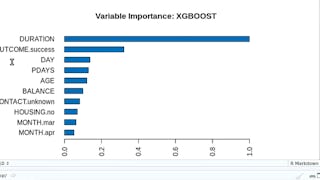
Skills you'll gain: R Programming, Predictive Analytics, Applied Machine Learning, Predictive Modeling, Data Pipelines, R (Software), Data-Driven Decision-Making, Analytics, Data Science, Data Processing, Machine Learning Software, Feature Engineering, Data Preprocessing, Statistical Machine Learning, Machine Learning Methods, Machine Learning, Model Training, Telemarketing, Model Deployment, Model Optimization

Skills you'll gain: Blogs, Content Performance Analysis, Google Analytics, Web Analytics, Promotional Strategies, Customer Engagement, Social Media Marketing, Social Media Analytics, Social Media, Customer Relationship Building, Content Marketing, Content Creation, Content Management Systems, Marketing
Skills you'll gain: Power BI, Data Transformation, Data Preprocessing, Data Manipulation, Data Cleansing, Data Integration, Data Wrangling, Predictive Modeling
Skills you'll gain: Pandas (Python Package), Scatter Plots, Histogram, Correlation Analysis, Data Visualization, Data Manipulation, Plot (Graphics), Data Wrangling, Data Import/Export, JSON, Statistical Visualization, Data Cleansing, Data Preprocessing, Exploratory Data Analysis, Data Analysis, Python Programming

Skills you'll gain: Model Evaluation, Forecasting, Trend Analysis, Statistical Visualization, Spreadsheet Software, Regression Analysis, Time Series Analysis and Forecasting, Statistical Methods, Statistical Analysis, Plot (Graphics), Predictive Modeling, Data-Driven Decision-Making, Data Analysis

What brings you to Coursera today?

Skills you'll gain: Dashboard, Microsoft Excel, Microsoft 365, Microsoft Office, Spreadsheet Software, Data Visualization, Document Management, Trend Analysis, Data Analysis
Skills you'll gain: Market Opportunities, Product Strategy, Competitive Analysis, Business Strategy, Product Planning, New Business Development, Business Solutions, Market Analysis, Business Analysis, Product Development, Business Planning, Entrepreneurship, Growth Strategies, Innovation

Skills you'll gain: Excel Formulas, Spreadsheet Software, Microsoft Excel, Microsoft Office, Microsoft 365, Data Analysis, Gross Profit, Business Mathematics
Skills you'll gain: Competitive Analysis, Business Strategy, Market Dynamics, Market Analysis, Market Opportunities, Market Intelligence, Strategic Thinking, Entrepreneurship, Market Research, New Business Development, Business Analysis Tools, Innovation
Skills you'll gain: Ggplot2, Model Evaluation, Plot (Graphics), Regression Analysis, Predictive Analytics, Predictive Modeling, Statistical Visualization, Data-Driven Decision-Making, Statistical Modeling, R Programming, Descriptive Statistics, R (Software), Exploratory Data Analysis, Descriptive Analytics, Statistical Analysis, Data Analysis
Skills you'll gain: Data Visualization, Microsoft Excel, Trend Analysis, Statistical Visualization, Pivot Tables And Charts, Data Visualization Software, Data Presentation, Spreadsheet Software, Plot (Graphics), Market Trend, Data Analysis, Exploratory Data Analysis
Skills you'll gain: PyTorch (Machine Learning Library), Model Training, Convolutional Neural Networks, Transfer Learning, Image Analysis, Predictive Modeling, Deep Learning, Radiology, Medical Imaging, Computer Vision, Machine Learning, Data Preprocessing, Data Transformation
What brings you to Coursera today?
Best free Predictive Analytics courses
High-quality free Predictive Analytics courses you can start today.
- Creating a Free Business Page with BloggerCourseraBeginnerLess Than 2 HoursFree
- Predicción de Ventas Pronosticando TendenciasCourseraIntermediateLess Than 2 HoursFree
- Create Charts and Dashboards Using Microsoft ExcelCourseraIntermediateLess Than 2 HoursFree
Best Predictive Analytics courses from Coursera
Top-rated Predictive Analytics courses offered by Coursera on Coursera.
- Predictive Analytics for Business with H2O in RCourseraIntermediateLess Than 2 HoursCoursera
- PowerBI for Beginners: Data transformationCourseraBeginnerLess Than 2 HoursCoursera
- Data Analysis in Python: Using Pandas DataFramesCourseraIntermediateLess Than 2 HoursCoursera
Best Predictive Analytics courses for beginners
Top-rated beginner-friendly Predictive Analytics courses with no prerequisites.
- Using Basic Formulas and Functions in Microsoft ExcelCourseraBeginnerLess Than 2 HoursNo prerequisites
- Analyzing Market Attractiveness Using CreatelyCourseraBeginnerLess Than 2 HoursNo prerequisites
Best short Predictive Analytics courses
Quick Predictive Analytics courses you can complete in a few hours or less.
- Analyzing Product Opportunities with CreatelyCourseraIntermediateLess Than 2 HoursQuick completion
- Data Analysis in R: Predictive Analysis with RegressionCourseraIntermediateLess Than 2 HoursQuick completion
- Conditional Formatting, Tables and Charts in Microsoft ExcelCourseraIntermediateLess Than 2 HoursQuick completion










