R Courses
R courses can help you learn data manipulation, statistical analysis, data visualization, and programming fundamentals. You can build skills in creating reproducible research, performing regression analysis, and implementing machine learning algorithms. Many courses introduce tools like RStudio and packages such as ggplot2 and dplyr, which enhance your ability to analyze datasets and present findings effectively.
Popular R Courses and Certifications
Coursera
Skills you'll gain: R (Software), Data Import/Export, Package and Software Management, R Programming, Data Structures, Software Installation, Data Analysis Software, Data Analysis, Data Science

Skills you'll gain: R (Software), R Programming, Computational Logic, Arithmetic, Statistical Programming, Development Environment, Programming Principles, Data Import/Export
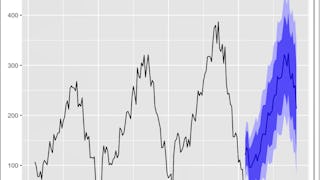
Skills you'll gain: Demand Planning, Customer Demand Planning, Supply Chain Planning, Production Planning, Forecasting, Time Series Analysis and Forecasting, Trend Analysis, Inventory Management System, Data Analysis, Plot (Graphics), R Programming, Data Visualization, R (Software), Model Evaluation, Model Training
Coursera
Skills you'll gain: Interactive Data Visualization, Plot (Graphics), R (Software), Hypertext Markup Language (HTML), Software Installation, Package and Software Management, R Programming, Integrated Development Environments, Statistical Programming
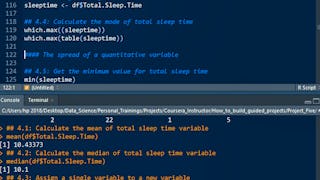
Skills you'll gain: Descriptive Statistics, Data Analysis, Exploratory Data Analysis, Quantitative Research, R Programming, Statistical Analysis, Histogram, R (Software), Statistical Methods, Statistical Programming, Probability & Statistics, Descriptive Analytics, Statistics, Statistical Software, Data Science

What brings you to Coursera today?
Skills you'll gain: Ggplot2, Plot (Graphics), Tidyverse (R Package), Data Visualization, Statistical Visualization, Data Analysis, Exploratory Data Analysis, R Programming, Data Visualization Software, Data Wrangling, Data Manipulation, R (Software)
Coursera
Skills you'll gain: Data Cleansing, Data Manipulation, Data Integration, R Programming, Data Wrangling, Data Preprocessing, Tidyverse (R Package), Data Processing, R (Software), Data Management
Skills you'll gain: Feature Engineering, Model Evaluation, Predictive Modeling, Model Deployment, Model Training, Predictive Analytics, R (Software), R Programming, Data Analysis, Statistical Analysis, Data Wrangling, Data Cleansing, Data Manipulation, Classification Algorithms, Data Import/Export, Data Preprocessing, Machine Learning
Skills you'll gain: Sampling (Statistics), Plot (Graphics), Statistical Methods, Descriptive Statistics, Statistical Visualization, Data Import/Export, Pareto Chart, Histogram, Statistical Programming, Descriptive Analytics, Statistical Analysis, R (Software), Box Plots, R Programming, Data Synthesis, Probability Distribution, Probability & Statistics, Exploratory Data Analysis, Statistics, Data Science
Coursera
Skills you'll gain: Ggplot2, Plot (Graphics), Data Cleansing, Tidyverse (R Package), Data Wrangling, Data Transformation, Data Visualization, R Programming, Data Manipulation, Statistical Visualization, R (Software), Data Analysis, Data Management, Pivot Tables And Charts
Skills you'll gain: Ggplot2, Model Evaluation, Plot (Graphics), Regression Analysis, Predictive Analytics, Predictive Modeling, Statistical Visualization, Data-Driven Decision-Making, Statistical Modeling, R Programming, Descriptive Statistics, R (Software), Exploratory Data Analysis, Descriptive Analytics, Statistical Analysis, Data Analysis
Skills you'll gain: Descriptive Statistics, Statistical Programming, R Programming, R (Software), Statistical Reporting, Data Quality, Data Preprocessing, Data Cleansing, Statistics, Data Processing, Statistical Methods, Statistical Software, Data Analysis Software, Statistical Analysis, Data Import/Export
What brings you to Coursera today?
Best R courses from Coursera
Top-rated R courses offered by Coursera on Coursera.
- Getting Started with RCourseraBeginnerLess Than 2 HoursCoursera
- Introduction to R: Basic R syntaxCourseraBeginnerLess Than 2 HoursCoursera
- Demand Planning in RStudio: Create Demand ForecastCourseraIntermediateLess Than 2 HoursCoursera
Best R courses for beginners
Top-rated beginner-friendly R courses with no prerequisites.
- Getting Started with RstudioCourseraBeginnerLess Than 2 HoursNo prerequisites
- Calculating Descriptive Statistics in RCourseraBeginnerLess Than 2 HoursNo prerequisites
- RStudio for Six Sigma - Basic Descriptive StatisticsCourseraBeginnerLess Than 2 HoursNo prerequisites
Best short R courses
Quick R courses you can complete in a few hours or less.
- Data Visualization using dplyr and ggplot2 in RCourseraIntermediateLess Than 2 HoursQuick completion
- Joining Data in R using dplyrCourseraIntermediateLess Than 2 HoursQuick completion
- Build and deploy a stroke prediction model using RCourseraIntermediateLess Than 2 HoursQuick completion










