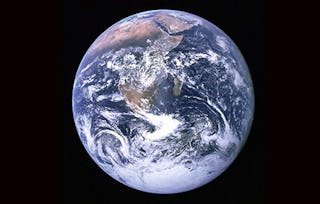
The AMNH course The Dynamic Earth: A Course for Educators provides students with an overview of the origin and evolution of the Earth. Informed by the recently released Next Generation Science Standards, this course examines geological time scales, radiometric dating, and how scientists “read the rocks.” We will explore dramatic changes in the Earth over the last 4 billion years, including how the evolution of life on Earth has affected its atmosphere. In addition to looking at geology on a global scale, participants will take to their own backyards to explore and share their local geologic history. Course participants will bring their understanding of the dynamic Earth - along with content resources, discussion questions, and assignments - into their own teaching.
You will explore the ways scientists study the rock record to determine the geologic history of the Earth.
What's included
4 videos5 readings1 assignment
Show info about module content
4 videos•Total 20 minutes
Course Overview•2 minutes
Introduction to the Course•2 minutes
How Zircons Have Revolutionized Understanding of Early Earth•11 minutes
The Rate of Decay•5 minutes
5 readings•Total 50 minutes
Syllabus•10 minutes
Resources•10 minutes
About This Course•10 minutes
Using Radiometric Dating to Determine the Age of Rocks and Mineral•10 minutes
"Reading" a Rock to Get Its Age•10 minutes
1 assignment•Total 30 minutes
Module One Quiz•30 minutes
Evolution of the Atmosphere
Module 2•4 hours to complete
Module details
You will learn how the evolution of photosynthetic life changed the concentration of oxygen in the oceans and atmosphere, and how this is reflected in the rock record. You will also become familiar with how the Next Generation Science Standards connect to this week’s content. Finally, you will complete a written assignment: an analysis of a local geologic feature.
What's included
7 videos2 readings1 assignment1 peer review
Show info about module content
7 videos•Total 56 minutes
Evolution of Early Earth's Atmosphere•11 minutes
Banded Iron Formation•3 minutes
Stromatolites•3 minutes
Teaching with the Next Generation Science Standards: Part 1•13 minutes
Teaching with the Next Generation Science Standards: Part 2•7 minutes
Local Geology Assignment: Part 1•10 minutes
Local Geology Assignment: Part 2•10 minutes
2 readings•Total 20 minutes
Early Life•10 minutes
Origin of Earth's Atmosphere•10 minutes
1 assignment•Total 30 minutes
Module Two Quiz•30 minutes
1 peer review•Total 120 minutes
Peer Review: Analyze a Local Geologic Feature•120 minutes
Plate Tectonics: Mountain Building
Module 3•1 hour to complete
Module details
You will learn how convection causes solid rock to flow in the Earth’s mantle and how the movement of the Earth’s tectonic plates forms mountains. You will also learn how to identify and address common student misconceptions about plate tectonics.
What's included
5 videos2 readings1 assignment
Show info about module content
5 videos•Total 37 minutes
The Structure of Mountain Belts: The Swiss Alps•12 minutes
Ductility of Rocks•1 minute
Marble Deformation•3 minutes
Scientists at Work: Mountain Building•6 minutes
Addressing Student Misconceptions When Teaching Plate Tectonics•15 minutes
2 readings•Total 20 minutes
How Rocks Flow•10 minutes
Mantle Convection and Plate Tectonics•10 minutes
1 assignment•Total 30 minutes
Module Three Quiz•30 minutes
Plate Tectonics: Earthquakes
Module 4•2 hours to complete
Module details
You will learn about earthquake risk. Using a multimedia teaching case about earthquake risk in Bangladesh, you will learn how scientists define and assess the risk from geologic events. You will also learn how to implement this or similar teaching cases with your students.
What's included
7 videos4 readings1 assignment
Show info about module content
7 videos•Total 38 minutes
Earthquake Risk•16 minutes
Learning & Teaching with the Teaching Case•5 minutes
Part One: Background•3 minutes
Part Two: Data Collection•4 minutes
Part Three: Results•3 minutes
Part Four: Beyond Tectonics•4 minutes
Closing Thoughts•4 minutes
4 readings•Total 40 minutes
Earthquake Risk in Bangladesh•10 minutes
Resources•10 minutes
Opportunities for Educators•10 minutes
Support AMNH•10 minutes
1 assignment•Total 30 minutes
Module Four Quiz•30 minutes
Instructors
Instructor ratings
Instructor ratings
We asked all learners to give feedback on our instructors based on the quality of their teaching style.
The American Museum of Natural History is one of the world’s preeminent scientific, educational and cultural institutions. Since its founding in 1869, the Museum has advanced its global mission to discover, interpret, and disseminate information about human cultures, the natural world, and the universe through a wide-ranging program of scientific research, education, and exhibition.
OK
Explore more from Environmental Science and Sustainability
"To be able to take courses at my own pace and rhythm has been an amazing experience. I can learn whenever it fits my schedule and mood."
Jennifer J.
Learner since 2020
"I directly applied the concepts and skills I learned from my courses to an exciting new project at work."
Larry W.
Learner since 2021
"When I need courses on topics that my university doesn't offer, Coursera is one of the best places to go."
Chaitanya A.
"Learning isn't just about being better at your job: it's so much more than that. Coursera allows me to learn without limits."
Learner reviews
4.7
230 reviews
5 stars
77.39%
4 stars
13.91%
3 stars
6.52%
2 stars
1.30%
1 star
0.86%
Showing 3 of 230
D
DF
5·
Reviewed on Aug 31, 2016
Excellent course. Required some corollary reading, but basically supplied all materials required to meet course outline requirements.
D
DG
5·
Reviewed on Jul 18, 2020
Thoroughly enjoyed this course. The two presenters were excellent & the course materials very clear. I learned a lot about my own area in the local geology project.
K
KW
5·
Reviewed on May 10, 2020
very educational and interesting. will be beneficial for me as I want to pursue geology in university.
When will I have access to the lectures and assignments?
To access the course materials, assignments and to earn a Certificate, you will need to purchase the Certificate experience when you enroll in a course. You can try a Free Trial instead, or apply for Financial Aid. The course may offer 'Full Course, No Certificate' instead. This option lets you see all course materials, submit required assessments, and get a final grade. This also means that you will not be able to purchase a Certificate experience.
What will I get if I purchase the Certificate?
When you purchase a Certificate you get access to all course materials, including graded assignments. Upon completing the course, your electronic Certificate will be added to your Accomplishments page - from there, you can print your Certificate or add it to your LinkedIn profile.
Is financial aid available?
Yes. In select learning programs, you can apply for financial aid or a scholarship if you can’t afford the enrollment fee. If fin aid or scholarship is available for your learning program selection, you’ll find a link to apply on the description page.