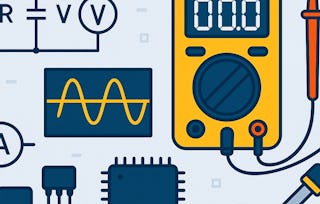
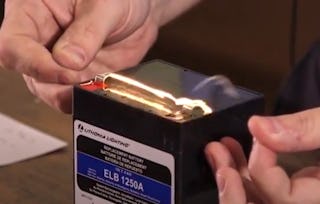
This course explains how to analyze circuits that have direct current (DC) current or voltage sources. A DC source is one that is constant. Circuits with resistors, capacitors, and inductors are covered, both analytically and experimentally. Some practical applications in sensors are demonstrated.
This module reviews background material from physics on the basic properties of electricity and electrical circuits.
What's included
16 videos4 readings23 assignments
Show info about module content
16 videos•Total 66 minutes
1.0 Introduction to Linear Circuits 1: DC Analysis•3 minutes
1.1 Overview and Current•6 minutes
1.2 Voltage•8 minutes
1.3 Power and Energy•9 minutes
1.4 Resistance and Ohm's Law•8 minutes
1.5 Intro to Circuit Diagrams•9 minutes
Sample Problem: Ohm's Law and Power 1•4 minutes
Sample Problem: Ohm's Law and Power 2•3 minutes
Sample Problem: Power 1•6 minutes
Sample Problem: Power 2•3 minutes
Sample Problem: Power 3•2 minutes
Sample Problem: Power 4•2 minutes
Sample Problem: Voltage and Energy•1 minute
Sample Problem: Electric Current and Charge 1•1 minute
Sample Problem: Electric Current and Charge 2•1 minute
Sample Problem: Voltage Division•1 minute
4 readings•Total 40 minutes
Start Here•10 minutes
Syllabus•10 minutes
Consent Form•10 minutes
Get More from Georgia Tech•10 minutes
23 assignments•Total 690 minutes
Problem 1-1-1•30 minutes
Problem 1-1-2•30 minutes
Problem 1-1-3•30 minutes
Problem 1-2-1•30 minutes
Problem 1-2-2•30 minutes
Problem 1-2-3•30 minutes
Problem 1-2-4•30 minutes
Problem 1-2-5•30 minutes
Problem 1-3-1•30 minutes
Problem 1-3-2•30 minutes
Problem 1-3-3•30 minutes
Problem 1-4-1•30 minutes
Problem 1-4-2•30 minutes
Problem 1-4-3•30 minutes
Problem 1-4-4•30 minutes
Problem 1-4-5•30 minutes
Problem 1-5-1•30 minutes
Problem 1-5-2•30 minutes
Problem 1-5-3•30 minutes
Problem 1-5-4•30 minutes
Problem 1-5-5•30 minutes
Finding Circuit Values using Power•30 minutes
Module 1 Quiz•30 minutes
Module 2
Module 2•16 hours to complete
Module details
The module describes some basic principles used in circuit analysis.
What's included
47 videos1 reading22 assignments
Show info about module content
47 videos•Total 265 minutes
2.1 Overview and Kirchhoff's Voltage Law•10 minutes
2.2 Kirchhoff's Current Law•9 minutes
2.3 Series and Parallel Resistance•7 minutes
2.4 Equivalent Resistance•6 minutes
2.5 Voltage Divider Law•7 minutes
2.6 Current Divider Law•6 minutes
Sample Problem: DC Op Amp 1•9 minutes
Sample Problem: DC Op Amp 2•6 minutes
Sample Problem: DC Op Amp 3•4 minutes
Sample Problem: DC Op Amp 4•6 minutes
Sample Problem: DC Op Amp 5•6 minutes
Sample Problem: Current Division 1•4 minutes
Sample Problem: Current Division 2•5 minutes
Sample Problem: Parallel and Series Resistors 1•2 minutes
Sample Problem: Parallel and Series Resistors 2•8 minutes
Sample Problem: KVL•6 minutes
Sample Problem: KVL 2•6 minutes
Sample Problem: KVL 3•2 minutes
Sample Problem: KCL 1•2 minutes
Sample Problem: KCL 2•5 minutes
Sample Problem: KCL 3•3 minutes
Sample Problem: KCL 4•1 minute
Sample Problem: KCL 5•2 minutes
Sample Problem: Op Amps 1•9 minutes
Sample Problem: Op Amps 2•5 minutes
Sample Problem: Op Amps 3•5 minutes
Sample Problem: Nodes, Branches, Paths, and Loops•3 minutes
Sample Problem: Summing Op Amp•6 minutes
Sample Problem: Differential Amp•7 minutes
Sample Problem: Inverting Op Amp•5 minutes
Sample Problem: Non-inverting Op Amp•8 minutes
Sample Problem: Max Power (Depend Sources)•4 minutes
This module introduces capacitors and inductors, which are called "reactive" circuit elements.
What's included
16 videos19 assignments
Show info about module content
16 videos•Total 86 minutes
5.1 Introduction to Capacitors (Part 1).•4 minutes
5.2 Introduction to Capacitors (Part 2)•5 minutes
5.3 Series and Parallel Capacitors.•7 minutes
5.4 Introduction to Inductors.•7 minutes
5.5 Series and Parallel Inductors.•7 minutes
5.6 Energy in Reactive Elements•11 minutes
Sample Problem: Equivalent Capacitance•3 minutes
Sample Problem: Energy Storing Elements, Inductor•3 minutes
Sample Problem: Energy Storing Elements, Capacitor•1 minute
Sample Problem: Energy Storing Elements 1•8 minutes
Sample Problem: Energy Storing Elements 2•4 minutes
Sample Problem: Energy Storing Elements 3•4 minutes
Sample Problem: Energy Storing Element and Op Amps 1•7 minutes
Sample Problem: Energy Storing Elements and Op Amps 2•5 minutes
Sample Problem: Energy Storing Elements and Op Amps 3•6 minutes
Sample Problem: Energy Storing Elements and Op Amps 4•5 minutes
19 assignments•Total 570 minutes
Problem 5-1-1•30 minutes
Problem 5-1-2•30 minutes
Problem 5-1-3•30 minutes
Problem 5-2-1•30 minutes
Problem 5-2-2•30 minutes
Problem 5-2-3•30 minutes
Problem 5-3-1•30 minutes
Problem 5-3-2•30 minutes
Problem 5-3-3•30 minutes
Problem 5-4-1•30 minutes
Problem 5-4-2•30 minutes
Problem 5-4-3•30 minutes
Problem 5-5-1•30 minutes
Problem 5-5-2•30 minutes
Problem 5-5-3•30 minutes
Problem 5-6-1•30 minutes
Problem 5-6-2•30 minutes
Problem 5-6-3•30 minutes
Module 5 Quiz•30 minutes
Module 6
Module 6•15 hours to complete
Module details
This module introduces the transient response behavior of RC and RL circuits after a switch in a circuit is changed.
What's included
12 videos27 assignments
Show info about module content
12 videos•Total 94 minutes
6.1 DC Behavior of Reactive Elements.•6 minutes
6.2 Continuity in Reactive Elements.•7 minutes
6.3 Switching With Reactive Elements After DC.•7 minutes
6.4 First Order RC Circuits.•13 minutes
6.5 Lab Demo: RC Circuit.•10 minutes
6.6 First Order RL Circuit.•9 minutes
Sample Problem: Circuits with Switches 1•4 minutes
Sample Problem: Circuits with Switches 2•5 minutes
Sample Problem: Energy Storing Elements and Switched Circuits•5 minutes
Sample Problem: Complete RL Response with Switches 1•8 minutes
Sample Problem: Complete RL Response with Switches 2•10 minutes
Sample Problem: Complete RC Response with Switches 1•11 minutes
27 assignments•Total 810 minutes
Problem 6-1-1•30 minutes
Problem 6-1-2•30 minutes
Problem 6-1-3•30 minutes
Problem 6-1-4•30 minutes
Problem 6-1-5•30 minutes
Problem 6-2-1•30 minutes
Problem 6-2-2•30 minutes
Problem 6-2-3•30 minutes
Problem 6-2-4•30 minutes
Problem 6-2-5•30 minutes
Problem 6-3-1•30 minutes
Problem 6-3-2•30 minutes
Problem 6-3-3•30 minutes
Problem 6-3-4•30 minutes
Problem 6-4-1•30 minutes
Problem 6-4-2•30 minutes
Problem 6-4-3•30 minutes
Problem 6-4-4•30 minutes
Problem 6-4-5•30 minutes
Problem 6-5-1•30 minutes
Problem 6-5-2•30 minutes
Problem 6-6-1•30 minutes
Problem 6-6-2•30 minutes
Problem 6-6-3•30 minutes
Problem 6-6-4•30 minutes
Problem 6-6-5•30 minutes
Module 6 Quiz•30 minutes
Module 7
Module 7•11 hours to complete
Module details
This module demonstrates useful applications of capacitors and inductors in real engineering systems and introduces the behavior of second-order reactive circuits.
What's included
10 videos19 assignments
Show info about module content
10 videos•Total 70 minutes
7.1 Applications of Capacitors.•10 minutes
7.2 Applications of Inductors.•7 minutes
7.3 Introduction to Second-Order Circuits.•6 minutes
7.4 The Natural Response.•7 minutes
7.5 Lab Demo:RLC Circuit.•8 minutes
7.6 (OPTIONAL): Obtaining the Differential Equation - Direct Method.•7 minutes
7.7 (OPTIONAL): Obtaining the Differential Equation - Operator Method.•9 minutes
7.8 (OPTIONAL): Finding the Initial Conditions•7 minutes
Sample Problem: Complete RLC Response 1•5 minutes
Sample Problem: Complete RLC Response 2•4 minutes
19 assignments•Total 570 minutes
Problem 7-1-1•30 minutes
Problem 7-1-2•30 minutes
Problem 7-1-3•30 minutes
Problem 7-2-1•30 minutes
Problem 7-2-2•30 minutes
Problem 7-2-3•30 minutes
Problem 7-2-4•30 minutes
Problem 7-3-1•30 minutes
Problem 7-3-2•30 minutes
Problem 7-3-3•30 minutes
Problem 7-3-4•30 minutes
Problem 7-3-5•30 minutes
Problem 7-4-1•30 minutes
Problem 7-4-2•30 minutes
Problem 7-4-3•30 minutes
Problem 7-7-1•30 minutes
Problem 7-7-2•30 minutes
Sample Problems•30 minutes
Module 7 Quiz•30 minutes
Instructors
Instructor ratings
Instructor ratings
We asked all learners to give feedback on our instructors based on the quality of their teaching style.
The Georgia Institute of Technology is one of the nation's top research universities, distinguished by its commitment to improving the human condition through advanced science and technology.
Georgia Tech's campus occupies 400 acres in the heart of the city of Atlanta, where more than 20,000 undergraduate and graduate students receive a focused, technologically based education.
"To be able to take courses at my own pace and rhythm has been an amazing experience. I can learn whenever it fits my schedule and mood."
Jennifer J.
Learner since 2020
"I directly applied the concepts and skills I learned from my courses to an exciting new project at work."
Larry W.
Learner since 2021
"When I need courses on topics that my university doesn't offer, Coursera is one of the best places to go."
Chaitanya A.
"Learning isn't just about being better at your job: it's so much more than that. Coursera allows me to learn without limits."
Learner reviews
4.5
1,490 reviews
5 stars
68.99%
4 stars
19.66%
3 stars
6.91%
2 stars
1.87%
1 star
2.55%
Showing 3 of 1490
P
PD
5·
Reviewed on Jan 2, 2023
The course is pretty good. One problem is that the answers in some questions are wrong and autograder hasn't fixed that.
J
JO
4·
Reviewed on Jun 29, 2020
Course is great although there are mistakes that haven't been fixed for some time now. I would recommend regardless of the mistakes though.
P
PR
5·
Reviewed on Sep 7, 2020
The course is very helpful to us to understand the DC circit analysis a lot.Thank you to the team.As a faculty,I know the concepts well.So directly went to the quiz part.
When will I have access to the lectures and assignments?
To access the course materials, assignments and to earn a Certificate, you will need to purchase the Certificate experience when you enroll in a course. You can try a Free Trial instead, or apply for Financial Aid. The course may offer 'Full Course, No Certificate' instead. This option lets you see all course materials, submit required assessments, and get a final grade. This also means that you will not be able to purchase a Certificate experience.
What will I get if I purchase the Certificate?
When you purchase a Certificate you get access to all course materials, including graded assignments. Upon completing the course, your electronic Certificate will be added to your Accomplishments page - from there, you can print your Certificate or add it to your LinkedIn profile.
Is financial aid available?
Yes. In select learning programs, you can apply for financial aid or a scholarship if you can’t afford the enrollment fee. If fin aid or scholarship is available for your learning program selection, you’ll find a link to apply on the description page.