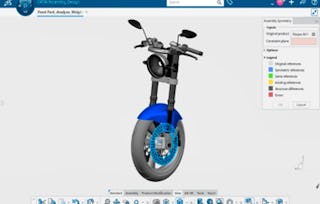
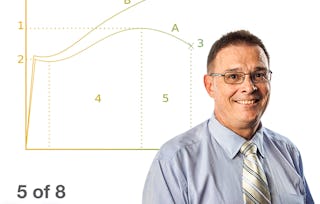
“Machine Design Part I” is the first course in an in-depth three course series of “Machine Design.” The “Machine Design” Coursera series covers fundamental mechanical design topics, such as static and fatigue failure theories, the analysis of shafts, fasteners, and gears, and the design of mechanical systems such as gearboxes. Throughout this series of courses we will examine a number of exciting design case studies, including the material selection of a total hip implant, the design and testing of the wing on the 777 aircraft, and the impact of dynamic loads on the design of an bolted pressure vessel.
In this first course, you will learn robust analysis techniques to predict and validate design performance and life. We will start by reviewing critical material properties in design, such as stress, strength, and the coefficient of thermal expansion. We then transition into static failure theories such as von Mises theory, which can be utilized to prevent failure in static loading applications such as the beams in bridges. Finally, we will learn fatigue failure criteria for designs with dynamic loads, such as the input shaft in the transmission of a car.
In this week, we will first provide an overview on the course's content, targeted audiences, the instructor's professional background, and tips to succeed in this course. Then we will cover critical material properties in design, such as strength, modulus of elasticity, and the coefficient of thermal expansion. A case study examining material selection in a Zimmer orthopedic hip implant will demonstrate the real life design applications of these material properties. At the end of the week you will have the opportunity to check your own knowledge of these fundamental material properties by taking Quiz 1 "Material Properties in Design."
Module 4: Modulus of Elasticity - Introduction•7 minutes
Module 5: Modulus of Elastricity - Applications•9 minutes
Module 6: Ashby Plots•7 minutes
Module 7: Material Selection in Hip Implant•13 minutes
Module 8: Common Metals in Design•9 minutes
Module 9: Metal Designations and Processing•9 minutes
Module 10: Temperature Effects and Creep•9 minutes
Module 11: CTE mismatch•13 minutes
4 readings•Total 40 minutes
Syllabus•10 minutes
Consent Form•10 minutes
Total Hip Replacement Surgical Process:•10 minutes
Get More from Georgia Tech•10 minutes
2 assignments•Total 90 minutes
Complete prior to Module 4 - Modulus of Elasticity•30 minutes
Material Properties in Design•60 minutes
1 discussion prompt•Total 10 minutes
Design considerations for orthopedic implant•10 minutes
Static Failure Theories - Part I
Module 2•6 hours to complete
Module details
In week 2, we will review stress, strength, and the factory of safety. Specifically, we will review axial, torsional, bending, and transverse shear stresses. Please note that these modules are intended for review- students should already be familiar with these topics from their previous solid mechanics, mechanics of materials, or deformable bodies course. For each topic this week, be sure to refresh your analysis skills by working through worksheets 2, 3, 4 and 5. There is no quiz for this week.
What's included
8 videos10 readings1 assignment
Show info about module content
8 videos•Total 63 minutes
Module 12: Review of Stress, Strength, and Factor of Safety•10 minutes
Module 13: Factor of Safety Example•6 minutes
Module 14: Axial and Torsional Stress Review•9 minutes
Module 15: Axial, and Torsional Stress Example•7 minutes
Module 16: Bending Stress Review•7 minutes
Module 17: Bending Stress Example•10 minutes
Module 18: Transverse Shear Review•8 minutes
Module 19: Transverse Shear Example•8 minutes
10 readings•Total 300 minutes
Tip for Units 2 and 3: Equation Sheet•10 minutes
Example Problem Module 12 : Factor of Safety•60 minutes
Solution Module 13: Factor of Safety•10 minutes
Example Problem Module 14: Axial and Torsional Stress•60 minutes
Solution Module 15: Axial and Torsional Stress•10 minutes
Example Problem Module 16: Bending Stress•60 minutes
Solution Module 17: Bending Stress•10 minutes
Example Problem Module 18: Transverse Shear•60 minutes
Solution Module 19: Tranverse Shear•10 minutes
Earn a Georgia Tech Certificate/Badge/CEUs•10 minutes
1 assignment•Total 12 minutes
Pre-Quiz: Static Loading•12 minutes
Static Failure Theories - Part II
Module 3•8 hours to complete
Module details
In this week we will first cover the ductile to brittle transition temperature and stress concentration factors. Then, we will learn two critical static failure theories; the Distortion Energy Theory and Brittle Coulomb-Mohr Theory. A case study featuring the ultimate load testing of the Boeing 777 will highlight the importance of analysis and validation. Be sure to work through worksheets 6, 7, 8 and 9 to self-check your understanding of the course materials. At the end of this week, you will take Quiz 2 “Static Failure.”
What's included
9 videos12 readings1 assignment
Show info about module content
9 videos•Total 81 minutes
Module 20: Ductile to Brittle Transition Temperature•8 minutes
Worksheet 4: Practice Problems: Coulomb Mohr Theory•60 minutes
Worksheet 4 Solution•10 minutes
Tips for preparing for Quiz 2•10 minutes
Quiz 2 Solution•10 minutes
1 assignment•Total 60 minutes
Static Failure•60 minutes
Fatigue Failure - Part I
Module 4•6 hours to complete
Module details
In week 4, we will introduce critical fatigue principles, starting with fully revisable stresses and the SN Curve. Then, we discuss how to estimate a fully adjusted endurance limit. Finally, a case study covering the root cause analysis of the fatigue failure of the Aloha Airlines flight 293 will emphasize the dangers of fatigue failure. In this week, you should complete worksheets 10, 11 and 12 as well as Quiz 3 “Fully Reversed Loading in Fatigue.”
What's included
8 videos10 readings1 assignment
Show info about module content
8 videos•Total 70 minutes
Module 29: Introduction to Fatigue Failure•7 minutes
Module 30: Fatigue and the SN Curve•11 minutes
Module 31: Approximating the SN Curve•9 minutes
Module 32: Estimating the Endurance Limit•13 minutes
Module 33: Estimating the Endurance Limit - Example Problem•7 minutes
Module 34: Fatigue Stress Concentration Factors Part I•9 minutes
Module 35: Fatigue Stress Concentration Factors Part II•6 minutes
Worksheet 5: SN Curve Practice Problem•60 minutes
Worksheet 5 Solution•10 minutes
Example Problem Module 32: Estimating Endurance Limit•10 minutes
Solution Module 33: Estimating the Endurance Limit•10 minutes
Worksheet 6: Endurance Limit Practice Problem•60 minutes
Worksheet 6 Solution•10 minutes
Worksheet 7: Fully Reversed Loading in Fatigue Practice Problems•60 minutes
Worksheet 7 Solution•10 minutes
Tips for preparing for Quiz 3•10 minutes
Quiz 3 Solution•10 minutes
1 assignment•Total 60 minutes
Fully Reversed Loading in Fatigue•60 minutes
Fatigue Failure - Part II
Module 5•7 hours to complete
Module details
In this last week of the course, we will cover the fatigue failure criteria for fluctuating and randomly varying stresses, including key concepts such as the Modified Goodman line and Miner’s Rule. This week be sure to complete worksheets 13 and 14 as well as Quiz 4 “Fluctuating Fatigue and Miner’s Rule.” Finally, take Quiz 5, “The Comprehensive Quiz”, which will measure your overall knowledge of this course.
What's included
8 videos10 readings2 assignments
Show info about module content
8 videos•Total 75 minutes
Module 37: Fatigue Case Study - Aloha Airlines Flight 243 Failure•15 minutes
The Georgia Institute of Technology is one of the nation's top research universities, distinguished by its commitment to improving the human condition through advanced science and technology.
Georgia Tech's campus occupies 400 acres in the heart of the city of Atlanta, where more than 20,000 undergraduate and graduate students receive a focused, technologically based education.
"To be able to take courses at my own pace and rhythm has been an amazing experience. I can learn whenever it fits my schedule and mood."
Jennifer J.
Learner since 2020
"I directly applied the concepts and skills I learned from my courses to an exciting new project at work."
Larry W.
Learner since 2021
"When I need courses on topics that my university doesn't offer, Coursera is one of the best places to go."
Chaitanya A.
"Learning isn't just about being better at your job: it's so much more than that. Coursera allows me to learn without limits."
Learner reviews
4.8
2,217 reviews
5 stars
83.35%
4 stars
14.79%
3 stars
1.08%
2 stars
0.31%
1 star
0.45%
Showing 3 of 2217
A
AN
5·
Reviewed on Mar 15, 2020
This course was extremely good as my basics were weak and this course helped me to build it up from the foundation. I learned about a lot of new things and in a very calm manner.
B
BJ
5·
Reviewed on Jul 27, 2017
Great review for degreed ME that has not worked in this particular field since college. I would like to see more courses from Dr. Wingate-both in other areas and more advanced.
R
RS
5·
Reviewed on May 5, 2017
This course was very fruitful for me. The teacher presented the study material in an exciting and orderly manner. I thank Georgia Tech, and Dr. Kathryn Wingate for this course.
When will I have access to the lectures and assignments?
To access the course materials, assignments and to earn a Certificate, you will need to purchase the Certificate experience when you enroll in a course. You can try a Free Trial instead, or apply for Financial Aid. The course may offer 'Full Course, No Certificate' instead. This option lets you see all course materials, submit required assessments, and get a final grade. This also means that you will not be able to purchase a Certificate experience.
What will I get if I purchase the Certificate?
When you purchase a Certificate you get access to all course materials, including graded assignments. Upon completing the course, your electronic Certificate will be added to your Accomplishments page - from there, you can print your Certificate or add it to your LinkedIn profile.
Is financial aid available?
Yes. In select learning programs, you can apply for financial aid or a scholarship if you can’t afford the enrollment fee. If fin aid or scholarship is available for your learning program selection, you’ll find a link to apply on the description page.