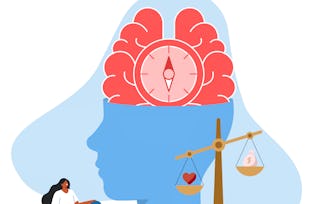
How can we explain kindness and cruelty? Where does our sense of right and wrong come from? Why do people so often disagree about moral issues? This course explores the psychological foundations of our moral lives.
What's included
2 videos4 readings
Show info about module content
2 videos•Total 44 minutes
Introduction to the Course•23 minutes
What is Morality?•21 minutes
4 readings•Total 40 minutes
Meet your instructors!•10 minutes
Course resources•10 minutes
Pre-Course Survey•10 minutes
Your Learning, Your Way•10 minutes
The Big Questions
Module 2•4 hours to complete
Module details
What is morality, anyway? What are the big debates in the field of moral psychology?
What's included
8 videos1 reading1 assignment
Show info about module content
8 videos•Total 136 minutes
Philosophical Approaches•21 minutes
Reason vs. Emotions•15 minutes
The Case of Disgust•14 minutes
Cute and Sexy•9 minutes
Return to the Trolley Problem•6 minutes
The Big Questions•13 minutes
Week 1 Office Hours (2015)•32 minutes
Week 1 Office Hours (2014)•26 minutes
1 reading•Total 90 minutes
Week 1 Readings•90 minutes
1 assignment•Total 30 minutes
Week 1 Quiz•30 minutes
Compassion
Module 3•3 hours to complete
Module details
Where does concern for others come from? How is it related to empathy—and is more empathy necessarily a good thing? And what can we learn from the study of those who seemingly lack normal moral feelings, such as violent psychopaths?
What's included
6 videos1 reading1 assignment
Show info about module content
6 videos•Total 154 minutes
Caring About Others•11 minutes
How Do We Treat Strangers?•22 minutes
Empathy and Concern•27 minutes
Empathy and its Limits•16 minutes
Week 2 Office Hours (2015)•50 minutes
Week 2 Office Hours (2014)•28 minutes
1 reading•Total 10 minutes
Week 2 Readings•10 minutes
1 assignment•Total 30 minutes
Week 2 Quiz•30 minutes
Origins of Morality
Module 4•5 hours to complete
Module details
Here, we ask about which aspects of morality are universal. We discuss evolution, cross-cultural research, and the fascinating new science of the moral life of babies.
What's included
10 videos1 reading1 assignment
Show info about module content
10 videos•Total 269 minutes
Moral Diversity•10 minutes
Moral Universals•13 minutes
Evolution of Morality•20 minutes
Reciprocal Altruism•19 minutes
Guest Lecture, Laurie Santos•70 minutes
Development of Morality•18 minutes
How Much Can Evolution Explain?•7 minutes
Discussion with Laurie Santos•28 minutes
Week 3 Office Hours (2015)•51 minutes
Week 3 Office Hours (2014)•33 minutes
1 reading•Total 10 minutes
Week 3 Readings•10 minutes
1 assignment•Total 30 minutes
Week 3 Quiz•30 minutes
Differences
Module 5•4 hours to complete
Module details
How does culture influence our moral thought and moral action? What role does religion play? Why are some of us conservative and others liberal, and how do political differences influence our sense of right and wrong?
What's included
9 videos1 reading1 assignment
Show info about module content
9 videos•Total 182 minutes
Moral Differences•9 minutes
Kinds of Societies•17 minutes
Conservatives and Liberals•19 minutes
Disgust and Honor I•20 minutes
Disgust and Honor II•15 minutes
Religion and Morality I•13 minutes
Religion and Morality II•19 minutes
Week 4 Office Hours (2015)•42 minutes
Week 4 Office Hours (2014)•27 minutes
1 reading•Total 10 minutes
Week 4 Readings•10 minutes
1 assignment•Total 30 minutes
Week 4 Quiz•30 minutes
Family, Friends, and Strangers
Module 6•4 hours to complete
Module details
Our moral feelings are usually most powerful towards our kin (such as our parents and our children) and our friends and allies. We will discuss these special bonds, and then turn to the morality of racial and ethnic bias. Then we use the tools of behavioral economics to explore the controversial question of whether we are ever truly altruistic to strangers.
What's included
10 videos1 reading1 assignment
Show info about module content
10 videos•Total 170 minutes
Moral Circles•18 minutes
The Morality of Group Preference•6 minutes
What Groups Matter?•12 minutes
Stereotypes•23 minutes
Economic Games•11 minutes
Criticisms of Economic Games•12 minutes
How Do We Naturally Respond to Strangers?•6 minutes
The Problem of Kindness•10 minutes
Week 5 Office Hours (2015)•40 minutes
Week 5 Office Hours Part (2014)•31 minutes
1 reading•Total 10 minutes
Week 5 Readings•10 minutes
1 assignment•Total 30 minutes
Week 5 Quiz•30 minutes
The Big Answers
Module 7•3 hours to complete
Module details
We’ll discuss some clever studies that show how our moral behavior is powerfully influenced—often at the unconscious level—by the situations that we find ourselves in. Such findings raise some hard problems about determinism, free will, and moral responsibility. Most of all, if our actions are determined by our brains, our genes, and our situations, in what sense can we be said to be moral agents? The course will end by trying to address this question.
What's included
6 videos2 readings1 assignment
Show info about module content
6 videos•Total 136 minutes
Morality as Part of Our Nature•10 minutes
Skepticism About the Self•19 minutes
Free Will and the Situation•17 minutes
Conclusion•13 minutes
Week 6 Office Hours (2015)•42 minutes
Week 6 Office Hours (2014)•36 minutes
2 readings•Total 20 minutes
Week 6 Readings•10 minutes
Post- Course Survey•10 minutes
1 assignment•Total 30 minutes
Week 6 Quiz•30 minutes
Instructor
Instructor ratings
Instructor ratings
We asked all learners to give feedback on our instructors based on the quality of their teaching style.
For more than 300 years, Yale University has inspired the minds that inspire the world. Based in New Haven, Connecticut, Yale brings people and ideas together for positive impact around the globe. A research university that focuses on students and encourages learning as an essential way of life, Yale is a place for connection, creativity, and innovation among cultures and across disciplines.
"To be able to take courses at my own pace and rhythm has been an amazing experience. I can learn whenever it fits my schedule and mood."
Jennifer J.
Learner since 2020
"I directly applied the concepts and skills I learned from my courses to an exciting new project at work."
Larry W.
Learner since 2021
"When I need courses on topics that my university doesn't offer, Coursera is one of the best places to go."
Chaitanya A.
"Learning isn't just about being better at your job: it's so much more than that. Coursera allows me to learn without limits."
Learner reviews
4.8
3,413 reviews
5 stars
86.43%
4 stars
11.92%
3 stars
1.11%
2 stars
0.26%
1 star
0.26%
Showing 3 of 3413
E
EL
5·
Reviewed on May 5, 2020
Enjoyed the course immensely. Professor Bloom really is excellent! He provides entertaining lectures and is also quite funny. High quality overall, learned a lot. Highly recommended!
J
JE
5·
Reviewed on Dec 18, 2017
Coming from undergraduate course Psychology, and with my paper about Generosity, this course has shared with me lessons that both strengthened and challenged my learnings on this topic of interest.
C
C
5·
Reviewed on Mar 29, 2020
Hi team, I wanted to thank you all here for the very interesting and informative course. I wish you all the best for your future. Keep up the good work!With kind regards from GermanyChris
When will I have access to the lectures and assignments?
To access the course materials, assignments and to earn a Certificate, you will need to purchase the Certificate experience when you enroll in a course. You can try a Free Trial instead, or apply for Financial Aid. The course may offer 'Full Course, No Certificate' instead. This option lets you see all course materials, submit required assessments, and get a final grade. This also means that you will not be able to purchase a Certificate experience.
What will I get if I purchase the Certificate?
When you purchase a Certificate you get access to all course materials, including graded assignments. Upon completing the course, your electronic Certificate will be added to your Accomplishments page - from there, you can print your Certificate or add it to your LinkedIn profile.
Is financial aid available?
Yes. In select learning programs, you can apply for financial aid or a scholarship if you can’t afford the enrollment fee. If fin aid or scholarship is available for your learning program selection, you’ll find a link to apply on the description page.