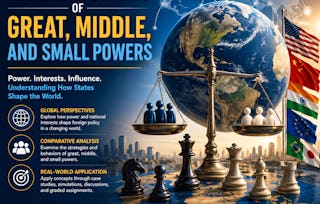
Welcome to the Power and Foreign Policy in International Relations course! This course acquaints you with how power matters in the conduct of international relations and how it affects the strategies and tactics of a nation-state in dealing with other nation-states. It demonstrates the link between a country’s ranking in the international system and the means and methods it adopts to deal with the rest of the world. The course begins with introducing a few concepts about what constitutes power in world affairs, how it is calculated, and how the international power configuration changes over time. You will also learn what foreign policy means and what its constituent elements, strategies, or activities are.
Then, the course delves deeper into case studies of contemporary great powers, middle powers, and small powers. These empirical case studies will raise the general knowledge of students about current developments and trends in foreign relations from different regions of the world. The examples of foreign policy approaches and decisions of nation-states, based on world news events of recent times, will help students to figure out the essence of world politics as it is being practiced in present times and prepare students to anticipate the future international orders to come.
Welcome to the Power and Foreign Policy in International Relations course! This course acquaints you with how power matters in the conduct of international relations and how it affects the strategies and tactics of a nation-state in dealing with other nation-states. It demonstrates the link between a country’s ranking in the international system and the means and methods it adopts to deal with the rest of the world. The course begins with introducing a few concepts about what constitutes power in world affairs, how it is calculated, and how the international power configuration changes over time. You will also learn what foreign policy means and what its constituent elements, strategies, or activities are. Then, the course delves deeper into case studies of contemporary great powers, middle powers, and small powers. These empirical case studies will raise the general knowledge of students about current developments and trends in foreign relations from different regions of the world. The examples of foreign policy approaches and decisions of nation-states, based on world news events of recent times, will help students to figure out the essence of world politics as it is being practiced in present times and prepare students to anticipate the future international orders to come.
In this module, you will learn about what power means in international relations and how it is measured in terms of specific attributes of a nation-state. You will also learn about core concepts such as international power configuration and international order and the role of units (nation-states and non-state actors) in these structures. The module also analyzes what foreign policy means, how it is formulated on the basis of national interests, why a nation-state adopts a particular type of foreign policy, and how all this is inextricably linked to its power position in the international system. By the end of this module, you will gain an insight into why a great power behaves in a manner that is different from the behavior of a middle power or a small power.
Graded Quiz: Power and Foreign Policy–The Inseparable Twins •20 minutes
1 discussion prompt•Total 20 minutes
Current and Future International Power Configurations•20 minutes
Foreign Policy of Great Powers: Case Study–The United States of America
Module 2•3 hours to complete
Module details
In this module, you will build upon the earlier awareness of power and foreign policy behavior. You will closely examine the conduct of the USA, which has been a key great power since the end of World War II, and how it shaped the post-World War II international system through a variety of strategies and means. You will also gain an insight into how there was a shift in the policies of the USA in tandem with the changes in the international power configuration from the Cold War era of bipolarity to the post-1991 unipolar period and then again from bipolarity to the present emergent multipolar world order. By the end of this module, you can appreciate how the USA has dealt with fellow great powers and weaker powers and what kind of grand strategy has motivated the USA since 1945.
Sustaining Primacy and the Global Balance of Power •9 minutes
Preserving the Capitalist World Order •8 minutes
Making the World Safe for Democracy•9 minutes
The Seismic Shift After the Collapse of the Soviet Union •9 minutes
The Liberal Takeover and the Trend of Humanitarian Interventions •9 minutes
The Global War on Terrorism: A Fatal Diversion from Great Power Competition •9 minutes
Are we Entering Bipolarity or Multipolarity? •8 minutes
Exiting the Forever Wars•8 minutes
Reorienting US Foreign Policy to Face China •8 minutes
Shifts in Domestic American Politics and an Inward Turn •9 minutes
3 readings•Total 30 minutes
Recommended Reading: Introduction in Safeguarding Democratic Capitalism•10 minutes
Recommended Reading: Does America Need a Foreign Policy?•10 minutes
Recommended Reading: Emerging Powers in a Post-American World•10 minutes
1 assignment•Total 20 minutes
Graded Quiz: Foreign Policy of Great Powers: Case Study I–The United States of America•20 minutes
1 discussion prompt•Total 20 minutes
US Foreign Policy and Its Underlying Purposes•20 minutes
Foreign Policy of Middle Powers: Case Study–India
Module 3•3 hours to complete
Module details
In this module, you will learn about concepts like power and foreign policy in the context of an emerging middle power, India, which is estimated to have the potential of becoming a great power. You will also learn how India’s rise in the past two decades is closely associated with its high economic growth, its international multilateral alignments and strategic partnerships, and the vision of its political leadership to attain the status of a leading power in the world. The module will take you along India’s journey from being a sub-regional power in South Asia to an Asian regional power and an important balancing power in present times in the broader Indo-Pacific. Finally, you will gain an insight into the factors pushing India up in the international power configurations and the domestic political obstacles to its rise.
From the Hindu Rate of Growth to the Express Train •9 minutes
From Estranged Democracies to Comprehensive Global Strategic Partnership •9 minutes
Strategic Diffidence to Strategic Assertion •10 minutes
A Net Provider of Security in the Indian Ocean Region •10 minutes
To Intervene or Not in Smaller Neighboring Countries •9 minutes
Rescue Diplomacy and Vaccine Diplomacy •9 minutes
Regional Integration and Connectivity Strategies •9 minutes
Narendra Modi’s Three Ds•9 minutes
Idealism vs. Realism in Indian Foreign Policy•10 minutes
A Multilateral Alliance of Democracies to Counterbalance China•9 minutes
3 readings•Total 30 minutes
Recommended Reading: Emerging Powers in a Post-American World•10 minutes
Essential Reading: Indian Foreign Policy: The Quest for Greatness•10 minutes
Recommended Reading: The Foreign Policy of India’s Prime Minister•10 minutes
1 assignment•Total 20 minutes
Graded Quiz: Foreign Policy of Middle Powers: Case Study I–India•20 minutes
1 discussion prompt•Total 20 minutes
India’s Transformation into a Potential Great Power•20 minutes
Foreign Policy of Small Powers: Case Study–Qatar
Module 4•3 hours to complete
Module details
In this module, you will learn about the tiny Persian Gulf monarchy of Qatar, which has adopted a foreign policy mix of alliance with the USA while simultaneously pursuing an independent and ambitious form of assertiveness vis-à-vis its regional competitors. The module discusses the rise of Qatar as a fossil fuel colossus and how it parlayed its natural resource abundance to punch above its weight in the Middle East and global energy institutions. You will also learn why Qatar moved to a policy of supporting Islamist political groups in the region and beyond and how it capitalized on being a small power to become a moderator and mediator in multiple armed conflict zones. Finally, the module also explains how regime survival is a critical driver of foreign policy in this authoritarian country.
The Watershed Moment of the Gulf War of 1990-91•9 minutes
Military and Economic Interdependence with the West •9 minutes
The Trump Disruption and the Qatar-Saudi Cold War•9 minutes
The Role of Values in the US-Qatar Alliance•9 minutes
Iran and Qatar’s Zero Enemy Policy •9 minutes
Picking up the Radical Palestinian Cause •9 minutes
Teaming up with Erdogan’s Turkey•9 minutes
Al Jazeera and the Forging of a Critical Arab Voice•9 minutes
Energy Diplomacy as a Vehicle for Influence •9 minutes
Mediating the War in Afghanistan•9 minutes
3 readings•Total 30 minutes
Recommended Reading: Qatari-US Military Relations•10 minutes
Recommended Reading: Reflecting on Qatar's "Islamist" Soft Power•10 minutes
Essential Reading: From Afghanistan to the World Cup, Tiny, Wealthy Qatar Steps Up•10 minutes
1 assignment•Total 20 minutes
Graded Quiz: Foreign Policy of Small Powers: Case Study II–Qatar•20 minutes
1 discussion prompt•Total 20 minutes
Qatar’s Energy Diplomacy and Long-Term Strategy•20 minutes
Peer Review Assignment
Module 5•5 hours to complete
Module details
This module describes the learning objectives, project brief, review criteria, and submission instructions for the Peer Review Individual Assignment for the course.
What's included
1 peer review
Show info about module content
1 peer review•Total 300 minutes
How Do Countries Adjust Their Foreign Policies in Response to the Changing International/Regional Power Configuration?•300 minutes
Course Wrap-Up
Module 6•3 minutes to complete
Module details
What's included
1 video
Show info about module content
1 video•Total 3 minutes
Course Wrap-Up•3 minutes
Prepare for a degree
Taking this course by O.P. Jindal Global University may provide you with a preview of the topics, materials and instructors in a related degree program which can help you decide if the topic or university is right for you.
View eligible degrees
Prepare for a degree
Taking this course by O.P. Jindal Global University may provide you with a preview of the topics, materials and instructors in a related degree program which can help you decide if the topic or university is right for you.
O.P. Jindal Global University is recognised as an Institution of Eminence by the Ministry of Education, Government of India. It is also ranked the No. 1 Private University in India in the QS World University Rankings 2021. The university has 9000+ students across 12 schools that offer 52 degree programs. The university maintains a 1:9 faculty-student ratio.
It is a research-intensive university, deeply committed to institutional values of interdisciplinary and innovative learning, pluralism and rigorous scholarship, globalism, and international engagement.
"To be able to take courses at my own pace and rhythm has been an amazing experience. I can learn whenever it fits my schedule and mood."
Jennifer J.
Learner since 2020
"I directly applied the concepts and skills I learned from my courses to an exciting new project at work."
Larry W.
Learner since 2021
"When I need courses on topics that my university doesn't offer, Coursera is one of the best places to go."
Chaitanya A.
"Learning isn't just about being better at your job: it's so much more than that. Coursera allows me to learn without limits."
Learner reviews
4.7
343 reviews
5 stars
77.55%
4 stars
16.61%
3 stars
3.79%
2 stars
1.16%
1 star
0.87%
Showing 3 of 343
L
LM
5·
Reviewed on Oct 27, 2024
The course highlighted the ways power is influential on the world stage, and is especially insightful when it comes to small powers.
M
M
5·
Reviewed on Jun 3, 2025
It is one of the best courses! Thank you to the teacher, he was good!
D
DB
4·
Reviewed on Jan 10, 2024
What a well structured not so easy but made easy by the lecturer .Quiet interesting topic kept me captivated from beginning to end .Yes have enjoyed and want some more .
Does this course stack into other programs or degrees?
This course stacks into the Foreign Policy of Great, Middle and Small Powers course in the Master of Arts degree International Relations, Security and Strategy (MA IRSS) and covers four weeks of material that is taught in the course. To access the MA Degree in International Relations, Security and Strategy click here.
When will I have access to the lectures and assignments?
To access the course materials, assignments and to earn a Certificate, you will need to purchase the Certificate experience when you enroll in a course. You can try a Free Trial instead, or apply for Financial Aid. The course may offer 'Full Course, No Certificate' instead. This option lets you see all course materials, submit required assessments, and get a final grade. This also means that you will not be able to purchase a Certificate experience.
What will I get if I purchase the Certificate?
When you purchase a Certificate you get access to all course materials, including graded assignments. Upon completing the course, your electronic Certificate will be added to your Accomplishments page - from there, you can print your Certificate or add it to your LinkedIn profile.
Is financial aid available?
Yes. In select learning programs, you can apply for financial aid or a scholarship if you can’t afford the enrollment fee. If fin aid or scholarship is available for your learning program selection, you’ll find a link to apply on the description page.