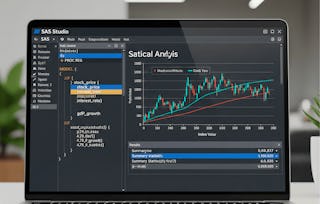


Master quantitative methods for finance with practical, real-world applications. Learn to analyze data, interpret statistical models, and forecast financial outcomes with confidence.
This course provides a structured approach to regression analysis, hypothesis testing, and time series modeling. Starting with foundational concepts such as correlation and covariance, learners progress to advanced topics including regression diagnostics, model limitations, and forecasting techniques. Participants will learn to interpret key statistical measures such as coefficient estimates, goodness-of-fit metrics, significance tests, and model evaluation indicators. The course also addresses common analytical challenges, including heteroskedasticity, multicollinearity, and model specification issues. In addition, learners explore time series techniques, including autoregressive models, seasonality analysis, and volatility modeling. Through practical examples and applied exercises, the course emphasizes the interpretation and application of quantitative methods for financial analysis and decision-making. By the end of the course, learners will be able to evaluate financial data, apply statistical techniques appropriately, interpret analytical results, and support data-driven decisions in finance, investment, research, and risk analysis roles.